“THE WORST IS OVER; OUR GDP IS GROWING MORE THAN OUR POPULATION. THAT MEANS WE HAVE A FUTURE” - UMAHI TELLS NANS
— As Nigerian Students Induct Him as Grand Patron, Hail Him as “One of the Finest” in Tinubu’s Renewed Hope Cabinet
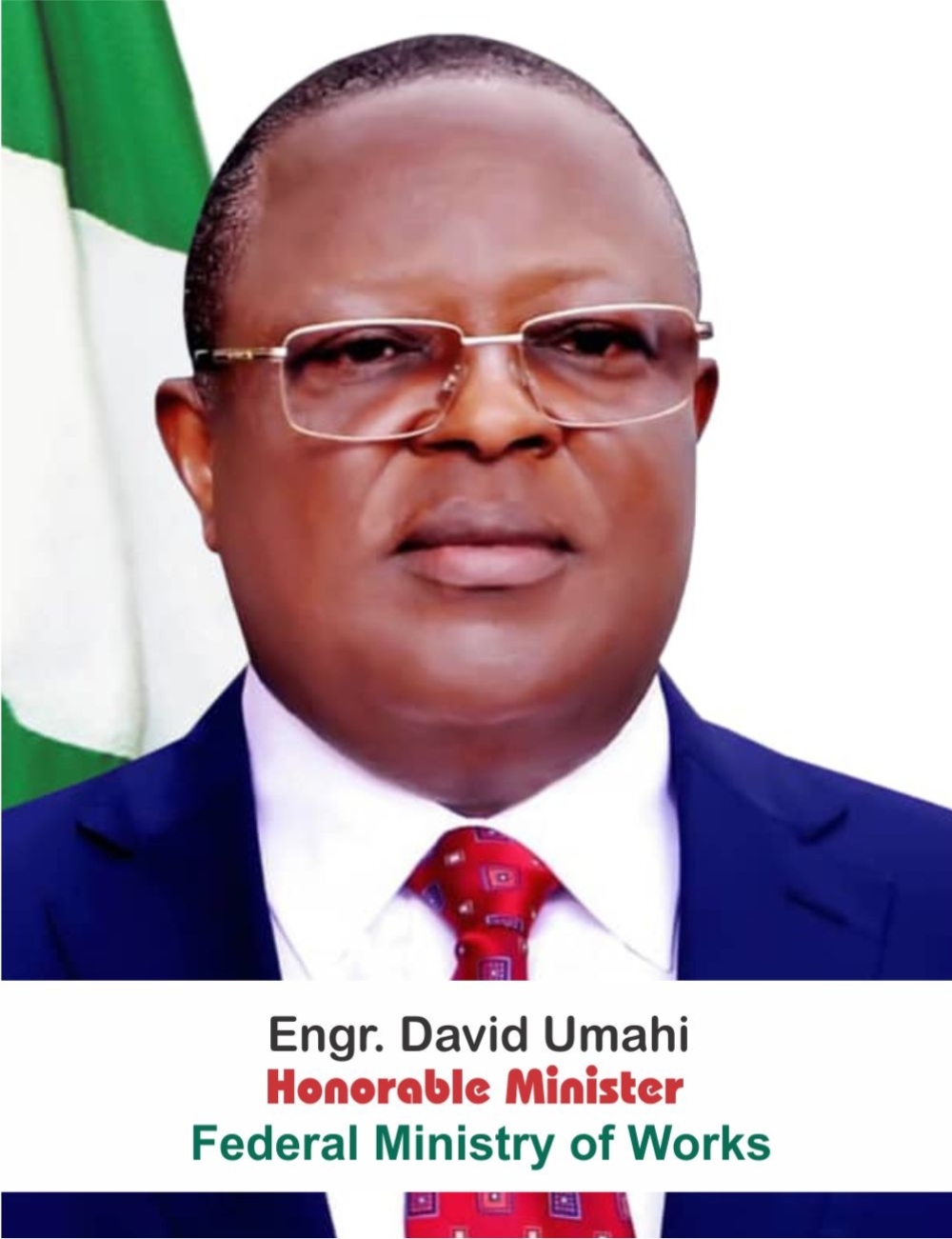
The Minister of Works, Senator Engr. David Umahi, CON, has declared that Nigeria is now seeing stronger economic outlook under President Bola Ahmed Tinubu, noting that the country’s Gross Domestic Product (GDP) is now growing faster than its population.
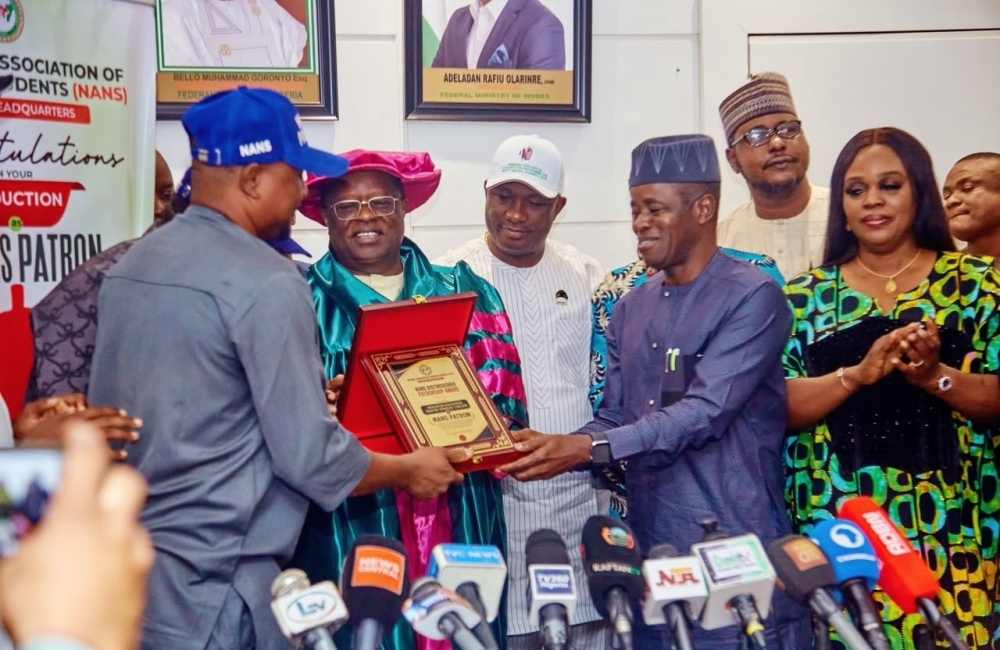
Umahi made the declaration on Monday, August 10, 2026, at the headquarters of the Federal Ministry of Works in Abuja, while speaking after he was formally inducted as Patron of the National Association of Nigerian Students (NANS).
The minister described the development as a positive indication of Nigeria’s economic prospects, saying, “I was enthused to find out that our GDP is growing more than our population. That means we have a future.”
The NANS leadership, led by its President, Dist. Comr. Akinteye Babatunde Afeez, GCNS, had earlier commended Umahi for his contributions to national infrastructure and described him as “a worthy member of the Renewed Hope Cabinet and, indeed, as one of the finest public servants Nigeria has produced in the contemporary era.”
The students said the recognition was not merely ceremonial but a reflection of Umahi’s visible contribution to road infrastructure and national development under President Bola Ahmed Tinubu’s administration.
According to NANS, the roads and bridges being delivered under Umahi’s supervision are directly connected to the lives of Nigerian students, affecting their mobility, access to educational institutions, examinations, internships, businesses and employment opportunities.
The students specifically cited major projects including the Abuja-Kaduna-Kano Expressway, Abuja-Kaduna-Minna route, Enugu-Port Harcourt Expressway and Lagos-Calabar Coastal Highway as examples of projects they said demonstrate the Federal Government’s commitment to improving national connectivity.
Afeez also disclosed that NANS had studied project reports of the Federal Ministry of Works covering the period between May 2023 and May 2026 and expressed its intention to embark on nationwide project tours to inspect completed and rehabilitated projects.
He said the students would use their platforms to communicate the impact of the projects to millions of Nigerian students, Nigerians and the wider world.
Responding, Umahi challenged Nigerian students and young people to look beyond political sentiments and examine the policies and achievements of the Tinubu administration objectively.
“We have had somebody say, ‘President Tinubu is tired.’ How do you know he is tired? I am part of President Tinubu. The Minister of Interior, the FCT, all the ministers and all the SSAs are vibrant and working. So how do you just jump at that conclusion?”
The minister urged Nigerians to demand concrete alternatives from those criticising the administration.
“If you say that the President is not doing well, what is your alternative?” he asked, stressing that political promises must be backed by clear plans and a credible mission.
He also called on students and other young Nigerians to take a position on issues affecting the country, arguing that remaining neutral in the face of visible progress was not always the right approach.
“You may say that you are not politicians or that you will not take sides, but this is the time to take sides in our national affairs. It is time to take a stand,” Umahi said.
On the economy, the minister acknowledged that the macroeconomy was only beginning to recover but urged Nigerians to consider the condition of the economy before the present administration took office and assess the reforms objectively.
“You may say that the macroeconomy is just beginning to recover. What was it like before the President took over? Everybody agrees that the macroeconomy is being fixed. It is up to you to dissect the ongoing reforms and take a position.”
Umahi also pointed to developments in the education sector, saying the stability being witnessed under the Tinubu administration had created an environment in which students were able to continue their studies without the disruption of nationwide strikes.
“For the first time, students never went on strike. Never. Look at the stability of Nigeria. That has never happened throughout the history of this country.”
“Where is the subsidy money?” Umahi explains
Addressing questions surrounding the removal of fuel subsidy and where the resulting resources were being deployed, Umahi pointed to the scale of ongoing infrastructure projects across the country.
He cited the Abuja-Kaduna-Zaria-Kano road, which he said covers 375 kilometres and, when measured as a dual carriageway, amounts to 750 kilometres.
According to the minister, more than ₦200 billion has already been spent on the project, with 480 kilometres of the dual carriageway completed and further sections nearing completion.
“For the first time, we have been able to complete 118 kilometres of concrete pavement within 30 months. That has never happened,” he said.
The Minister said the remaining works were expected to be completed by November, noting that the two projects on the route have a combined cost of ₦752 billion, with more than 80 percent already paid.
He also highlighted the Sokoto-Zamfara-Zaria corridor, the Benue-Ninth Mile road, and the Bodo - Bonny Island road as examples of projects receiving significant attention under the Tinubu administration.
On the Bonny Island project, he said:
“For the first time, people will move from the island to the mainland in Bonny Island, where the LNG is produced. A project costing ₦280 billion under President Bola Ahmed Tinubu has been completed. The 39.7-kilometre road is fully done, and the people of Bonny are very happy. They are no longer dying at sea. They are now driving through the land.”
The minister also spoke extensively about the administration’s legacy road projects, including the Lagos-Calabar Coastal Highway and the expanded Northeast Fourth Legacy Project.
He disclosed that the Northeast project, originally running from Akwanga through Jos, Bauchi, Gombe and Biu, had been extended through Yobe to Maiduguri, adding another 400 kilometres to the project.
Umahi defended the Lagos-Calabar Coastal Highway against criticisms, saying the project was strategically important to the Niger Delta and would be completed.
“I do not know why people are attacking the Lagos-Calabar Coastal Highway. After all, this is coming from the Niger Delta, where the oil is coming from. Why is nobody attacking the other three Legacy Projects, but this one is being attacked? That is unfair and unrealistic. That project will be completed. In fact, over 50 percent of the entire stretch is already under construction.”
The minister also used the occasion to speak about the development of the Southeast, saying President Tinubu had deliberately embarked on projects aimed at integrating the region into the national infrastructure network.
“The Southeast, for the first time, is being remembered, and I thank the people in the Southeast because sometimes I say, ‘Listen, our people should not be sentimental.’”
He said the administration’s approach to the region was intentional and urged the people of the Southeast to work with other parts of the country.
“The President has a good intention to integrate the people of the Southeast, and I have to be very honest with you. If I were not a minister from the Southeast, we would not have been able to get the projects we have secured. It is intentional on the part of Mr. President. Go and right the wrongs of the Southeast.”
Umahi cited the Enugu-Onitsha Expressway and Enugu-Port Harcourt Expressway among the major projects transforming connectivity in the region.
He also disclosed that President Tinubu had approved the re-scoping and reconstruction of the Lokoja-Benin-Warri corridor, covering a total of 401 kilometres.
The minister was particularly direct in urging the students to support President Tinubu in the 2027 election, arguing that Nigerians should support the administration if they believe its policies are producing results.
“I want you to take a side. If you say you are on the list of a coalition and you say that what we are doing is good, then we have to take a stand to vote for the President in the coming election.”
“Let him finish. Let him take back our country. Let him reposition our country.”
Umahi also urged Nigerians to look beyond political rhetoric and focus on practical solutions to the country’s challenges.
“Listening to others should not mean allowing yourselves to be insulted or blackmailed. Cheap talk will not solve our problems. Nobody is saying what he or she can do differently. The worst is over. The darkest part of the night is an hour before dawn.”
He pointed to the decline in food prices as one of the developments Nigerians should consider in assessing the economy, recalling that a 50-kilogramme bag of rice, which he said had risen above ₦80,000 and at some point reached ₦100,000, was now selling at about ₦58,000.
Umahi also stressed the administration’s commitment to transparency in the execution of road projects, saying the Ministry of Works had opened its projects to scrutiny by anti-corruption agencies.
“Now, why are we doing this? Transparency. We have turned these projects over to the ICPC. They have gone round. We are ready for constructive criticism, and where necessary, we will make amends.”
He added that the Ministry had also written to the Economic and Financial Crimes Commission (EFCC) to inspect its projects. “We have nothing to hide in this administration.”
The minister urged NANS to organise a major student engagement across the geopolitical zones where students could ask questions directly and hear the government’s explanations on its policies and projects.
“Let me defend this administration. Organise it and let me come. Move students from across the zone to a central point where we can talk to them and address their concerns. We have to deliberate on the issues. We have to debate them. Ask your questions, and we will answer them.”
He said he would attend such engagements with some ministers and Senior Special Assistants to the President, stressing that students were important stakeholders in the country’s future.
Umahi further challenged young Nigerians to take responsibility for protecting public infrastructure and contributing positively to national development. “See something, say something. Together, we can take back our country because it belongs to us.”
He said the responsibility for the performance of government should be placed on the officials directly responsible for specific sectors, rather than on the President for every operational issue.
“I am here because the President gave me the responsibility to be in charge of roads and bridges. If I do not do it, I should be the one to be blamed, not the President. I am not the President. The President has divided himself into a number of his appointees. These appointees should be the ones to answer and take responsibility.”
The minister concluded by thanking the students for the recognition and expressing his readiness to deepen collaboration with NANS.
“I want to thank you very much.“
He described the students as important partners in the national development process and encouraged them to remain informed, ask questions and hold leaders accountable.
The NANS President, in his address, said the association considered Umahi worthy of its patronage because of his record of public service, infrastructure delivery and commitment to national development.
He said the roads being constructed under Umahi’s leadership would outlive the present administration and continue to serve generations of Nigerians.
“History will not remember public officers merely because they occupied important offices. History will remember them for what they built, what they changed and the lives they touched.”
Afeez formally welcomed Umahi into the NANS family as Patron, describing the partnership between the student body and the Federal Ministry of Works as an opportunity to bring government projects closer to young Nigerians and deepen informed national discourse.

“THE WORST IS OVER; OUR GDP IS GROWING MORE THAN OUR POPULATION. THAT MEANS WE HAVE A FUTURE” - UMAHI TELLS NANS — As Nigerian Students Induct Him as Grand Patron, Hail Him as “One of the Finest” in Tinubu’s Renewed Hope Cabinet The Minister of Works, Senator Engr. David Umahi, CON, has declared that Nigeria is now seeing stronger economic outlook under President Bola Ahmed Tinubu, noting that the country’s Gross Domestic Product (GDP) is now growing faster than its population. Umahi made the declaration on Monday, August 10, 2026, at the headquarters of the Federal Ministry of Works in Abuja, while speaking after he was formally inducted as Patron of the National Association of Nigerian Students (NANS). The minister described the development as a positive indication of Nigeria’s economic prospects, saying, “I was enthused to find out that our GDP is growing more than our population. That means we have a future.” The NANS leadership, led by its President, Dist. Comr. Akinteye Babatunde Afeez, GCNS, had earlier commended Umahi for his contributions to national infrastructure and described him as “a worthy member of the Renewed Hope Cabinet and, indeed, as one of the finest public servants Nigeria has produced in the contemporary era.” The students said the recognition was not merely ceremonial but a reflection of Umahi’s visible contribution to road infrastructure and national development under President Bola Ahmed Tinubu’s administration. According to NANS, the roads and bridges being delivered under Umahi’s supervision are directly connected to the lives of Nigerian students, affecting their mobility, access to educational institutions, examinations, internships, businesses and employment opportunities. The students specifically cited major projects including the Abuja-Kaduna-Kano Expressway, Abuja-Kaduna-Minna route, Enugu-Port Harcourt Expressway and Lagos-Calabar Coastal Highway as examples of projects they said demonstrate the Federal Government’s commitment to improving national connectivity. Afeez also disclosed that NANS had studied project reports of the Federal Ministry of Works covering the period between May 2023 and May 2026 and expressed its intention to embark on nationwide project tours to inspect completed and rehabilitated projects. He said the students would use their platforms to communicate the impact of the projects to millions of Nigerian students, Nigerians and the wider world. Responding, Umahi challenged Nigerian students and young people to look beyond political sentiments and examine the policies and achievements of the Tinubu administration objectively. “We have had somebody say, ‘President Tinubu is tired.’ How do you know he is tired? I am part of President Tinubu. The Minister of Interior, the FCT, all the ministers and all the SSAs are vibrant and working. So how do you just jump at that conclusion?” The minister urged Nigerians to demand concrete alternatives from those criticising the administration. “If you say that the President is not doing well, what is your alternative?” he asked, stressing that political promises must be backed by clear plans and a credible mission. He also called on students and other young Nigerians to take a position on issues affecting the country, arguing that remaining neutral in the face of visible progress was not always the right approach. “You may say that you are not politicians or that you will not take sides, but this is the time to take sides in our national affairs. It is time to take a stand,” Umahi said. On the economy, the minister acknowledged that the macroeconomy was only beginning to recover but urged Nigerians to consider the condition of the economy before the present administration took office and assess the reforms objectively. “You may say that the macroeconomy is just beginning to recover. What was it like before the President took over? Everybody agrees that the macroeconomy is being fixed. It is up to you to dissect the ongoing reforms and take a position.” Umahi also pointed to developments in the education sector, saying the stability being witnessed under the Tinubu administration had created an environment in which students were able to continue their studies without the disruption of nationwide strikes. “For the first time, students never went on strike. Never. Look at the stability of Nigeria. That has never happened throughout the history of this country.” “Where is the subsidy money?” Umahi explains Addressing questions surrounding the removal of fuel subsidy and where the resulting resources were being deployed, Umahi pointed to the scale of ongoing infrastructure projects across the country. He cited the Abuja-Kaduna-Zaria-Kano road, which he said covers 375 kilometres and, when measured as a dual carriageway, amounts to 750 kilometres. According to the minister, more than ₦200 billion has already been spent on the project, with 480 kilometres of the dual carriageway completed and further sections nearing completion. “For the first time, we have been able to complete 118 kilometres of concrete pavement within 30 months. That has never happened,” he said. The Minister said the remaining works were expected to be completed by November, noting that the two projects on the route have a combined cost of ₦752 billion, with more than 80 percent already paid. He also highlighted the Sokoto-Zamfara-Zaria corridor, the Benue-Ninth Mile road, and the Bodo - Bonny Island road as examples of projects receiving significant attention under the Tinubu administration. On the Bonny Island project, he said: “For the first time, people will move from the island to the mainland in Bonny Island, where the LNG is produced. A project costing ₦280 billion under President Bola Ahmed Tinubu has been completed. The 39.7-kilometre road is fully done, and the people of Bonny are very happy. They are no longer dying at sea. They are now driving through the land.” The minister also spoke extensively about the administration’s legacy road projects, including the Lagos-Calabar Coastal Highway and the expanded Northeast Fourth Legacy Project. He disclosed that the Northeast project, originally running from Akwanga through Jos, Bauchi, Gombe and Biu, had been extended through Yobe to Maiduguri, adding another 400 kilometres to the project. Umahi defended the Lagos-Calabar Coastal Highway against criticisms, saying the project was strategically important to the Niger Delta and would be completed. “I do not know why people are attacking the Lagos-Calabar Coastal Highway. After all, this is coming from the Niger Delta, where the oil is coming from. Why is nobody attacking the other three Legacy Projects, but this one is being attacked? That is unfair and unrealistic. That project will be completed. In fact, over 50 percent of the entire stretch is already under construction.” The minister also used the occasion to speak about the development of the Southeast, saying President Tinubu had deliberately embarked on projects aimed at integrating the region into the national infrastructure network. “The Southeast, for the first time, is being remembered, and I thank the people in the Southeast because sometimes I say, ‘Listen, our people should not be sentimental.’” He said the administration’s approach to the region was intentional and urged the people of the Southeast to work with other parts of the country. “The President has a good intention to integrate the people of the Southeast, and I have to be very honest with you. If I were not a minister from the Southeast, we would not have been able to get the projects we have secured. It is intentional on the part of Mr. President. Go and right the wrongs of the Southeast.” Umahi cited the Enugu-Onitsha Expressway and Enugu-Port Harcourt Expressway among the major projects transforming connectivity in the region. He also disclosed that President Tinubu had approved the re-scoping and reconstruction of the Lokoja-Benin-Warri corridor, covering a total of 401 kilometres. The minister was particularly direct in urging the students to support President Tinubu in the 2027 election, arguing that Nigerians should support the administration if they believe its policies are producing results. “I want you to take a side. If you say you are on the list of a coalition and you say that what we are doing is good, then we have to take a stand to vote for the President in the coming election.” Umahi also urged Nigerians to look beyond political rhetoric and focus on practical solutions to the country’s challenges. “Listening to others should not mean allowing yourselves to be insulted or blackmailed. Cheap talk will not solve our problems. Nobody is saying what he or she can do differently. The worst is over. The darkest part of the night is an hour before dawn.” He pointed to the decline in food prices as one of the developments Nigerians should consider in assessing the economy, recalling that a 50-kilogramme bag of rice, which he said had risen above ₦80,000 and at some point reached ₦100,000, was now selling at about ₦58,000. Umahi also stressed the administration’s commitment to transparency in the execution of road projects, saying the Ministry of Works had opened its projects to scrutiny by anti-corruption agencies. “Now, why are we doing this? Transparency. We have turned these projects over to the ICPC. They have gone round. We are ready for constructive criticism, and where necessary, we will make amends.” He added that the Ministry had also written to the Economic and Financial Crimes Commission (EFCC) to inspect its projects. “We have nothing to hide in this administration.” The minister urged NANS to organise a major student engagement across the geopolitical zones where students could ask questions directly and hear the government’s explanations on its policies and projects. “Let me defend this administration. Organise it and let me come. Move students from across the zone to a central point where we can talk to them and address their concerns. We have to deliberate on the issues. We have to debate them. Ask your questions, and we will answer them.” He said he would attend such engagements with some ministers and Senior Special Assistants to the President, stressing that students were important stakeholders in the country’s future. Umahi further challenged young Nigerians to take responsibility for protecting public infrastructure and contributing positively to national development. “See something, say something. Together, we can take back our country because it belongs to us.” He said the responsibility for the performance of government should be placed on the officials directly responsible for specific sectors, rather than on the President for every operational issue. “I am here because the President gave me the responsibility to be in charge of roads and bridges. If I do not do it, I should be the one to be blamed, not the President. I am not the President. The President has divided himself into a number of his appointees. These appointees should be the ones to answer and take responsibility.” The minister concluded by thanking the students for the recognition and expressing his readiness to deepen collaboration with NANS. “I want to thank you very much.“ He described the students as important partners in the national development process and encouraged them to remain informed, ask questions and hold leaders accountable. The NANS President, in his address, said the association considered Umahi worthy of its patronage because of his record of public service, infrastructure delivery and commitment to national development. He said the roads being constructed under Umahi’s leadership would outlive the present administration and continue to serve generations of Nigerians. “History will not remember public officers merely because they occupied important offices. History will remember them for what they built, what they changed and the lives they touched.” Afeez formally welcomed Umahi into the NANS family as Patron, describing the partnership between the student body and the Federal Ministry of Works as an opportunity to bring government projects closer to young Nigerians and deepen informed national discourse.
“Let him finish. Let him take back our country. Let him reposition our country.”
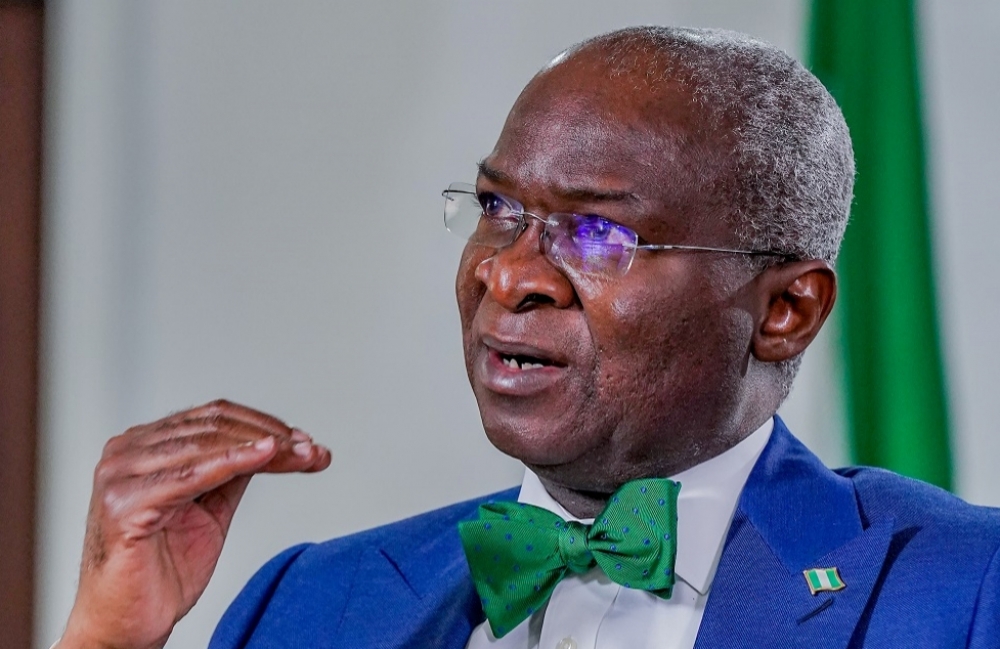
BRF At 58 : A Return To The Mind’s Infrastructure By Hakeem Bello Twelve years ago, in his Year 2010 budget presentation to the Lagos State House of Assembly on Tuesday, 3 November 2009, as Governor of Lagos State, Babatunde Raji Fashola, SAN, had said, in part, “…while a lot of work has been done in our attempt to bridge the infrastructure gap and a lot of projects, too numerous to mention will be completed before the end of this year and in the first and subsequent quarters of next year such as schools, health facilities, roads, water supply facilities and so much more. We believe that we are now at the most challenging phase of our journey to a bright and rewarding future. “For too long, we seem to have evolved survival strategies for dealing with chaotic and unplanned living that we now seem afraid to approach orderly living predicated on law and order. We are at the point where we must build the most enduring infrastructure. This is the infrastructure of the mind. This is the infrastructure that empowers people to seek new levels of excellence that demands new attitudes that commits to greater ideals. We recognise that while the buildings, schools and roads can be easily pulled down and rebuilt, the human mind is the most difficult to rebuild, although it is the most enduring.” A rigorous enforcement of the law and multi-dimensional public awareness campaigns followed that declaration and characterised the rest of the administration. Six years into his assignment as a minister responsible for the renewal and expansion of our country’s infrastructure, he had repeatedly stated a fact: there is no state in the country where the Federal Government is not building or rehabilitating a road or bridge or house, or to use a phrase he had used while governing Lagos State, doing “infrastructure catch-up” with population growth. Progress has certainly been made. By 21 June 2021, when he made a presentation titled, “The Politics of Economy and the Economy of Politics: Infrastructure Development; the Progressive Way" at the first APC Youth Conference in Abuja, infrastructure deliverables had shot to 895 ongoing Highway and Bridge projects, internal road rehabilitation in 43 federal tertiary institutions, construction of new Federal Secretariats in six states and rehabilitation/maintenance of 24 Federal Secretariats across the country, construction of housing estates under the National Housing Programme in 34 states, rehabilitation of 41 bridges, scheduled maintenance of 5,461.88Km of roads and 8,000KM of Highway maintenance by FERMA, all across the nation while Government established the first ever National Building Maintenance Policy for the country, leading to the creation of the Department of Federal Public Asset Maintenance (FPAM) with the Ministry. Earlier in an interview published in African Business of 6 April 2021, Fashola told the magazine’s Publisher Omar Ben Yedder: “The point to make here is that the outline of the infrastructure commitments of this government are very clear now. The wheels are also turning and what people should expect to see is more developments on the ease of doing business. Infrastructure is very important too for enabling and achieving that. We’re refurbishing public infrastructure highways, and we are beginning to build our maintenance economy because it is a very important economy that really has not taken off. This is where we will be, this will be a decade of infrastructure renewal and expansion. It will be an exciting space to play.” Fashola turns 58 today, and the theme of the Babatunde Raji Fashola (BRF) Gabfest (held yearly in the last five years to commemorate his birthday by discussing the role of the youth in Nigeria’s future) is “Arrive Alive: Building a road towards better driving culture.” From verifiable data by traffic management authorities, it is becoming clear that with better road infrastructure, motorists now overspeed and are becoming generally less compliant with road safety rules and regulations. In a recent submission to the Federal Executive Council, Fashola had noted: “Consistently over the years and this data is available, the impact of bad roads and accidents was less than 2%. As big as that may be, it is less than 2%. (Whereas) overspeeding, loss of control, wrongful overtaking cumulate to over 70%.” This is huge. For Fashola, this cannot be overlooked; the numbers must be drastically brought down. For him, it is time again to focus on building the infrastructure of our minds. As he puts it further in that submission “our focus as a government is that we've agreed that the driver has a role to play, starting from education and certification….” Thankfully, the Federal Government has recently inaugurated the National Road Safety Advisory Council with Vice President Prof Yemi Osinbajo, SAN, as chair, to “ensure the effective implementation of the Nigerian Road Safety Strategy Version 2, 2021-2030, which centres on a safe system approach to road safety based on global standards,” to quote the Corps Marshal of the Federal Road Safety Corps (FRSC), Dr Boboye Oyeyemi. Besides education and certification, which will be executed by the Ministries of Education and Information, FRSC, state and local governments, Fashola has noted that installation of road traffic signs and patrol of the highways will be intensified. So also, it is a good development that one of the key elements of the recently signed National Health Act is the development of emergency life support system. As Fashola noted: “Road traffic crashes happen everywhere in the world. The problem is: can you bring it down? and should a road traffic crash lead to death? So, emergency life support is critical.” Fashola has, over the years, demonstrated that law and order have a human face and could be imbibed as societal norm through the cross-pollination of education and enlightenment, in addition to effective law enforcement and a transparent justice system. This means that both those who enforce law and order and the populace among whom they are enforced must come to a clear understanding and agreement as to their necessity in the growth and development of the society. In 2017, Fashola told the executives of The Guardian Newspapers in an interview. “When failures happen in developed societies, they call them scandals. When the parliamentarians in the United Kingdom were found stealing funds and all that, they called it ‘Political Expenses Scandal’. When Lionel Messi was involved in tax evasion, they called it Tax Evasion Scandal. The reason is that they have focused so much on law and order that non-compliance is the exception. Society is (definitely) scandalized by non-compliance.” With hope, this 5th edition of BRF Gabfest will come up with ideas and workable solutions on how to build the infrastructure of the minds of motorists and other road users. Fatalities on our Roads have to be an exception not the Rule. It is obvious that BRF is scandalized by every single life that is lost to road crashes. GABFEST 5 is a call for action to end it. Somehow, BRF himself may have thrown up one consideration for the Gabfest participants because just last week while hosting a delegation of the FCT Council of the Scout Association of Nigeria in his office, he spoke very strongly about the urgent need to resuscitate the various youth clubs and associations which formed the building blocks of societal values and ideals in the past such as the Boys Scout Movement, the Girl Guides and the Boys' Brigade. He told the delegation: “I am particularly enthused to have you here today because you represent a critical building block of society, a block that builds values and morality for young men and women that society seems to have left behind. The block has to be repositioned very urgently as a cornerstone of rebuilding of our nation, as a nation, not only of a high human resource capacity but of a human resource that has the highest value and morality. Urging the association to work with other affiliates like the Girl Guides and the Boys Brigade, among others, Fashola said that such collaboration was necessary in order to give young people the choice to join noble, moral clubs to expend their energy, to build their optimism and dream great dreams, adding that if those clubs were not available, they would be recruited by other clubs with less noble intentions. For Fashola, finding practical ways to restore positive values among Nigerians would be the best 58th birthday gift. ● Mr Hakeem Bello, FNGE, is Special Adviser, Communications to the Hon. Minister ...
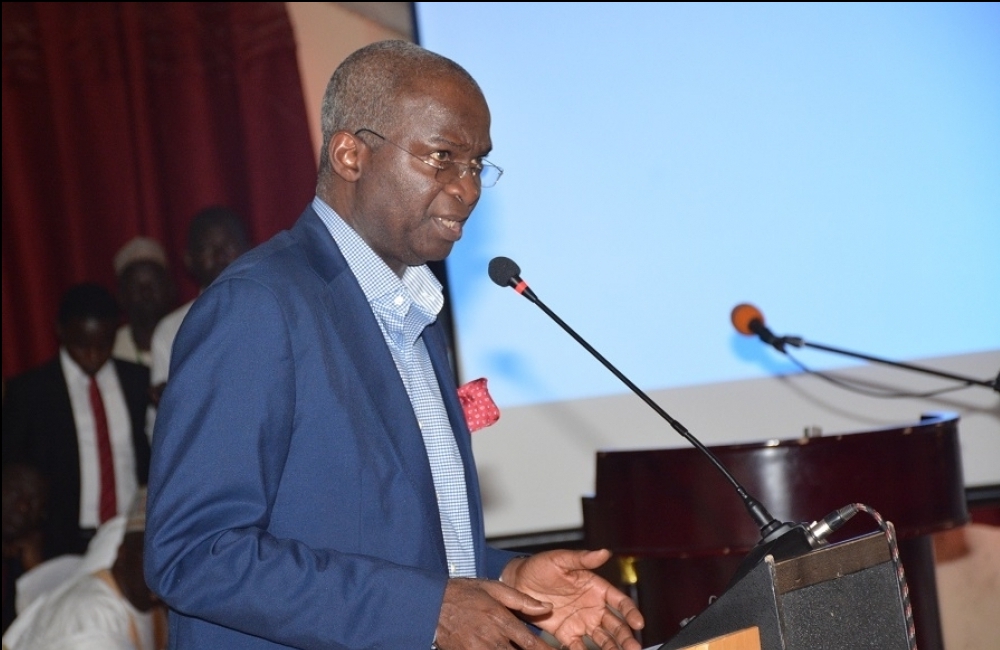
BRF Gabfest 5: Discussing the Ways to Curb the Human Factors Involved in Road Accidents Lagos, Nigeria, June 22, 2021 — For the 5th edition of the Babatunde Raji Fashola (BRF) GabFest, an event created to discuss the role of the youth in Nigeria’s future, the theme is “Arrive Alive: Building a Road towards better driving culture”. Statistics show that Road traffic injuries are the leading cause of death among young people aged 15-29. Around the world, road traffic injuries cause 1.25 million deaths and up to 50 million injuries each year. Surprisingly, data shows that the top causative factor for road accidents are not bad roads but speeding, loss of vehicular control, wrongful overtaking and generally poor driving culture. To discuss this pandemic, and explore ways to curb the human factors behind such accidents, six speakers across two panels will offer constructive insight at the event, on the 28th June, 2021. The speakers will cut across both the public and private sectors, and offer the audience the chance to engage on the subject matter. They will discuss matters ranging from road safety traffic measures and how accidents occur, to what to do in the event of an accident, insurance, drinking and driving responsibly, and also breaking users cycle of road accidents. The aim is to realize the factors that we have control over, and how to take a collective responsibility over them to improve the future. Attendees would also be allowed to ask questions after the Panelist discussion. The confirmed line-up of speakers includes Dr Yazid Omotayo -Head, Medical Unit/Pre-Hospital Care Unit, Lagos State Emergency Management Agency (LASEMA), Ms Bethia Idoko -Head of Business Development, Gidi Traffic, Mr Oluseye Banjoko MCIArb (Uk)- Partner, CLP Legal and Fred Akinmuyisitan - Head, Marketing Strategy and Planning, The Heineken Company. The Corps Marshal of the Federal Road Safety Corps (FRSC), Dr Boboye Oyeyemi will offer insights on the statistics coming in from Federal Highways across the country. It will be a platform for these leaders to share their expertise as pertains to Road Accidents. “It is imperative to find opportunities to convene and discuss ways in which we can push forward as a people, and reduce these casualties” says Terfa Tilley-Gyado, Director of Communications of The Temple Company, who will also be addressing attendees of the event. The programme will end with a closing remark by the Honourable Minister of Works and Housing, Mr Babatunde Raji Fashola SAN. Due to COVID-19 restrictions, the event will be conducted virtually over ZOOM, and is open to the public to register via https://bit.ly/gabfest5. The entire session will run for a duration of two hours. ...
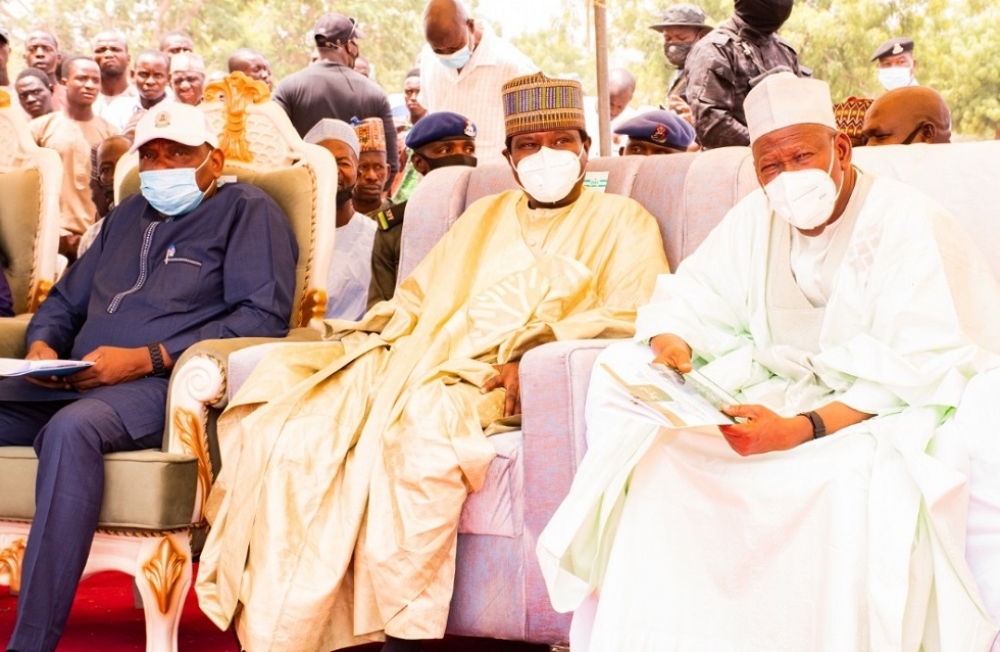
FG Flags-off N62.7bn Construction of Kano-Gwarzo-Dayi Federal Highway The Federal Government has flagged-off the construction work of the 90.65km Kano-Gwarzo-Dayi Federal Highway linking Kano and Katsina States, Thursday, June 10, 2021 in Kano. The contract for the reconstruction of the road to dual carriage way was approved by the Federal Executive Council (FEC) in November 2020 at the cost of N62.711b with the completion period of 24 months. Permanent Secretary, Federal Ministry of Works and Housing, Babangida Hussaini, in his welcome address stated that the contract was awarded on December 1st, 2020 to Messes CGC Nigeria Limited. The Permanent Secretary was represented at the flag-off ceremony by Engr Folorunsho Esan, Director Highways (North -West) in the Federal Ministry of Works and Housing. He explained that the 90.65km dual carriage way has a total number of three bridges, with additional 7.3 meters width and 1.5 meters shoulder width and an outer shoulder width of 2.7meters. Already the Kano State Government had dualised 7.2km of the road from the Bayero University Kano (BUK) axis. The construction started from the BUK junction and terminated at outskirt of Dayi town in Katsina State. Hussaini disclosed that the road would be completed with all the furnitures such as lane markings, kilometer signs, signages etc., adding that the road would last not less than 20 years. In his remarks at the ceremony, Kano State Governor Abdullahi Umar Ganduje described the project as gigantic, important, socially and economically of great benefits to the people of Kano, Katsina, Zamfara, Sokoto and Kebbi States. The governor also explained that the reconstructed road would also contribute in addressing the security challenges along the area. Accordingly, Governor Ganduje said that, as requested by the Federal Government, Kano State Government is ready to pay the compensation for the facilities and utilities that would be affected by the dualisation of the road He commended President Muhammadu Buhari for all the projects he brought to Kano State, stating that the President has paid back the Kano people for the massive votes they always give him during elections. Governor Ganduje listed among others, a number of projects which the Federal Government brought to Kano to include: Maiduguri- Yobe- Kano Road; Kano- Kaduna-Abuja Road, Kano-Katsina Road, Kano- Katsina- Jibia- Maradi rail project, Lagos- Ibadan- Kaduna- Kano rail project and now Kano- Gwarzo- Dayi Road and construction of new wing at Mallam Aminu Kano International Airport (MAKIA). Ganduje told the gathering that, with all the projects, commercial and business opportunities had increased in Kano as well as improved security. In his remarks, the Senator representing Kano North Senator Barau Jibrin commended the Minister of Works and Housing Babatunde Fashola, Minister of State, Engr Abubakar Aliyu and the Permanent Secretary, Babangida Hussaini. Senator Barau reminded the gathering that, the project was a promise they made to the people during their campaign tour with the Governor, stating that it was now time to thank God for making it realisable. Also, the Executive Director of Messes CGC Nigeria Limited, the Construction Company handling the contract, Mr Fan Xiaojing thanked the Federal Government and Kano State for the opportunity given to his company to handle the project, stating that it was an indication that their expertise in handling such project was recognised. He stated that with the cooperation of all the stakeholders the job would be delivered on scheduled. Royal fathers of the day that graced the occasion wer:, His Highness the Emir of Bichi, Alhaji Nasiru Ado Bayero and Dr. Alhaji Ibrahim Abubay Ii the Emir of Karaye Al in Kano State. ...
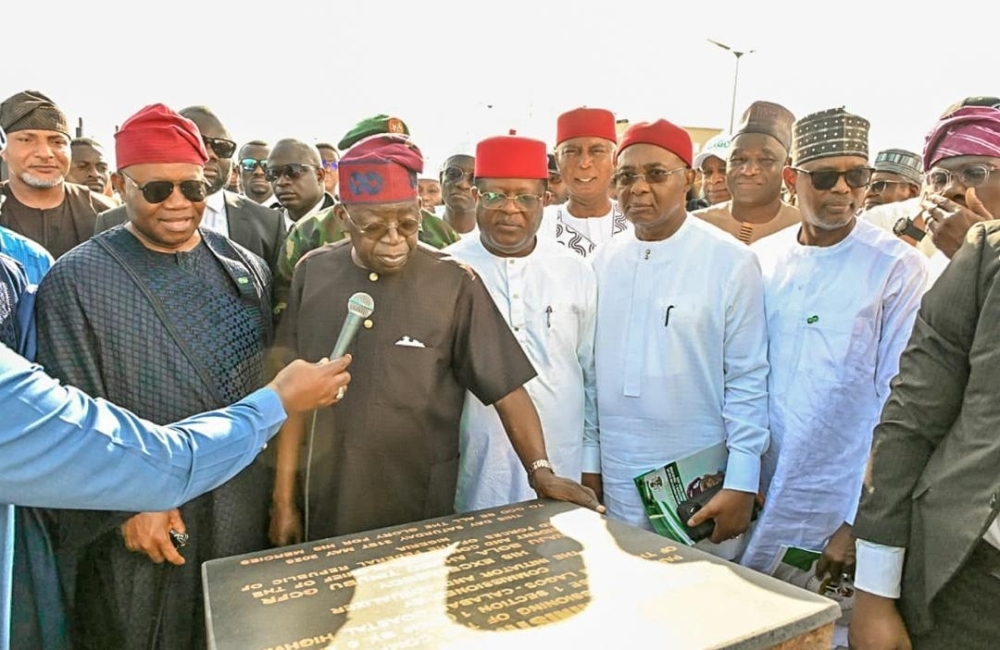
DRIVING NIGERIA’S FUTURE: CELEBRATING TWO YEARS OF TRANSFORMATIVE LEADERSHIP AND THE LAGOS-CALABAR COASTAL HIGHWAY MILESTONE
DRIVING NIGERIA’S FUTURE: CELEBRATING TWO YEARS OF TRANSFORMATIVE LEADERSHIP AND THE LAGOS-CALABAR COASTAL HIGHWAY MILESTONE
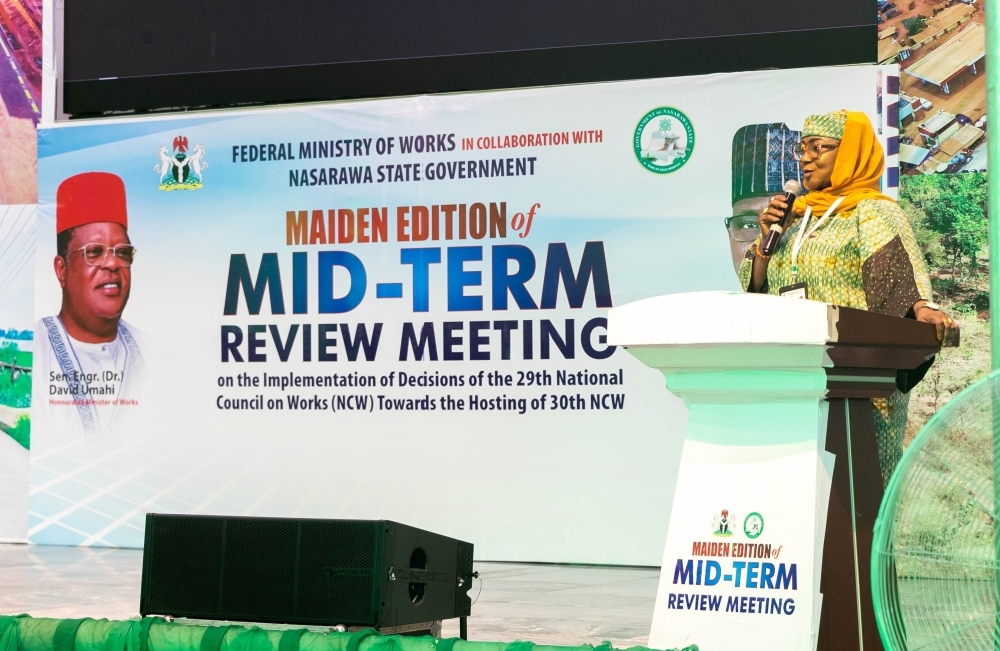
MID -TERM REVIEW MEETING ON THE IMPLIMENTATION OF THE DECISIONS REACHED AT THE 29TH NATIONAL COUNCIL ON WORKS (NCW) DAY 1
MID -TERM REVIEW MEETING ON THE IMPLIMENTATION OF THE DECISIONS REACHED AT THE 29TH NATIONAL COUNCIL ON WORKS (NCW) DAY 1