“THE WORST IS OVER; OUR GDP IS GROWING MORE THAN OUR POPULATION. THAT MEANS WE HAVE A FUTURE” - UMAHI TELLS NANS
— As Nigerian Students Induct Him as Grand Patron, Hail Him as “One of the Finest” in Tinubu’s Renewed Hope Cabinet
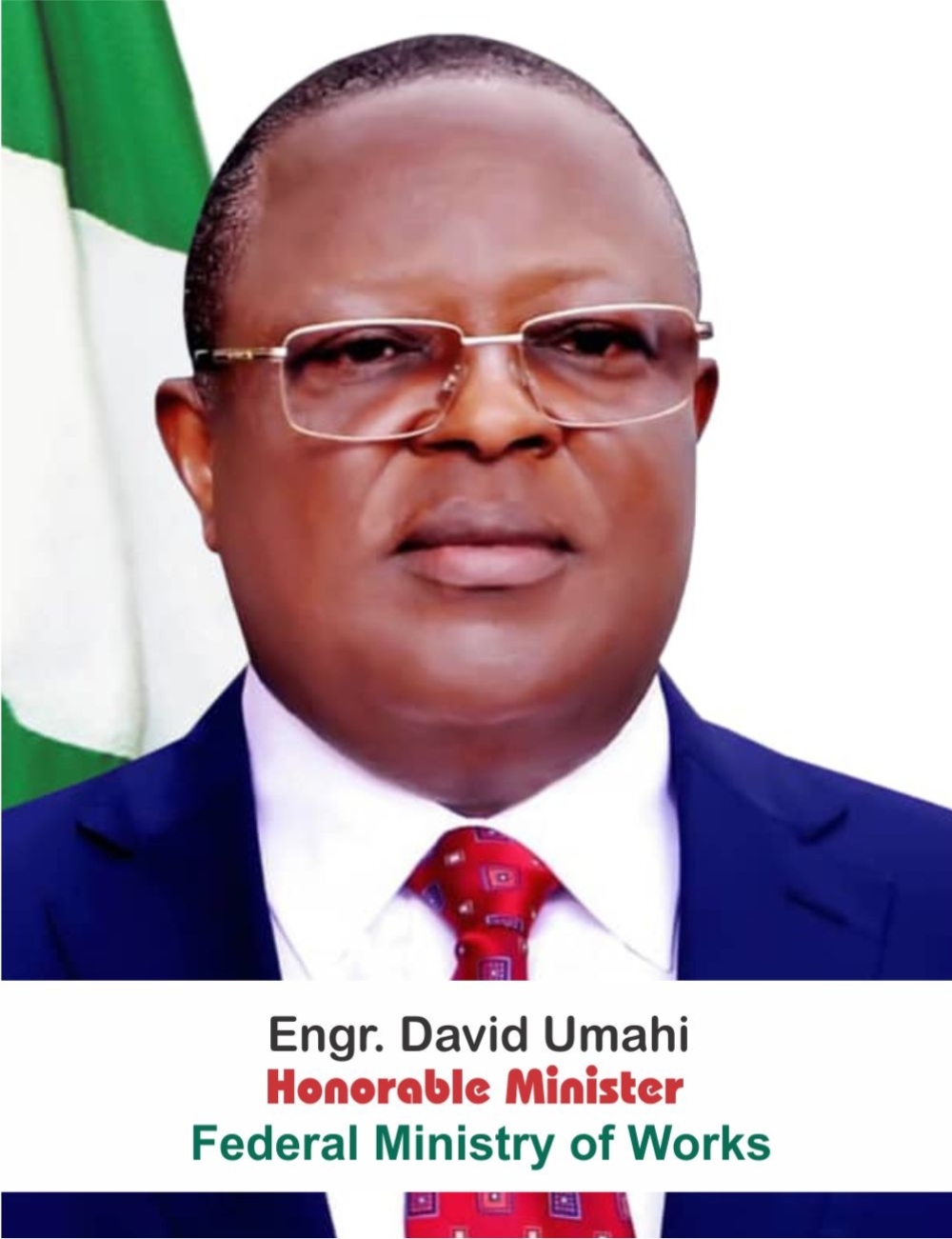
The Minister of Works, Senator Engr. David Umahi, CON, has declared that Nigeria is now seeing stronger economic outlook under President Bola Ahmed Tinubu, noting that the country’s Gross Domestic Product (GDP) is now growing faster than its population.
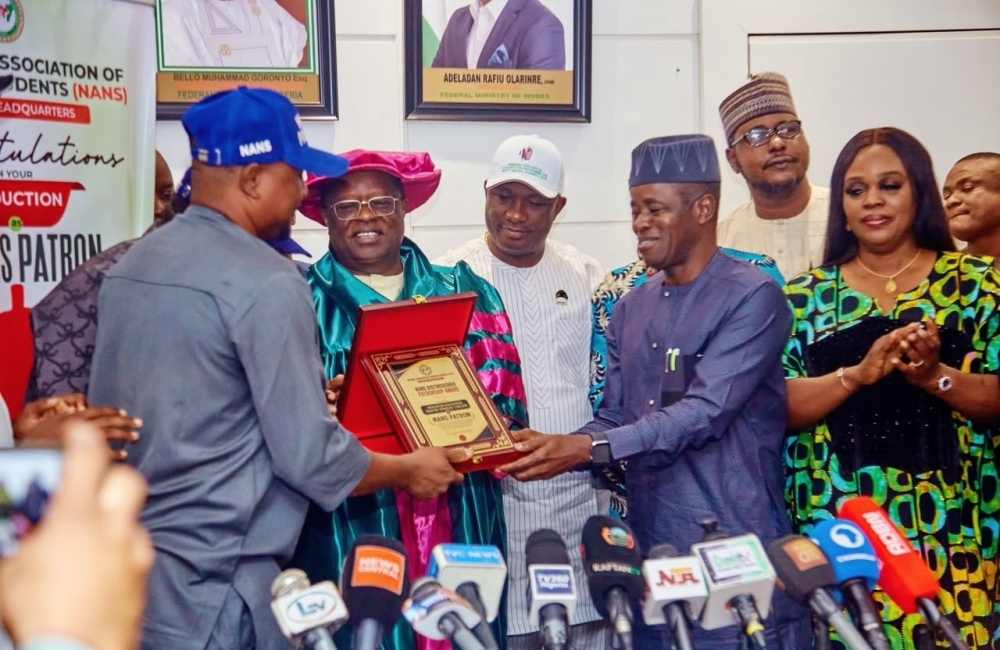
Umahi made the declaration on Monday, August 10, 2026, at the headquarters of the Federal Ministry of Works in Abuja, while speaking after he was formally inducted as Patron of the National Association of Nigerian Students (NANS).
The minister described the development as a positive indication of Nigeria’s economic prospects, saying, “I was enthused to find out that our GDP is growing more than our population. That means we have a future.”
The NANS leadership, led by its President, Dist. Comr. Akinteye Babatunde Afeez, GCNS, had earlier commended Umahi for his contributions to national infrastructure and described him as “a worthy member of the Renewed Hope Cabinet and, indeed, as one of the finest public servants Nigeria has produced in the contemporary era.”
The students said the recognition was not merely ceremonial but a reflection of Umahi’s visible contribution to road infrastructure and national development under President Bola Ahmed Tinubu’s administration.
According to NANS, the roads and bridges being delivered under Umahi’s supervision are directly connected to the lives of Nigerian students, affecting their mobility, access to educational institutions, examinations, internships, businesses and employment opportunities.
The students specifically cited major projects including the Abuja-Kaduna-Kano Expressway, Abuja-Kaduna-Minna route, Enugu-Port Harcourt Expressway and Lagos-Calabar Coastal Highway as examples of projects they said demonstrate the Federal Government’s commitment to improving national connectivity.
Afeez also disclosed that NANS had studied project reports of the Federal Ministry of Works covering the period between May 2023 and May 2026 and expressed its intention to embark on nationwide project tours to inspect completed and rehabilitated projects.
He said the students would use their platforms to communicate the impact of the projects to millions of Nigerian students, Nigerians and the wider world.
Responding, Umahi challenged Nigerian students and young people to look beyond political sentiments and examine the policies and achievements of the Tinubu administration objectively.
“We have had somebody say, ‘President Tinubu is tired.’ How do you know he is tired? I am part of President Tinubu. The Minister of Interior, the FCT, all the ministers and all the SSAs are vibrant and working. So how do you just jump at that conclusion?”
The minister urged Nigerians to demand concrete alternatives from those criticising the administration.
“If you say that the President is not doing well, what is your alternative?” he asked, stressing that political promises must be backed by clear plans and a credible mission.
He also called on students and other young Nigerians to take a position on issues affecting the country, arguing that remaining neutral in the face of visible progress was not always the right approach.
“You may say that you are not politicians or that you will not take sides, but this is the time to take sides in our national affairs. It is time to take a stand,” Umahi said.
On the economy, the minister acknowledged that the macroeconomy was only beginning to recover but urged Nigerians to consider the condition of the economy before the present administration took office and assess the reforms objectively.
“You may say that the macroeconomy is just beginning to recover. What was it like before the President took over? Everybody agrees that the macroeconomy is being fixed. It is up to you to dissect the ongoing reforms and take a position.”
Umahi also pointed to developments in the education sector, saying the stability being witnessed under the Tinubu administration had created an environment in which students were able to continue their studies without the disruption of nationwide strikes.
“For the first time, students never went on strike. Never. Look at the stability of Nigeria. That has never happened throughout the history of this country.”
“Where is the subsidy money?” Umahi explains
Addressing questions surrounding the removal of fuel subsidy and where the resulting resources were being deployed, Umahi pointed to the scale of ongoing infrastructure projects across the country.
He cited the Abuja-Kaduna-Zaria-Kano road, which he said covers 375 kilometres and, when measured as a dual carriageway, amounts to 750 kilometres.
According to the minister, more than ₦200 billion has already been spent on the project, with 480 kilometres of the dual carriageway completed and further sections nearing completion.
“For the first time, we have been able to complete 118 kilometres of concrete pavement within 30 months. That has never happened,” he said.
The Minister said the remaining works were expected to be completed by November, noting that the two projects on the route have a combined cost of ₦752 billion, with more than 80 percent already paid.
He also highlighted the Sokoto-Zamfara-Zaria corridor, the Benue-Ninth Mile road, and the Bodo - Bonny Island road as examples of projects receiving significant attention under the Tinubu administration.
On the Bonny Island project, he said:
“For the first time, people will move from the island to the mainland in Bonny Island, where the LNG is produced. A project costing ₦280 billion under President Bola Ahmed Tinubu has been completed. The 39.7-kilometre road is fully done, and the people of Bonny are very happy. They are no longer dying at sea. They are now driving through the land.”
The minister also spoke extensively about the administration’s legacy road projects, including the Lagos-Calabar Coastal Highway and the expanded Northeast Fourth Legacy Project.
He disclosed that the Northeast project, originally running from Akwanga through Jos, Bauchi, Gombe and Biu, had been extended through Yobe to Maiduguri, adding another 400 kilometres to the project.
Umahi defended the Lagos-Calabar Coastal Highway against criticisms, saying the project was strategically important to the Niger Delta and would be completed.
“I do not know why people are attacking the Lagos-Calabar Coastal Highway. After all, this is coming from the Niger Delta, where the oil is coming from. Why is nobody attacking the other three Legacy Projects, but this one is being attacked? That is unfair and unrealistic. That project will be completed. In fact, over 50 percent of the entire stretch is already under construction.”
The minister also used the occasion to speak about the development of the Southeast, saying President Tinubu had deliberately embarked on projects aimed at integrating the region into the national infrastructure network.
“The Southeast, for the first time, is being remembered, and I thank the people in the Southeast because sometimes I say, ‘Listen, our people should not be sentimental.’”
He said the administration’s approach to the region was intentional and urged the people of the Southeast to work with other parts of the country.
“The President has a good intention to integrate the people of the Southeast, and I have to be very honest with you. If I were not a minister from the Southeast, we would not have been able to get the projects we have secured. It is intentional on the part of Mr. President. Go and right the wrongs of the Southeast.”
Umahi cited the Enugu-Onitsha Expressway and Enugu-Port Harcourt Expressway among the major projects transforming connectivity in the region.
He also disclosed that President Tinubu had approved the re-scoping and reconstruction of the Lokoja-Benin-Warri corridor, covering a total of 401 kilometres.
The minister was particularly direct in urging the students to support President Tinubu in the 2027 election, arguing that Nigerians should support the administration if they believe its policies are producing results.
“I want you to take a side. If you say you are on the list of a coalition and you say that what we are doing is good, then we have to take a stand to vote for the President in the coming election.”
“Let him finish. Let him take back our country. Let him reposition our country.”
Umahi also urged Nigerians to look beyond political rhetoric and focus on practical solutions to the country’s challenges.
“Listening to others should not mean allowing yourselves to be insulted or blackmailed. Cheap talk will not solve our problems. Nobody is saying what he or she can do differently. The worst is over. The darkest part of the night is an hour before dawn.”
He pointed to the decline in food prices as one of the developments Nigerians should consider in assessing the economy, recalling that a 50-kilogramme bag of rice, which he said had risen above ₦80,000 and at some point reached ₦100,000, was now selling at about ₦58,000.
Umahi also stressed the administration’s commitment to transparency in the execution of road projects, saying the Ministry of Works had opened its projects to scrutiny by anti-corruption agencies.
“Now, why are we doing this? Transparency. We have turned these projects over to the ICPC. They have gone round. We are ready for constructive criticism, and where necessary, we will make amends.”
He added that the Ministry had also written to the Economic and Financial Crimes Commission (EFCC) to inspect its projects. “We have nothing to hide in this administration.”
The minister urged NANS to organise a major student engagement across the geopolitical zones where students could ask questions directly and hear the government’s explanations on its policies and projects.
“Let me defend this administration. Organise it and let me come. Move students from across the zone to a central point where we can talk to them and address their concerns. We have to deliberate on the issues. We have to debate them. Ask your questions, and we will answer them.”
He said he would attend such engagements with some ministers and Senior Special Assistants to the President, stressing that students were important stakeholders in the country’s future.
Umahi further challenged young Nigerians to take responsibility for protecting public infrastructure and contributing positively to national development. “See something, say something. Together, we can take back our country because it belongs to us.”
He said the responsibility for the performance of government should be placed on the officials directly responsible for specific sectors, rather than on the President for every operational issue.
“I am here because the President gave me the responsibility to be in charge of roads and bridges. If I do not do it, I should be the one to be blamed, not the President. I am not the President. The President has divided himself into a number of his appointees. These appointees should be the ones to answer and take responsibility.”
The minister concluded by thanking the students for the recognition and expressing his readiness to deepen collaboration with NANS.
“I want to thank you very much.“
He described the students as important partners in the national development process and encouraged them to remain informed, ask questions and hold leaders accountable.
The NANS President, in his address, said the association considered Umahi worthy of its patronage because of his record of public service, infrastructure delivery and commitment to national development.
He said the roads being constructed under Umahi’s leadership would outlive the present administration and continue to serve generations of Nigerians.
“History will not remember public officers merely because they occupied important offices. History will remember them for what they built, what they changed and the lives they touched.”
Afeez formally welcomed Umahi into the NANS family as Patron, describing the partnership between the student body and the Federal Ministry of Works as an opportunity to bring government projects closer to young Nigerians and deepen informed national discourse.

“THE WORST IS OVER; OUR GDP IS GROWING MORE THAN OUR POPULATION. THAT MEANS WE HAVE A FUTURE” - UMAHI TELLS NANS — As Nigerian Students Induct Him as Grand Patron, Hail Him as “One of the Finest” in Tinubu’s Renewed Hope Cabinet The Minister of Works, Senator Engr. David Umahi, CON, has declared that Nigeria is now seeing stronger economic outlook under President Bola Ahmed Tinubu, noting that the country’s Gross Domestic Product (GDP) is now growing faster than its population. Umahi made the declaration on Monday, August 10, 2026, at the headquarters of the Federal Ministry of Works in Abuja, while speaking after he was formally inducted as Patron of the National Association of Nigerian Students (NANS). The minister described the development as a positive indication of Nigeria’s economic prospects, saying, “I was enthused to find out that our GDP is growing more than our population. That means we have a future.” The NANS leadership, led by its President, Dist. Comr. Akinteye Babatunde Afeez, GCNS, had earlier commended Umahi for his contributions to national infrastructure and described him as “a worthy member of the Renewed Hope Cabinet and, indeed, as one of the finest public servants Nigeria has produced in the contemporary era.” The students said the recognition was not merely ceremonial but a reflection of Umahi’s visible contribution to road infrastructure and national development under President Bola Ahmed Tinubu’s administration. According to NANS, the roads and bridges being delivered under Umahi’s supervision are directly connected to the lives of Nigerian students, affecting their mobility, access to educational institutions, examinations, internships, businesses and employment opportunities. The students specifically cited major projects including the Abuja-Kaduna-Kano Expressway, Abuja-Kaduna-Minna route, Enugu-Port Harcourt Expressway and Lagos-Calabar Coastal Highway as examples of projects they said demonstrate the Federal Government’s commitment to improving national connectivity. Afeez also disclosed that NANS had studied project reports of the Federal Ministry of Works covering the period between May 2023 and May 2026 and expressed its intention to embark on nationwide project tours to inspect completed and rehabilitated projects. He said the students would use their platforms to communicate the impact of the projects to millions of Nigerian students, Nigerians and the wider world. Responding, Umahi challenged Nigerian students and young people to look beyond political sentiments and examine the policies and achievements of the Tinubu administration objectively. “We have had somebody say, ‘President Tinubu is tired.’ How do you know he is tired? I am part of President Tinubu. The Minister of Interior, the FCT, all the ministers and all the SSAs are vibrant and working. So how do you just jump at that conclusion?” The minister urged Nigerians to demand concrete alternatives from those criticising the administration. “If you say that the President is not doing well, what is your alternative?” he asked, stressing that political promises must be backed by clear plans and a credible mission. He also called on students and other young Nigerians to take a position on issues affecting the country, arguing that remaining neutral in the face of visible progress was not always the right approach. “You may say that you are not politicians or that you will not take sides, but this is the time to take sides in our national affairs. It is time to take a stand,” Umahi said. On the economy, the minister acknowledged that the macroeconomy was only beginning to recover but urged Nigerians to consider the condition of the economy before the present administration took office and assess the reforms objectively. “You may say that the macroeconomy is just beginning to recover. What was it like before the President took over? Everybody agrees that the macroeconomy is being fixed. It is up to you to dissect the ongoing reforms and take a position.” Umahi also pointed to developments in the education sector, saying the stability being witnessed under the Tinubu administration had created an environment in which students were able to continue their studies without the disruption of nationwide strikes. “For the first time, students never went on strike. Never. Look at the stability of Nigeria. That has never happened throughout the history of this country.” “Where is the subsidy money?” Umahi explains Addressing questions surrounding the removal of fuel subsidy and where the resulting resources were being deployed, Umahi pointed to the scale of ongoing infrastructure projects across the country. He cited the Abuja-Kaduna-Zaria-Kano road, which he said covers 375 kilometres and, when measured as a dual carriageway, amounts to 750 kilometres. According to the minister, more than ₦200 billion has already been spent on the project, with 480 kilometres of the dual carriageway completed and further sections nearing completion. “For the first time, we have been able to complete 118 kilometres of concrete pavement within 30 months. That has never happened,” he said. The Minister said the remaining works were expected to be completed by November, noting that the two projects on the route have a combined cost of ₦752 billion, with more than 80 percent already paid. He also highlighted the Sokoto-Zamfara-Zaria corridor, the Benue-Ninth Mile road, and the Bodo - Bonny Island road as examples of projects receiving significant attention under the Tinubu administration. On the Bonny Island project, he said: “For the first time, people will move from the island to the mainland in Bonny Island, where the LNG is produced. A project costing ₦280 billion under President Bola Ahmed Tinubu has been completed. The 39.7-kilometre road is fully done, and the people of Bonny are very happy. They are no longer dying at sea. They are now driving through the land.” The minister also spoke extensively about the administration’s legacy road projects, including the Lagos-Calabar Coastal Highway and the expanded Northeast Fourth Legacy Project. He disclosed that the Northeast project, originally running from Akwanga through Jos, Bauchi, Gombe and Biu, had been extended through Yobe to Maiduguri, adding another 400 kilometres to the project. Umahi defended the Lagos-Calabar Coastal Highway against criticisms, saying the project was strategically important to the Niger Delta and would be completed. “I do not know why people are attacking the Lagos-Calabar Coastal Highway. After all, this is coming from the Niger Delta, where the oil is coming from. Why is nobody attacking the other three Legacy Projects, but this one is being attacked? That is unfair and unrealistic. That project will be completed. In fact, over 50 percent of the entire stretch is already under construction.” The minister also used the occasion to speak about the development of the Southeast, saying President Tinubu had deliberately embarked on projects aimed at integrating the region into the national infrastructure network. “The Southeast, for the first time, is being remembered, and I thank the people in the Southeast because sometimes I say, ‘Listen, our people should not be sentimental.’” He said the administration’s approach to the region was intentional and urged the people of the Southeast to work with other parts of the country. “The President has a good intention to integrate the people of the Southeast, and I have to be very honest with you. If I were not a minister from the Southeast, we would not have been able to get the projects we have secured. It is intentional on the part of Mr. President. Go and right the wrongs of the Southeast.” Umahi cited the Enugu-Onitsha Expressway and Enugu-Port Harcourt Expressway among the major projects transforming connectivity in the region. He also disclosed that President Tinubu had approved the re-scoping and reconstruction of the Lokoja-Benin-Warri corridor, covering a total of 401 kilometres. The minister was particularly direct in urging the students to support President Tinubu in the 2027 election, arguing that Nigerians should support the administration if they believe its policies are producing results. “I want you to take a side. If you say you are on the list of a coalition and you say that what we are doing is good, then we have to take a stand to vote for the President in the coming election.” Umahi also urged Nigerians to look beyond political rhetoric and focus on practical solutions to the country’s challenges. “Listening to others should not mean allowing yourselves to be insulted or blackmailed. Cheap talk will not solve our problems. Nobody is saying what he or she can do differently. The worst is over. The darkest part of the night is an hour before dawn.” He pointed to the decline in food prices as one of the developments Nigerians should consider in assessing the economy, recalling that a 50-kilogramme bag of rice, which he said had risen above ₦80,000 and at some point reached ₦100,000, was now selling at about ₦58,000. Umahi also stressed the administration’s commitment to transparency in the execution of road projects, saying the Ministry of Works had opened its projects to scrutiny by anti-corruption agencies. “Now, why are we doing this? Transparency. We have turned these projects over to the ICPC. They have gone round. We are ready for constructive criticism, and where necessary, we will make amends.” He added that the Ministry had also written to the Economic and Financial Crimes Commission (EFCC) to inspect its projects. “We have nothing to hide in this administration.” The minister urged NANS to organise a major student engagement across the geopolitical zones where students could ask questions directly and hear the government’s explanations on its policies and projects. “Let me defend this administration. Organise it and let me come. Move students from across the zone to a central point where we can talk to them and address their concerns. We have to deliberate on the issues. We have to debate them. Ask your questions, and we will answer them.” He said he would attend such engagements with some ministers and Senior Special Assistants to the President, stressing that students were important stakeholders in the country’s future. Umahi further challenged young Nigerians to take responsibility for protecting public infrastructure and contributing positively to national development. “See something, say something. Together, we can take back our country because it belongs to us.” He said the responsibility for the performance of government should be placed on the officials directly responsible for specific sectors, rather than on the President for every operational issue. “I am here because the President gave me the responsibility to be in charge of roads and bridges. If I do not do it, I should be the one to be blamed, not the President. I am not the President. The President has divided himself into a number of his appointees. These appointees should be the ones to answer and take responsibility.” The minister concluded by thanking the students for the recognition and expressing his readiness to deepen collaboration with NANS. “I want to thank you very much.“ He described the students as important partners in the national development process and encouraged them to remain informed, ask questions and hold leaders accountable. The NANS President, in his address, said the association considered Umahi worthy of its patronage because of his record of public service, infrastructure delivery and commitment to national development. He said the roads being constructed under Umahi’s leadership would outlive the present administration and continue to serve generations of Nigerians. “History will not remember public officers merely because they occupied important offices. History will remember them for what they built, what they changed and the lives they touched.” Afeez formally welcomed Umahi into the NANS family as Patron, describing the partnership between the student body and the Federal Ministry of Works as an opportunity to bring government projects closer to young Nigerians and deepen informed national discourse.
“Let him finish. Let him take back our country. Let him reposition our country.”
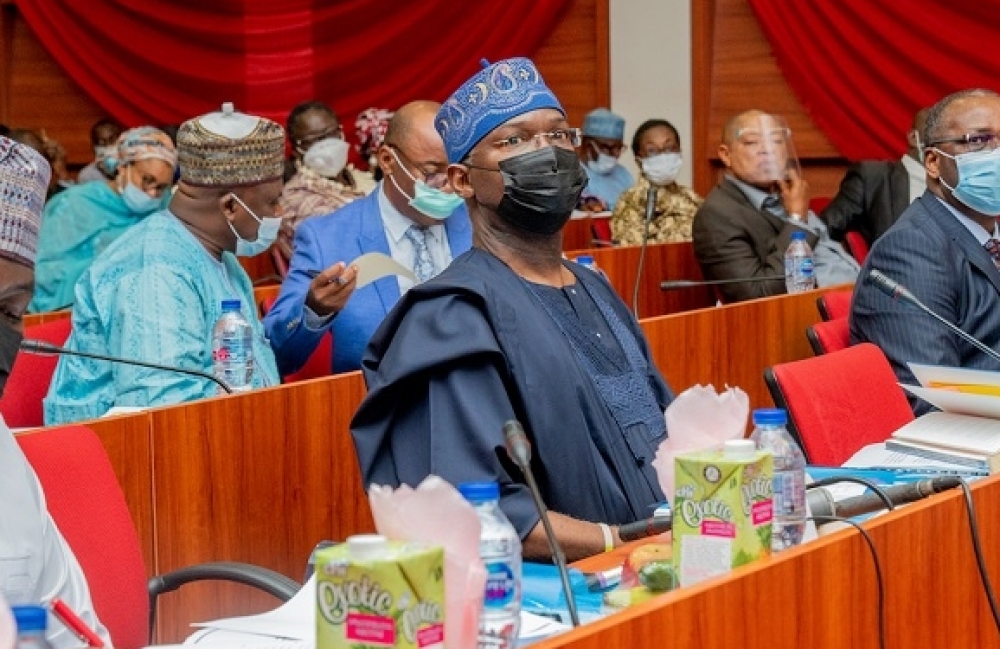
2021 Budget: FG To Focus On Completion Of Priority Road, Bridge Projects, Says Fashola * As Minister begins defense of budget for his Ministry before Senate Committee on Works * Calls for review of regulations guiding release of Funds for ongoing projects in order to pay for works done * Commends the Minister of Finance for committed efforts to raise funds for project execution * Receives commendations from Committee members for execution of projects in various parts of the country The Minister of Works and Housing, Mr. Babatunde Fashola, SAN, Wednesday began the defense of the budget proposals for his Ministry in the 2021 Budget with the assertion that focus would be on the completion of priority road projects, especially those on the routes A1-A9. The routes, which are those leading to ports and major agricultural hubs across the six geopolitical zones, Fashola said, include 18 road and bridge projects which have already attained some appreciable physical achievements for completion within a 12-15 months period (December 2021). Making his presentation, which encompassed the defense of the Ministry’s 2020 Budget Performance and 2021 Budget Proposals, before the Senate Committee on Works, the Minister, who said focus would also be on roads that have attained 70 per cent completion to enable such projects achieve substantial completion levels, added that the Ministry has also taken the maintenance of bridges as a priority “to avoid further deterioration of these critical structures”. He told the Committee Members, “What you will see of these roads, which crisscross our country from East to West and from North to South, is that they connect most of the important sectors of our economy. They connect our fuel depots so that we can move our fuel, they connect our manufacturing agro-industries so that we can get agricultural goods from farm to market for processing, they connect our ports so that we can do export and import business”. Saying that 18 of such roads had been identified by his Ministry, Fashola, who said the projects cut across the six geopolitical zones of the country declared, “If you accept our proposals, we should finish them between 12 and 15 months and take them of our list”, adding that on a graduating basis they were at different stages of completion. Listing some of the Bridges to include the Third Mainland Bridge with an Average Daily Traffic of 122,978, the Bodo Bonny Bridge, the Koton Karfe Bridge and the Makurdi Bridge among others, the Minister, who said they were part of about 50 Bridges being rehabilitated simultaneously among others, added that some of the bridges require replacement of expansion joints and hand rails while others require major underwater repairs of exposed piles, pile caps and piers. He said the Ministry also intends to complete the construction of Chanchangi Bridge along Takum-Wukari Road and Ikom Bridge along Calabar-Ikom Road within available fund allocated to it adding that provisions had been made to ensure that the rehabilitation of the listed bridges was not hindered during the budget year. Fashola, who solicited the support of the law makers “to achieve these national objectives” , pointed out that in the course of each year there was need to address washouts and erosion envisaged with the subsiding discharge of floodwaters nationwide. “We are mindful of the limitation of resources but the frequency of these natural disasters caused by climate change and aging infrastructure must compel us to think of making provisions for emergencies”, the Minister said adding that Best Practice was between 5-10 percent of the Capital Budget. He said the Ministry has also selected two roads and a bridge in each of the six geopolitical zones as target projects for enhanced funding in the 2021 Budget to achieve appreciable progress on the projects adding that also targeted for adequate funding is the Federal Government of Nigeria Counterpart Fund for the projects financed by the China Exim Bank. On the interventions which the Ministry made between 2018 and 2019 on roads in tertiary institutions, the Minister, who noted that 18 out of a total of 43 such projects nationwide have been completed, however, added that the amendment in the 2020 Budget which cut the budget by about 17.35 percent, made it impossible to pay Contractors who have completed their projects as well as to complete the remaining projects, putting the amount owed the contractors at N3.4 billion while the amount needed to complete the rest stands at N3.54 billion. Calling for a review of regulations guiding the release of funds allocated for the execution of projects, Fashola who blamed the delay in funds release for the slow pace being experienced in the completion of the various projects, said most of the contractors were being owed significant amounts for completed projects adding that most of those still working on sites were doing so on trust. “The major challenge to the Ministry’s efforts towards the timely completion of projects is inadequate budgetary provision and releases for projects to sustain annual cash-flow requirement levels”, the Minister said adding that although the additional funding from the Presidential Infrastructure Development Fund (PIDF), the SUKUK Bond and the Tax Credit Scheme had been helpful in bringing some form of relief, “the Ministry’s exposure continues to expand as the roads age and deteriorate and require attention”. He said although the total sum of N276.244 billion provided for Highway projects in the 2021 Budget was an improvement over the N154.2 billion allocated to the sector in the 2020 Budget, it was still inadequate to address the funding challenges of highway projects where, according to him, the year 2021 project cash flow requirement was estimated at about N1.2 Trillion. Expatiating on the expansion of the exposure of the Ministry, Fashola, who again called for a halt to the introduction of new projects while old ones were yet to be completed, pointed out that various demands for new projects were still being made adding that currently and in spite of the dearth of resources, the Ministry was contending with 711 uncompleted projects, up from 601 last year. The Minister, who commended the Minister of Finance, Budget and National Planning, Mrs Zainab Ahmed for her committed efforts to source funds for the execution of capital projects, said in order to enable the Ministry make a significant impact in the improvement of the Federal road network “so as to boost economic activities and create more jobs”, it was imperative to improve the funding of highway projects by enhancing the release of funds for projects under the Amended 2020 Budget to defray the outstanding payments. He said there was also a need to enhance the budget ceiling for Highway projects in the 2021 Budget proposal to cover the execution of works during the year and leverage on other alternative funding sources like the SUKUK Bond and the PIDF. During the question and answer session, some Committee members, including the Chairman, Senator Adamu Aliero, commended the Minister and his team for the good works and the impacts they have made in project execution across the country. On the question of equity in the allocation of funds to projects which some of the members raised, Fashola clarified that some of the projects which seemingly had low allocations compared to others were being funded by other sources of funding like the SUKUK while the one with seeming high allocation was funded through China Exim Bank with Nigeria contributing a small percentage as Counterpart Fund. Earlier in his Welcome remarks, Chairman of the Committee, Senator Adamu Aliero, said the Senate Committee was focusing on the Infrastructure based on the emphasis laid on that sector by President Muhammadu Buhari during his 2021 Budget Presentation adding that although allocation to the Ministry of works remained one of the highest, it was still not enough to address the challenges of infrastructure development in the country especially the road network. Some Committee members present included, Senator Gabriel Suswan, Senator Orji Uzor Kalu, Senator Oluremi Tinubu, Senator Kashim Shettima and Senator Kabiru Gaya, among other distinguished Senators while the Minister was accompanied by the Minister of State, Engr. Abubakar Aliyu, the Permanent Secretary, Mr. Ernest Umakhihe and Directors from the Ministry. ...
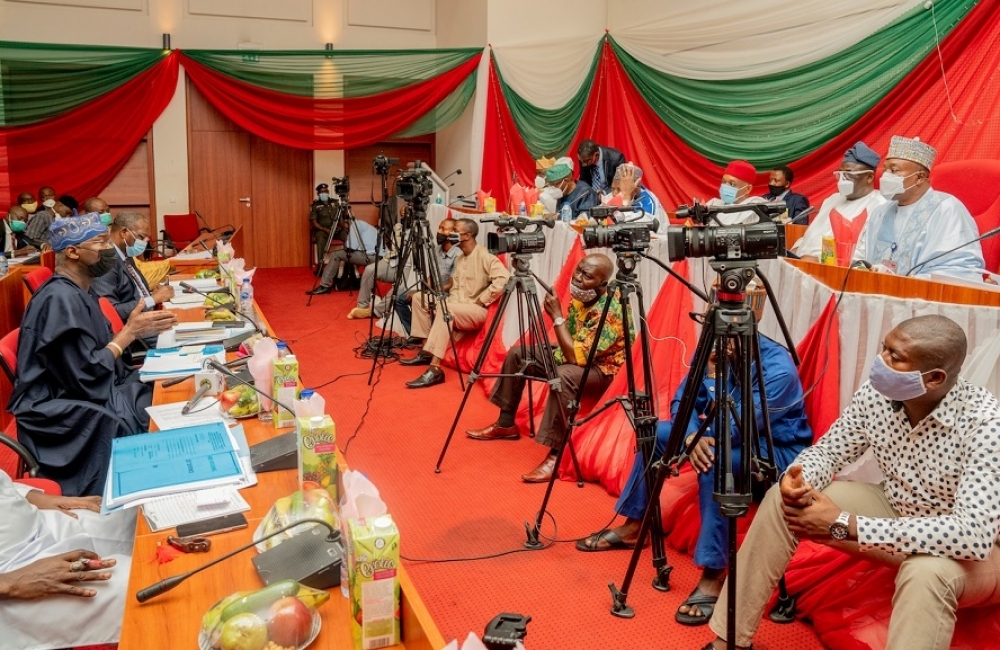
FG To Focus on Completion Of Priority Road Projects In 2021 - Fashola The Minister of Works and Housing Mr. Babatunde Fashola, SAN has said that the focus of the 2021 Budget Proposal of the Ministry remains the completion of priority road projects in the country. The Minister who stated this during the Presentation and Defence of the Ministry’s 2021 Budget before the Senate Committee on Works said that given the wide disparity between the Ministry’s liabilities in unpaid certificates and the volume of road projects, it has become imperative for the Ministry to prioritize its 2021 Capital proposal in order to make appreciable impact in road infrastructure development. He said that Ministry was currently undertaking a total of 711 Highway Projects spread over the Six Geo-Political Zones of the country. The 711 on-going road projects were categorized according to funding mechanisms which included; Highway Projects financed with Presidential Infrastructure Development Fund (PIDF), Highway Projects financed with Sovereign Sukuk Fund, Highway Projects financed under Tax Credit and Highway Projects funded from Multilateral. Speaking on Highway Projects financed with the Sovereign Sukuk Fund, he explained that the Ministry was financing a total of 44 roads and bridges across the country using the 2020 Sovereign Sukuk issuance. He added that the roads were mainly dual carriageways on the major arterial routes A1 to A9 on the Federal road networks. On the 2021 Budget proposal, he said that the focus of the Ministry remained the completion of some priority road projects especially those on routes A1 to A9 saying that these roads and bridges lead to ports and major agricultural hubs across the six Geo-Political Zones of the country. In furtherance to this, he said Mr. President has repeatedly emphasized the need to focus budget on completion of projects. “Therefore, the Ministry has given priority first to about 18 road and bridge projects that have attained some appreciable level of completion. We are focusing on roads that have attained 70 percent completion levels,” he said. Fashola appealed to members of the National Assembly and other well-meaning Nigerians to build a national consensus as adults to stop the agitation for new road projects but to agree on completion of ongoing road projects that cut across the six Geo-political zones of the country due to budgetary constraints. On the impact the proposed 2021 budget would have on the economy and its citizenry, he said: “In order to enable the Ministry make a significant impact in the improvement of the Federal road networks to boost economic activities and create jobs, it is imperative to improve the funding of Highway Projects by releasing funds for the projects under the Amended 2020 Budget to defray the outstanding payments,” he said. He also appealed that budget ceiling for Highway Projects in the 2021 Budget proposal be made to cover the execution of works during the year as well as leveraging on other alternative funding sources like the Sukuk Bond and the PIDF. Earlier, in his opening remarks, the Chairman, Senate Committee on Works, Senator Adamu Aliero stated that although budgetary allocation to the Ministry remained one of the highest, but was not enough looking at the humongous work to be done on the nation’s roads and the current debt profile of the Ministry. The Chairman assured the Minister that the Committee would continue to work with the Ministry to ensure that it succeeds. “The Committee is poised to work in line with the principles of the 2021 Budget. We will strengthen the outcome of our oversight duties,” he said. ...
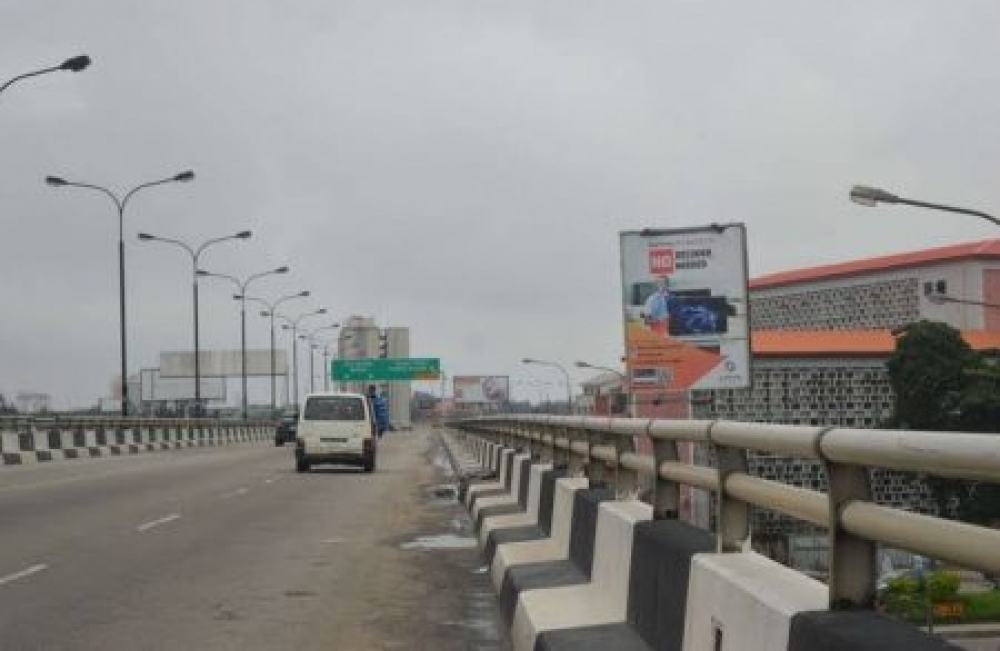
After Emergency Repairs By FG, Fashola Approves Reopening Of Eko, Marine Bridges On Monday * Minister thanks Lagosians for their patience, understanding, cooperation * First Phase completed while work commences immediately on the Second Phase After concluding urgently needed repair works on Eko and Marine Bridges in Lagos, the Minister of Works and Housing, Mr. Babatunde Fashola, SAN, has directed that both bridges be reopened to traffic on Monday, October 19, 2020. The approval for the reopening of the completed First Phase of the repairs on the Bridges by midnight on Sunday 18th of October, which was given by the Minister on Friday was sequel to the report by the Contractor handling the projects, Messrs. Buildwell Plant & Equipment Industries Limited that the repair works on the First Phase had been completed 100 percent. In his directives for the reopening of the Bridges, Fashola thanked Lagosians for their patience, understanding and cooperation while sections of the Bridges were closed also directed that members of the public should be informed of any restrictions to traffic while work is ongoing on the Second Phase of the project. The Minister added that while the completed section of the Eko Bridge (Lagos Island Bound) should be reopened to traffic, work should commence immediately on the Alaka Bound side of the project. Explaining further on the next phase of repair works on the Bridges, the Director Highways (Bridges & Designs) in the Ministry, Engr. Emmanuel Adeoye, said work was taking off without the need for either partial or complete closure of the Bridges, adding, however , that the public would be informed adequately should such a step become necessary. The 1,350 metre Eko Bridge, built in phases between 1965 and 1975, links the Lagos Island to the Mainland. It was closed to traffic in March this year in order to replace faulty joints and bearings. But, as a result of COVID-19 lockdown, actual repair works commenced in the first week of June. Work commenced in May on the first of the three phases in which repair works on the Marine Bridge was divided. The repairs on the Bridge, which is part of a network of complex bridges with several loops taking traffic in and out of the Apapa area of Lagos, included jacketing and skin repairs of the piers, lifting the bridge section deck in order to change the electrometric bearing, milling and placing a new wearing course of asphalt among others. The repair works on the Eko and Marine Bridges is part of the ongoing Federal Government’s Bridge Maintenance Programme which involves the repairs and rehabilitation of over 37 bridges nationwide with a substantial number already completed while others are at different stages of completion. ...
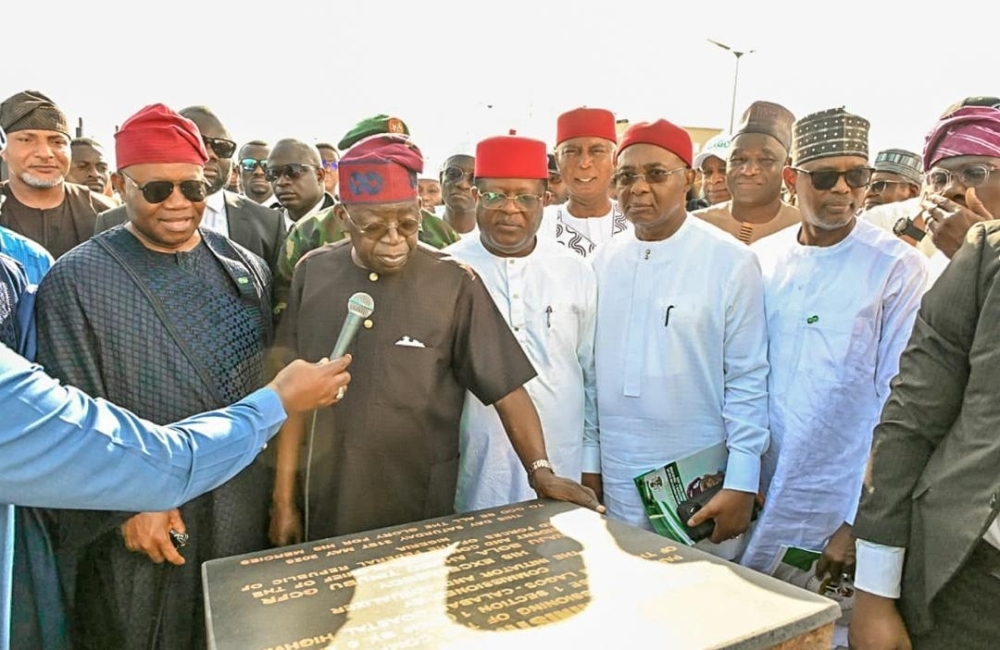
DRIVING NIGERIA’S FUTURE: CELEBRATING TWO YEARS OF TRANSFORMATIVE LEADERSHIP AND THE LAGOS-CALABAR COASTAL HIGHWAY MILESTONE
DRIVING NIGERIA’S FUTURE: CELEBRATING TWO YEARS OF TRANSFORMATIVE LEADERSHIP AND THE LAGOS-CALABAR COASTAL HIGHWAY MILESTONE
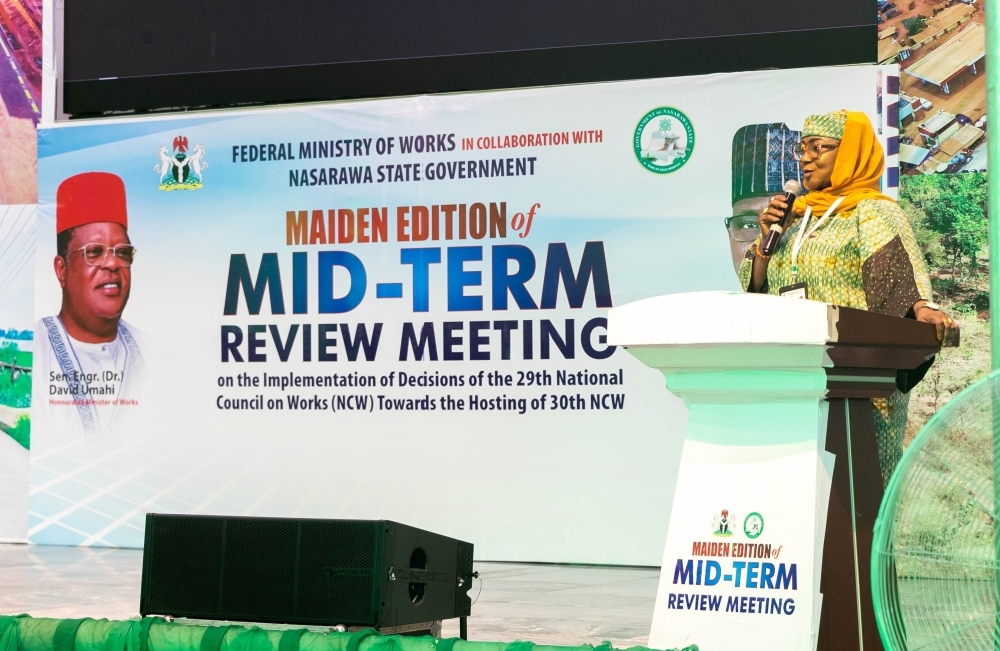
MID -TERM REVIEW MEETING ON THE IMPLIMENTATION OF THE DECISIONS REACHED AT THE 29TH NATIONAL COUNCIL ON WORKS (NCW) DAY 1
MID -TERM REVIEW MEETING ON THE IMPLIMENTATION OF THE DECISIONS REACHED AT THE 29TH NATIONAL COUNCIL ON WORKS (NCW) DAY 1