“THE WORST IS OVER; OUR GDP IS GROWING MORE THAN OUR POPULATION. THAT MEANS WE HAVE A FUTURE” - UMAHI TELLS NANS
— As Nigerian Students Induct Him as Grand Patron, Hail Him as “One of the Finest” in Tinubu’s Renewed Hope Cabinet
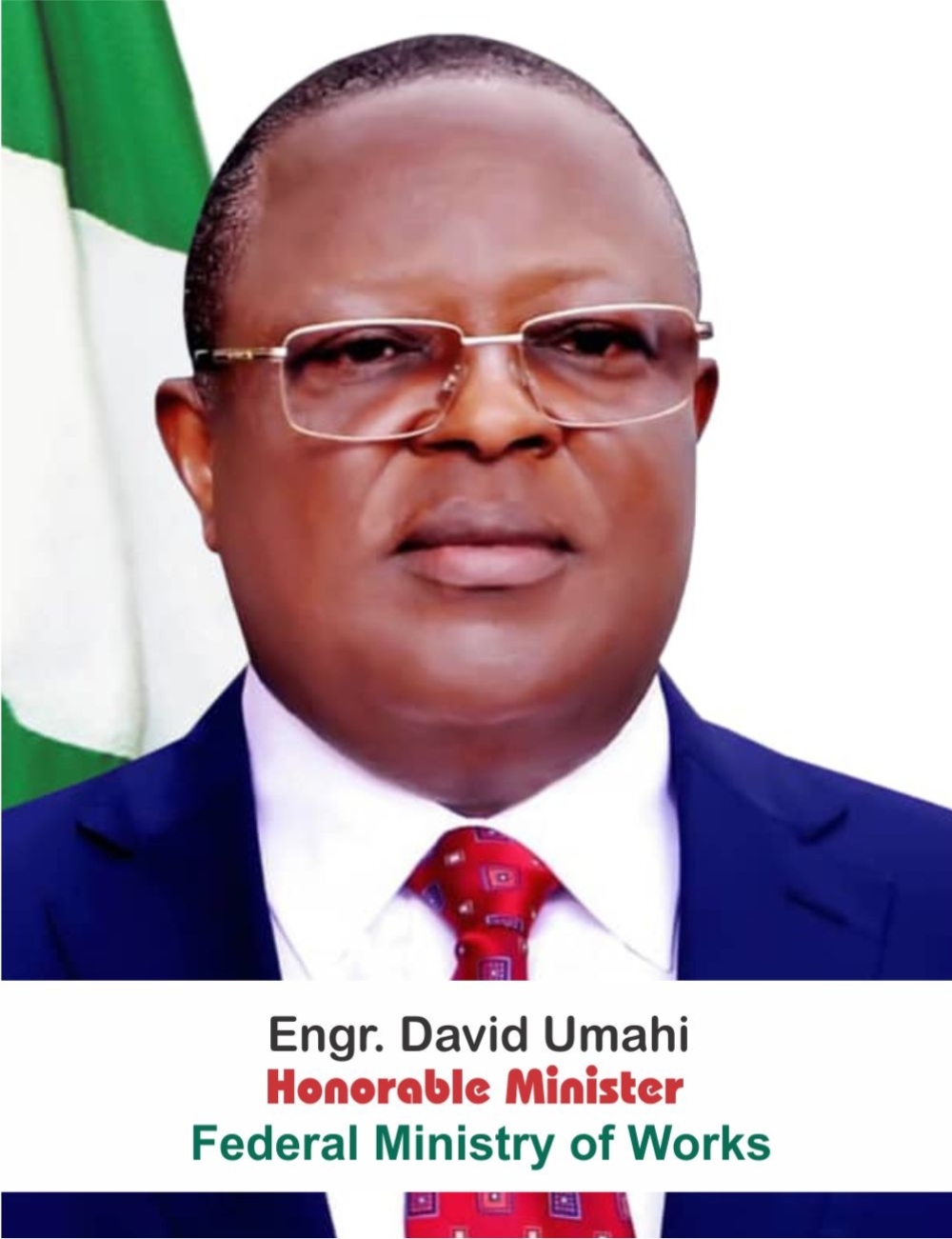
The Minister of Works, Senator Engr. David Umahi, CON, has declared that Nigeria is now seeing stronger economic outlook under President Bola Ahmed Tinubu, noting that the country’s Gross Domestic Product (GDP) is now growing faster than its population.
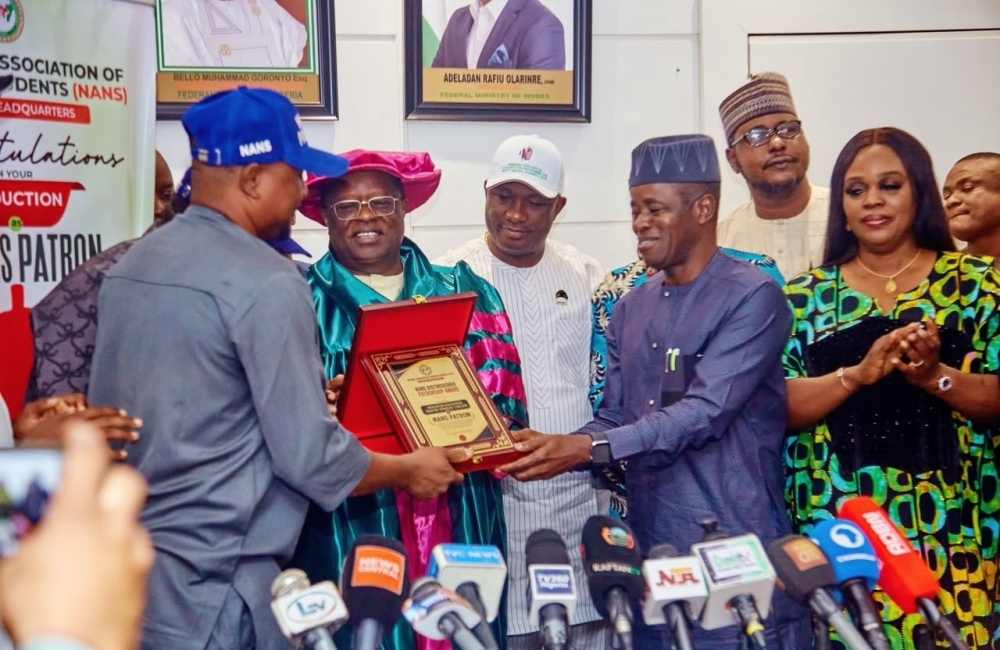
Umahi made the declaration on Monday, August 10, 2026, at the headquarters of the Federal Ministry of Works in Abuja, while speaking after he was formally inducted as Patron of the National Association of Nigerian Students (NANS).
The minister described the development as a positive indication of Nigeria’s economic prospects, saying, “I was enthused to find out that our GDP is growing more than our population. That means we have a future.”
The NANS leadership, led by its President, Dist. Comr. Akinteye Babatunde Afeez, GCNS, had earlier commended Umahi for his contributions to national infrastructure and described him as “a worthy member of the Renewed Hope Cabinet and, indeed, as one of the finest public servants Nigeria has produced in the contemporary era.”
The students said the recognition was not merely ceremonial but a reflection of Umahi’s visible contribution to road infrastructure and national development under President Bola Ahmed Tinubu’s administration.
According to NANS, the roads and bridges being delivered under Umahi’s supervision are directly connected to the lives of Nigerian students, affecting their mobility, access to educational institutions, examinations, internships, businesses and employment opportunities.
The students specifically cited major projects including the Abuja-Kaduna-Kano Expressway, Abuja-Kaduna-Minna route, Enugu-Port Harcourt Expressway and Lagos-Calabar Coastal Highway as examples of projects they said demonstrate the Federal Government’s commitment to improving national connectivity.
Afeez also disclosed that NANS had studied project reports of the Federal Ministry of Works covering the period between May 2023 and May 2026 and expressed its intention to embark on nationwide project tours to inspect completed and rehabilitated projects.
He said the students would use their platforms to communicate the impact of the projects to millions of Nigerian students, Nigerians and the wider world.
Responding, Umahi challenged Nigerian students and young people to look beyond political sentiments and examine the policies and achievements of the Tinubu administration objectively.
“We have had somebody say, ‘President Tinubu is tired.’ How do you know he is tired? I am part of President Tinubu. The Minister of Interior, the FCT, all the ministers and all the SSAs are vibrant and working. So how do you just jump at that conclusion?”
The minister urged Nigerians to demand concrete alternatives from those criticising the administration.
“If you say that the President is not doing well, what is your alternative?” he asked, stressing that political promises must be backed by clear plans and a credible mission.
He also called on students and other young Nigerians to take a position on issues affecting the country, arguing that remaining neutral in the face of visible progress was not always the right approach.
“You may say that you are not politicians or that you will not take sides, but this is the time to take sides in our national affairs. It is time to take a stand,” Umahi said.
On the economy, the minister acknowledged that the macroeconomy was only beginning to recover but urged Nigerians to consider the condition of the economy before the present administration took office and assess the reforms objectively.
“You may say that the macroeconomy is just beginning to recover. What was it like before the President took over? Everybody agrees that the macroeconomy is being fixed. It is up to you to dissect the ongoing reforms and take a position.”
Umahi also pointed to developments in the education sector, saying the stability being witnessed under the Tinubu administration had created an environment in which students were able to continue their studies without the disruption of nationwide strikes.
“For the first time, students never went on strike. Never. Look at the stability of Nigeria. That has never happened throughout the history of this country.”
“Where is the subsidy money?” Umahi explains
Addressing questions surrounding the removal of fuel subsidy and where the resulting resources were being deployed, Umahi pointed to the scale of ongoing infrastructure projects across the country.
He cited the Abuja-Kaduna-Zaria-Kano road, which he said covers 375 kilometres and, when measured as a dual carriageway, amounts to 750 kilometres.
According to the minister, more than ₦200 billion has already been spent on the project, with 480 kilometres of the dual carriageway completed and further sections nearing completion.
“For the first time, we have been able to complete 118 kilometres of concrete pavement within 30 months. That has never happened,” he said.
The Minister said the remaining works were expected to be completed by November, noting that the two projects on the route have a combined cost of ₦752 billion, with more than 80 percent already paid.
He also highlighted the Sokoto-Zamfara-Zaria corridor, the Benue-Ninth Mile road, and the Bodo - Bonny Island road as examples of projects receiving significant attention under the Tinubu administration.
On the Bonny Island project, he said:
“For the first time, people will move from the island to the mainland in Bonny Island, where the LNG is produced. A project costing ₦280 billion under President Bola Ahmed Tinubu has been completed. The 39.7-kilometre road is fully done, and the people of Bonny are very happy. They are no longer dying at sea. They are now driving through the land.”
The minister also spoke extensively about the administration’s legacy road projects, including the Lagos-Calabar Coastal Highway and the expanded Northeast Fourth Legacy Project.
He disclosed that the Northeast project, originally running from Akwanga through Jos, Bauchi, Gombe and Biu, had been extended through Yobe to Maiduguri, adding another 400 kilometres to the project.
Umahi defended the Lagos-Calabar Coastal Highway against criticisms, saying the project was strategically important to the Niger Delta and would be completed.
“I do not know why people are attacking the Lagos-Calabar Coastal Highway. After all, this is coming from the Niger Delta, where the oil is coming from. Why is nobody attacking the other three Legacy Projects, but this one is being attacked? That is unfair and unrealistic. That project will be completed. In fact, over 50 percent of the entire stretch is already under construction.”
The minister also used the occasion to speak about the development of the Southeast, saying President Tinubu had deliberately embarked on projects aimed at integrating the region into the national infrastructure network.
“The Southeast, for the first time, is being remembered, and I thank the people in the Southeast because sometimes I say, ‘Listen, our people should not be sentimental.’”
He said the administration’s approach to the region was intentional and urged the people of the Southeast to work with other parts of the country.
“The President has a good intention to integrate the people of the Southeast, and I have to be very honest with you. If I were not a minister from the Southeast, we would not have been able to get the projects we have secured. It is intentional on the part of Mr. President. Go and right the wrongs of the Southeast.”
Umahi cited the Enugu-Onitsha Expressway and Enugu-Port Harcourt Expressway among the major projects transforming connectivity in the region.
He also disclosed that President Tinubu had approved the re-scoping and reconstruction of the Lokoja-Benin-Warri corridor, covering a total of 401 kilometres.
The minister was particularly direct in urging the students to support President Tinubu in the 2027 election, arguing that Nigerians should support the administration if they believe its policies are producing results.
“I want you to take a side. If you say you are on the list of a coalition and you say that what we are doing is good, then we have to take a stand to vote for the President in the coming election.”
“Let him finish. Let him take back our country. Let him reposition our country.”
Umahi also urged Nigerians to look beyond political rhetoric and focus on practical solutions to the country’s challenges.
“Listening to others should not mean allowing yourselves to be insulted or blackmailed. Cheap talk will not solve our problems. Nobody is saying what he or she can do differently. The worst is over. The darkest part of the night is an hour before dawn.”
He pointed to the decline in food prices as one of the developments Nigerians should consider in assessing the economy, recalling that a 50-kilogramme bag of rice, which he said had risen above ₦80,000 and at some point reached ₦100,000, was now selling at about ₦58,000.
Umahi also stressed the administration’s commitment to transparency in the execution of road projects, saying the Ministry of Works had opened its projects to scrutiny by anti-corruption agencies.
“Now, why are we doing this? Transparency. We have turned these projects over to the ICPC. They have gone round. We are ready for constructive criticism, and where necessary, we will make amends.”
He added that the Ministry had also written to the Economic and Financial Crimes Commission (EFCC) to inspect its projects. “We have nothing to hide in this administration.”
The minister urged NANS to organise a major student engagement across the geopolitical zones where students could ask questions directly and hear the government’s explanations on its policies and projects.
“Let me defend this administration. Organise it and let me come. Move students from across the zone to a central point where we can talk to them and address their concerns. We have to deliberate on the issues. We have to debate them. Ask your questions, and we will answer them.”
He said he would attend such engagements with some ministers and Senior Special Assistants to the President, stressing that students were important stakeholders in the country’s future.
Umahi further challenged young Nigerians to take responsibility for protecting public infrastructure and contributing positively to national development. “See something, say something. Together, we can take back our country because it belongs to us.”
He said the responsibility for the performance of government should be placed on the officials directly responsible for specific sectors, rather than on the President for every operational issue.
“I am here because the President gave me the responsibility to be in charge of roads and bridges. If I do not do it, I should be the one to be blamed, not the President. I am not the President. The President has divided himself into a number of his appointees. These appointees should be the ones to answer and take responsibility.”
The minister concluded by thanking the students for the recognition and expressing his readiness to deepen collaboration with NANS.
“I want to thank you very much.“
He described the students as important partners in the national development process and encouraged them to remain informed, ask questions and hold leaders accountable.
The NANS President, in his address, said the association considered Umahi worthy of its patronage because of his record of public service, infrastructure delivery and commitment to national development.
He said the roads being constructed under Umahi’s leadership would outlive the present administration and continue to serve generations of Nigerians.
“History will not remember public officers merely because they occupied important offices. History will remember them for what they built, what they changed and the lives they touched.”
Afeez formally welcomed Umahi into the NANS family as Patron, describing the partnership between the student body and the Federal Ministry of Works as an opportunity to bring government projects closer to young Nigerians and deepen informed national discourse.

“THE WORST IS OVER; OUR GDP IS GROWING MORE THAN OUR POPULATION. THAT MEANS WE HAVE A FUTURE” - UMAHI TELLS NANS — As Nigerian Students Induct Him as Grand Patron, Hail Him as “One of the Finest” in Tinubu’s Renewed Hope Cabinet The Minister of Works, Senator Engr. David Umahi, CON, has declared that Nigeria is now seeing stronger economic outlook under President Bola Ahmed Tinubu, noting that the country’s Gross Domestic Product (GDP) is now growing faster than its population. Umahi made the declaration on Monday, August 10, 2026, at the headquarters of the Federal Ministry of Works in Abuja, while speaking after he was formally inducted as Patron of the National Association of Nigerian Students (NANS). The minister described the development as a positive indication of Nigeria’s economic prospects, saying, “I was enthused to find out that our GDP is growing more than our population. That means we have a future.” The NANS leadership, led by its President, Dist. Comr. Akinteye Babatunde Afeez, GCNS, had earlier commended Umahi for his contributions to national infrastructure and described him as “a worthy member of the Renewed Hope Cabinet and, indeed, as one of the finest public servants Nigeria has produced in the contemporary era.” The students said the recognition was not merely ceremonial but a reflection of Umahi’s visible contribution to road infrastructure and national development under President Bola Ahmed Tinubu’s administration. According to NANS, the roads and bridges being delivered under Umahi’s supervision are directly connected to the lives of Nigerian students, affecting their mobility, access to educational institutions, examinations, internships, businesses and employment opportunities. The students specifically cited major projects including the Abuja-Kaduna-Kano Expressway, Abuja-Kaduna-Minna route, Enugu-Port Harcourt Expressway and Lagos-Calabar Coastal Highway as examples of projects they said demonstrate the Federal Government’s commitment to improving national connectivity. Afeez also disclosed that NANS had studied project reports of the Federal Ministry of Works covering the period between May 2023 and May 2026 and expressed its intention to embark on nationwide project tours to inspect completed and rehabilitated projects. He said the students would use their platforms to communicate the impact of the projects to millions of Nigerian students, Nigerians and the wider world. Responding, Umahi challenged Nigerian students and young people to look beyond political sentiments and examine the policies and achievements of the Tinubu administration objectively. “We have had somebody say, ‘President Tinubu is tired.’ How do you know he is tired? I am part of President Tinubu. The Minister of Interior, the FCT, all the ministers and all the SSAs are vibrant and working. So how do you just jump at that conclusion?” The minister urged Nigerians to demand concrete alternatives from those criticising the administration. “If you say that the President is not doing well, what is your alternative?” he asked, stressing that political promises must be backed by clear plans and a credible mission. He also called on students and other young Nigerians to take a position on issues affecting the country, arguing that remaining neutral in the face of visible progress was not always the right approach. “You may say that you are not politicians or that you will not take sides, but this is the time to take sides in our national affairs. It is time to take a stand,” Umahi said. On the economy, the minister acknowledged that the macroeconomy was only beginning to recover but urged Nigerians to consider the condition of the economy before the present administration took office and assess the reforms objectively. “You may say that the macroeconomy is just beginning to recover. What was it like before the President took over? Everybody agrees that the macroeconomy is being fixed. It is up to you to dissect the ongoing reforms and take a position.” Umahi also pointed to developments in the education sector, saying the stability being witnessed under the Tinubu administration had created an environment in which students were able to continue their studies without the disruption of nationwide strikes. “For the first time, students never went on strike. Never. Look at the stability of Nigeria. That has never happened throughout the history of this country.” “Where is the subsidy money?” Umahi explains Addressing questions surrounding the removal of fuel subsidy and where the resulting resources were being deployed, Umahi pointed to the scale of ongoing infrastructure projects across the country. He cited the Abuja-Kaduna-Zaria-Kano road, which he said covers 375 kilometres and, when measured as a dual carriageway, amounts to 750 kilometres. According to the minister, more than ₦200 billion has already been spent on the project, with 480 kilometres of the dual carriageway completed and further sections nearing completion. “For the first time, we have been able to complete 118 kilometres of concrete pavement within 30 months. That has never happened,” he said. The Minister said the remaining works were expected to be completed by November, noting that the two projects on the route have a combined cost of ₦752 billion, with more than 80 percent already paid. He also highlighted the Sokoto-Zamfara-Zaria corridor, the Benue-Ninth Mile road, and the Bodo - Bonny Island road as examples of projects receiving significant attention under the Tinubu administration. On the Bonny Island project, he said: “For the first time, people will move from the island to the mainland in Bonny Island, where the LNG is produced. A project costing ₦280 billion under President Bola Ahmed Tinubu has been completed. The 39.7-kilometre road is fully done, and the people of Bonny are very happy. They are no longer dying at sea. They are now driving through the land.” The minister also spoke extensively about the administration’s legacy road projects, including the Lagos-Calabar Coastal Highway and the expanded Northeast Fourth Legacy Project. He disclosed that the Northeast project, originally running from Akwanga through Jos, Bauchi, Gombe and Biu, had been extended through Yobe to Maiduguri, adding another 400 kilometres to the project. Umahi defended the Lagos-Calabar Coastal Highway against criticisms, saying the project was strategically important to the Niger Delta and would be completed. “I do not know why people are attacking the Lagos-Calabar Coastal Highway. After all, this is coming from the Niger Delta, where the oil is coming from. Why is nobody attacking the other three Legacy Projects, but this one is being attacked? That is unfair and unrealistic. That project will be completed. In fact, over 50 percent of the entire stretch is already under construction.” The minister also used the occasion to speak about the development of the Southeast, saying President Tinubu had deliberately embarked on projects aimed at integrating the region into the national infrastructure network. “The Southeast, for the first time, is being remembered, and I thank the people in the Southeast because sometimes I say, ‘Listen, our people should not be sentimental.’” He said the administration’s approach to the region was intentional and urged the people of the Southeast to work with other parts of the country. “The President has a good intention to integrate the people of the Southeast, and I have to be very honest with you. If I were not a minister from the Southeast, we would not have been able to get the projects we have secured. It is intentional on the part of Mr. President. Go and right the wrongs of the Southeast.” Umahi cited the Enugu-Onitsha Expressway and Enugu-Port Harcourt Expressway among the major projects transforming connectivity in the region. He also disclosed that President Tinubu had approved the re-scoping and reconstruction of the Lokoja-Benin-Warri corridor, covering a total of 401 kilometres. The minister was particularly direct in urging the students to support President Tinubu in the 2027 election, arguing that Nigerians should support the administration if they believe its policies are producing results. “I want you to take a side. If you say you are on the list of a coalition and you say that what we are doing is good, then we have to take a stand to vote for the President in the coming election.” Umahi also urged Nigerians to look beyond political rhetoric and focus on practical solutions to the country’s challenges. “Listening to others should not mean allowing yourselves to be insulted or blackmailed. Cheap talk will not solve our problems. Nobody is saying what he or she can do differently. The worst is over. The darkest part of the night is an hour before dawn.” He pointed to the decline in food prices as one of the developments Nigerians should consider in assessing the economy, recalling that a 50-kilogramme bag of rice, which he said had risen above ₦80,000 and at some point reached ₦100,000, was now selling at about ₦58,000. Umahi also stressed the administration’s commitment to transparency in the execution of road projects, saying the Ministry of Works had opened its projects to scrutiny by anti-corruption agencies. “Now, why are we doing this? Transparency. We have turned these projects over to the ICPC. They have gone round. We are ready for constructive criticism, and where necessary, we will make amends.” He added that the Ministry had also written to the Economic and Financial Crimes Commission (EFCC) to inspect its projects. “We have nothing to hide in this administration.” The minister urged NANS to organise a major student engagement across the geopolitical zones where students could ask questions directly and hear the government’s explanations on its policies and projects. “Let me defend this administration. Organise it and let me come. Move students from across the zone to a central point where we can talk to them and address their concerns. We have to deliberate on the issues. We have to debate them. Ask your questions, and we will answer them.” He said he would attend such engagements with some ministers and Senior Special Assistants to the President, stressing that students were important stakeholders in the country’s future. Umahi further challenged young Nigerians to take responsibility for protecting public infrastructure and contributing positively to national development. “See something, say something. Together, we can take back our country because it belongs to us.” He said the responsibility for the performance of government should be placed on the officials directly responsible for specific sectors, rather than on the President for every operational issue. “I am here because the President gave me the responsibility to be in charge of roads and bridges. If I do not do it, I should be the one to be blamed, not the President. I am not the President. The President has divided himself into a number of his appointees. These appointees should be the ones to answer and take responsibility.” The minister concluded by thanking the students for the recognition and expressing his readiness to deepen collaboration with NANS. “I want to thank you very much.“ He described the students as important partners in the national development process and encouraged them to remain informed, ask questions and hold leaders accountable. The NANS President, in his address, said the association considered Umahi worthy of its patronage because of his record of public service, infrastructure delivery and commitment to national development. He said the roads being constructed under Umahi’s leadership would outlive the present administration and continue to serve generations of Nigerians. “History will not remember public officers merely because they occupied important offices. History will remember them for what they built, what they changed and the lives they touched.” Afeez formally welcomed Umahi into the NANS family as Patron, describing the partnership between the student body and the Federal Ministry of Works as an opportunity to bring government projects closer to young Nigerians and deepen informed national discourse.
“Let him finish. Let him take back our country. Let him reposition our country.”
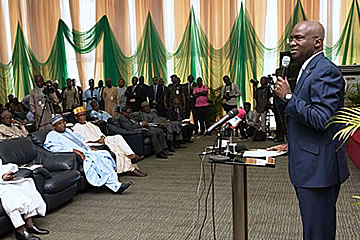
Fashola Charged Stakeholders To Complement Government’s Effort In Housing Delivery The Minister of Power, Works and Housing, Babatunde Raji Fashola, SAN, has charged stakeholders in the housing sector to focus more on how to solve the problem of housing deficits in the country rather than magnify the problem. He said inspite of the housing challenges; Nigeria will over time come out if consistent right policies are put in place. Fashola stated this at the opening ceremony of the 11th Abuja International Housing Show with the theme, Solving Nigeria’s Housing Challenges through Innovative Finance and Infrastructure Solution. The Minister noted that financing is not only the problem in the housing industry but also the issue of affordability and acceptability, adding that it is important to build to the satisfaction of the off - takers. He said that the Ministry is currently building in 33 States of the federation to respond to the climatic and cultural demands of the people under the National Housing Programme, adding that this will be used as a pilot to interface with the private sector. While commending the vision and tenacity of Fesadeb Communication Ltd, the organiser, the Minister said that it is important to have a housing economy, an economy that delivers on a value chain that will impact on people’s economic lives like the artisans, mason, plumbers, welders and food vendors. Earlier in his address, the Chairman of the All Progressive Congress (APC) and Chairman of the Abuja International Housing Show, Chief John Odigie-Oyegun, noted that the choice of the theme for this year’s event is not only apt but appropriate. Oyegun stated that the Buhari administration promised to provide decent and affordable housing to Nigerians through the establishment of the National Housing Programme with a target of raising enough finance to build 1 million housing estates annually within the next decades. He said that the APC-led government is also committed to bridge the gap of housing deficits by providing affordable housing for low income earners who are the most marginalised due to access to finance. He added that a new housing social project has been included in the economic recovery plan recently launched by the federal government with the objective to reduce the housing deficits and stimulate economic growth of the country. The Abuja International Housing Show over the years has proved to be a veritable platform that brings stakeholders’ in the built industry together to chat a way forward in solving housing problem in Nigeria. ...
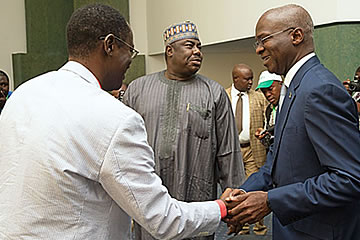
Fashola Advocates A Housing Economy For Rebuilding Economy, Country * Minister commends private sector participants in the Housing Sector at the 11th Abuja International Housing Show in the FCT * Says FG is now building models that respond to nation’s cultural and climatic diversities in 33 states “as a pilot to then interface with the Private Sector” * We remain committed and we will deliver and improve what we met , he declares The 11th Abuja International Housing Show kicked off in the Federal Capital Territory Monday with the Minister of Power, Works and Housing, Mr. Babatunde Fashola SAN, advocating a Housing Economy as a viable means of rebuilding the nation and its economy. In a keynote address at the International Conference Centre venue of the three-day event, Fashola, who explained the concept of Housing Economy to mean “an economy that delivers on a continuous basis at every spectrum of the value chain”, starting from the construction sites. He said such continuous construction would impact mostly on the lives of artisans, labourers, builders and others at the construction sites, whom he described as “the most vulnerable members of the society”. Stressing that the society has a duty to support such people, the Minister pointed out that the construction site has provided a major source of income for, not only construction workers such as plumbers, welders, bricklayers, retailers, but also suppliers of building materials and food vendors, adding, “It is the place where we can impact most on peoples’ lives”. “Those are the most vulnerable members of our society that we must continue to support”, he said adding that the kind of response that could be received from creating a sustainable housing construction through building on a continuous basis would be “almost unbelievable”. Recalling his inspection of Housing sites in Taraba, Gombe, Ekiti, Oyo and other states across the country earlier in the year, Fashola declared, “the story I can tell you is that plumbers, welders, bricklayers, food vendors, all say, ‘Thank Buhari for us because we are back to work’. And that is the story; that is where it starts”. Particularly recalling his visit to the Oyo State site where he met a couple working at the site with the husband as a mason and bricklayer while the wife sold food to workers, the Minister, who noted that the couple relocated from Lagos to the site on learning of the project, added, “Let us just continue to build because the opportunities that it provides for rebuilding the economy and for rebuilding our country are simply prolific”. On plans to include members of the informal sector in the Housing programme, Fashola said his Ministry was currently working on how to expand and register cooperatives and assist people to key into the programme adding that work in that regard has almost been concluded. The Minister said the plan had become necessary because within the financing sector it had become important to ensure that those who have legitimate assets and income but were not in the formal recorded form could still be assisted to participate in home ownership. Using the level 07 or 08 Civil Servant, who earns N50,000, as example, the Minister said although the amount may not be enough, he may have other assets like a farm or his wife’s business that they could put together adding that the plan was to expand the frontiers of how to determine what was affordable and the kind of income that could come into the programme. “What we are currently working on now is how to expand and register cooperatives and assist people; because we have seen that the formal sector has its own structured organization where they contribute money, they help each other to build it. How can we use that to help them to build for themselves? We are almost completing work in that regard”, he said. Fashola, who acknowledged that there is a challenge in the nation’s Housing sector, however, said the way to solve it was not to look at the size but to focus on how to solve it urging that the size of the problem should not dampen the enthusiasm to seek for solutions. Debunking the estimated size of the nation’s housing deficit as not based on any audit or accurate census, the Minister, who stated that life without problems was unimaginable, added, “I always say that it is because there are problems that opportunities also arise, whether in public or the private sector”. “I think the most important thing I want to say here is that the size of the problem should not dampen our enthusiasm to find solutions. Let us focus more on what we can contribute, what we can do rather than how big the problem is”, he said adding, “I will say this in the context of every time I hear 17 million Housing deficit; who did the census; who did the audit?” The Minister recalled that barely 15 years ago Nigerians needed to get international direct dialling to be able to call somebody outside the country adding that although it was a big problem, the country just focussed on how to find a solution and, indeed, found a solution with many Nigerians now owning phones. According to him, although not everybody in Nigeria today has a telephone, “But inch by inch, step by step, village by village, community by community we are connecting”, adding, “That must be the same attitude here”. Still emphasizing the need to focus on solutions, Fashola, who recalled the time in the country when the only television station available was the Nigerian Television Authority, stated that Nigerians now have more channels than they could watch, adding that Nigerians must adopt the attitude that having overcome many problems in the past, the housing problem could be overcome. The Minister commended Nigerians for their innovativeness pointing out that the banner, depicting the many brands of exhibitors at the Housing Show was a demonstration that Nigerians were not idle. He declared, “Look at all of those brands, it means that Nigerians are doing something. So we are not idle, we are not inactive and step by step we will get to our destination”. On the theme of the Show, “Solving Nigeria’s Housing Challenges Through Innovative Finance and Infrastructure Solutions”, Fashola, who said the financing problem would remain for as long as humanity, explained that the growth of global population was not proportionate with the increase in availability of funds. The Minister explained further, “The public Housing programme in the United Kingdom started since 1918. Next year it will be 100 years old. And, you know what, not everybody in the UK owns a house. There are people who still sleep on the streets. They have only managed to achieve about 65 per cent home ownership”. “And it varies depending on the economy because even home owners also lose their homes. They have reduced rental and increased ownership; but from 1918 till now, not everybody owns a home and that is just about 65million or 70million people”, he said. Also, according to the Minister, Singapore, with barely five million people, started her Housing programme in 1962 and has achieved a home ownership of 80 per cent of their population after about 60 years while in Hong Kong, one of the biggest financial centres in the world, people live in cages; in flats cut into pieces “because the average cost of a house is 19 times higher than the average wage”. “And this is the context in which I said the issue of financing will remain for a long time. But within that we can improve the quality of our lives if we focus on what we can do, if we focus on major progress, if we understand that housing delivery is a long time commitment”, he said. Expressing the commitment of the Federal Government to deliver on its promises of affordable housing for Nigerians, Fashola declared, “We remain committed and we will deliver and improve what we met”, adding that in discussing financing it should also be understood that there are many other problems such as issues of affordability and issues of acceptability. The Minister declared, “We have empty houses in many states of the Federation. Why are they not occupied? Can people afford them? Where they can afford them, do they like the way they are built?” adding that these were the problems that must be addressed in order to build for the choice and demand of the off taker. Fashola commended his team in the Ministry for the work they have done in the last one year during which, according to him, “they have designed a National Housing model that responds to the cultural and climatic diversities of Nigeria”, adding that the Ministry was now building in 33 states of the Federation “as a pilot to then interface with the Private Sector”. Also present at the Opening Ceremony of the Housing Show which is featuring hundreds of exhibitors and stakeholders in the Housing Sector, include, the Minister of State in the Ministry of Power, Works and Housing, Hon. Mustapha Baba Shehuri, Chairman of the All Progressives Congress (APC), Chief John Odigie Oyegun, who was Chairman of the Opening Ceremony, Minister of Labour and Productivity, Dr. Chris Ngige, Legislators, Governors, Traditional Rulers and other stakeholders in both Public and Private Sectors. ...
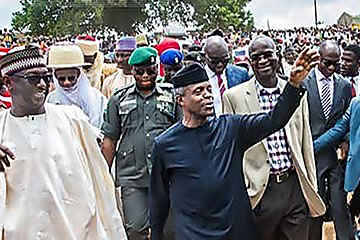
Osinbajo Visits Site of Collapsed Bridge on Ilorin-Mokwa-Jebba Road *Inspects Ongoing Repair Works & Assures Motorists, Residents Of FG’s Commitment To Address Their Plight The flow of vehicular traffic on the Ilorin-Mokwa-Jebba road would be normalized within two weeks according to Acting President Yemi Osinbajo, SAN. Already the Federal Government has commenced work to make the road passable pending the commencement of work on re-construction of the collapsed Bakino bridge at Tatabu community near Mokwa in Niger State. Prof. Osinbajo who visited the site for an on-the-spot assessment earlier today gave the assurance having received assurances from top government officials including Power, Works & Housing Minister, Mr. Babatunde Fashola and the contractors on site. Specifically the Ag. President received briefs from relevant officials on site including the site engineers and supervisors from the Federal Ministry of Works. He also embarked on a tour of the collapsed bridge. Prof. Osinbajo then told newsmen at the site that government was fully committed to ending the difficulties on the Ilorin-Mokwa-Jebba road by addressing the remote causes of the deterioration on the road. According to the Acting President, ``the Minister of Works is working on a lasting solution but in the interim we have assurances from the contractors and engineers working here that this road will be made passable in about a fortnight.’’ He assured that construction work on building a new bridge would commence but that it would take some time for it to be completed due to the slow movement of material from Ilorin to the site. According to him, ``The contractors have informed me that movement of material to this location would be difficult and slow because of the deplorable nature of the road but with the commitment and support of the Federal Road Safety Corps and other agencies, the job would be done in good time.’’ He added the Federal Ministry of Power, Works and Housing in collaboration with the Ministry of Transport were both working on a more lasting solution that will reduce the over -dependence on the highway especially by diverting the movement of heavy duty cargo from the roads to the railways. While speaking to youths who had gathered at the site of the collapsed bridge, Prof. Osinbajo conveyed the greetings of President Muhammadu Buhari to the community and urged for patience while government's efforts are in top gear to fix both the collapsed bridge and the road. The Acting President was companies on the visit by Mr. Fashola, the Minister of Power, Works and Housing; the Governor of Niger State, Abubakar Bello, the Estu Nupe, HRH, Dr Yahaya Abubakar and other senior government officials. ...
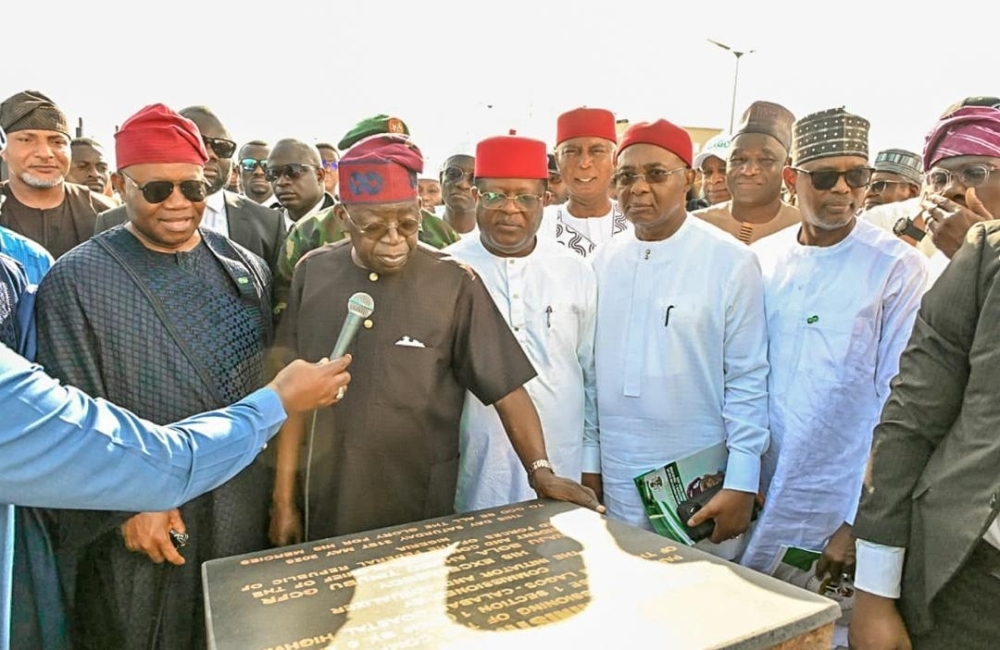
DRIVING NIGERIA’S FUTURE: CELEBRATING TWO YEARS OF TRANSFORMATIVE LEADERSHIP AND THE LAGOS-CALABAR COASTAL HIGHWAY MILESTONE
DRIVING NIGERIA’S FUTURE: CELEBRATING TWO YEARS OF TRANSFORMATIVE LEADERSHIP AND THE LAGOS-CALABAR COASTAL HIGHWAY MILESTONE
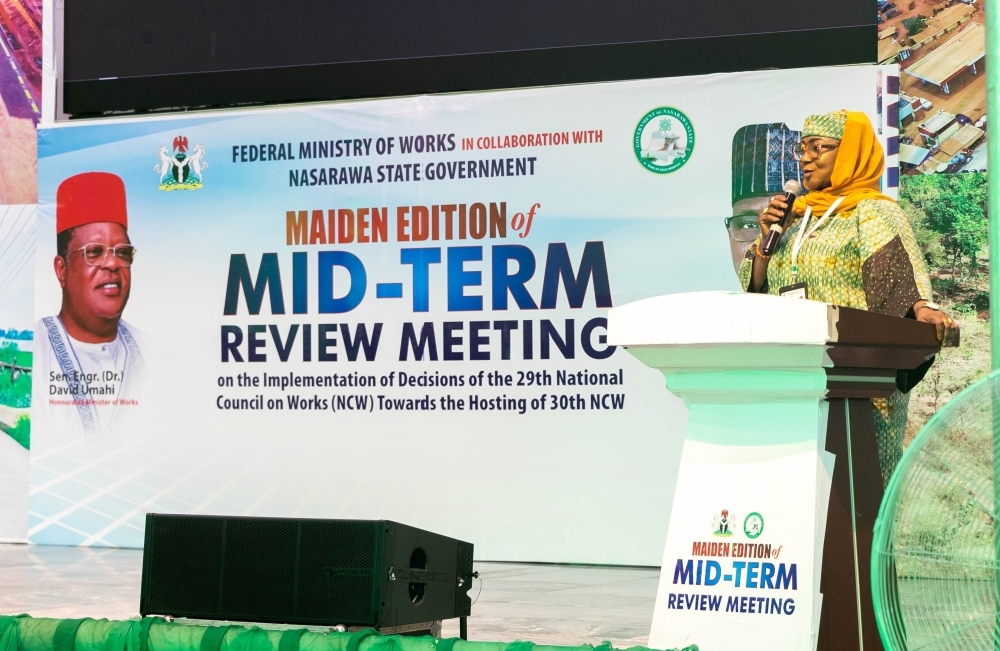
MID -TERM REVIEW MEETING ON THE IMPLIMENTATION OF THE DECISIONS REACHED AT THE 29TH NATIONAL COUNCIL ON WORKS (NCW) DAY 1
MID -TERM REVIEW MEETING ON THE IMPLIMENTATION OF THE DECISIONS REACHED AT THE 29TH NATIONAL COUNCIL ON WORKS (NCW) DAY 1