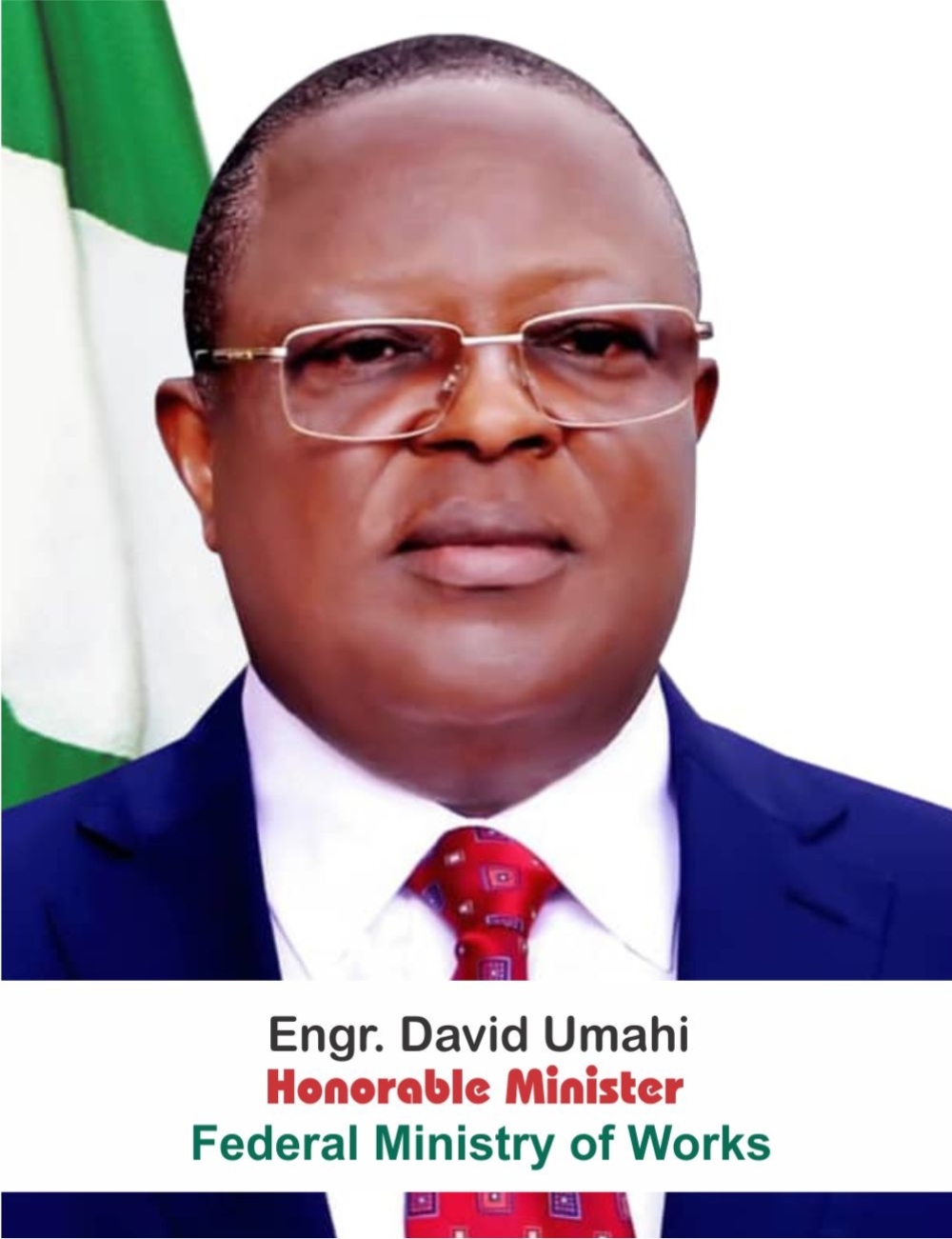
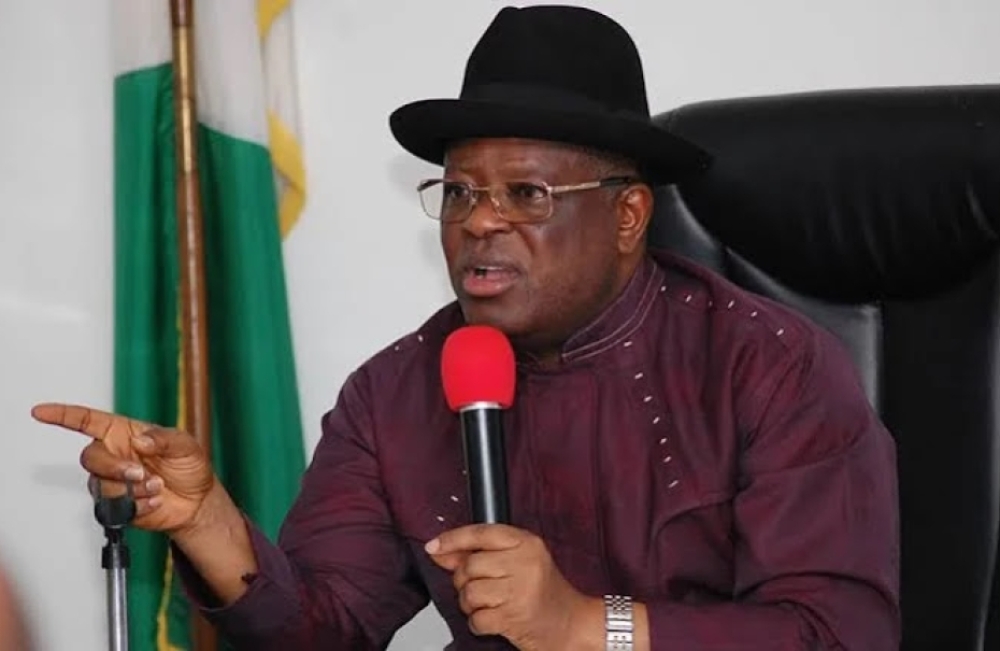
UMAHI ORDERS IMMEDIATE EMERGENCY INTERVENTION ON BENIN-ASABA ROAD, AND SOME OTHER CRITICAL FEDERAL ROADS
The Honourable Minister of Works, Senator Engr. David Nweze Umahi, CON, has directed the immediate deployment of major contractors to all three sections of the Benin-Asaba Federal Road to restore the failed sections and bring an end to the suffering of motorists and other road users.
This is because, the situation on the concessioned Benin-Asaba Road has reached a point where the overall public interest must take precedence over the existing concession agreement.
Recall that the Honourable Minister of Works was on the Benin-Asaba Road about seven days ago, where he assembled a number of contractors and directed them to prepare for immediate palliative intervention on the affected sections of the road at no cost to the concessionaire. In line with the Concession agreement which requires that before the Federal Government could intervene, the permission of the concessionaire must be required, and that permission was not granted to federal government.
The Minister subsequently proposed three options to the concessionaire, any one of which would have enabled the Federal Government to move in and address the worsening condition of the road. Unfortunately, none of the options was accepted by the concessionaire. Immediately after the Minister left Asaba, the already limited equipment deployed to the road by the concessionaire was further reduced to just one, worsening the situation and increasing the suffering of motorists and other road users.
While the Minister takes responsibility for the concerns and suffering of Nigerians using the road, it is important to state that the concessionaire has also not taken the suffering of Edo people and travelling public sufficiently into consideration by declining all the options put forward by the Federal Government. The concessionaire continues to rely on the terms of the concession agreement entered into by the previous administration, an agreement which weighs heavily against the Federal Government’s ability to intervene quickly in the interest of the public in a situation like this.
In view of this situation, the Honourable Minister of Works has directed the immediate deployment of major contractors within the corridor to all three sections of the Benin-Asaba Road to restore the failed sections and bring relief to the people, with the cost of the emergency intervention being borne by the Federal Government. The Honourable Minister has also directed immediate redesign of the entire route to be rebuilt with reinforced concrete pavement. The public should therefore take note that immediate action is underway to restore every failed section of the Benin-Asaba Road and subsequently rehabilitate the entire sections of the road using reinforced concrete pavement.
2. On the Benin-Sapele Road:
The Governors of Edo and Delta States, the Niger Delta Development Commission (NDDC), and the Federal Government are currently engaged in interventions on different sections of the road to restore the entire route. While some sections are receiving palliative attention, permanent works are also ongoing on other sections.
3. On Ifaki(Ekiti) - Kabba (Kogi) Road:
The Federal Government is engaging both the contractor; Gamji Nigeria Company Limited, and Dangote PLC on immediate emergency and permanent intervention on the most failed sections of the road, while efforts are being made to financially mobilise the company for more extensive permanent work to commence on the axis.
4. On the Sokoto-Zamfara-Katsina Road: This is an inherited project involving the dualisation of approximately 350 kilometres, which translates to about 700 kilometers. The project has since been redesigned and is currently ongoing and most sections are being reconstructed using reinforced concrete pavement. From the Sokoto axis towards Zamfara, over 50 kilometres of one carriageway have been fully completed with reinforced concrete pavement. From Zamfara to Katsina, some sections have been completed and palliative works have been ordered over the sections that have not been reconstructed. However, the pace of work slowed down due to the redesign and rephasing of the project. The contractors currently engaged on the road include CBC, SETRACO, Triacta and Mothercat. They are being remobilised to return to site and complete the outstanding works.
5. On the Abuja-Kaduna-Zaria-Kano Road: The Federal Government took over the Road project and has currently completed the 118-kilometer mostly on reinforced concrete pavement on lot 1. The Lot 2, which covers 164 kilometres, is over 60 percent completed on reinforced concrete pavement. The Federal Government has also introduced solar-powered light on the entire route of Abuja-Kaduna-Zaria - Kano to improve visibility during night travel and enhance the overall security situation on the route. The entire project is scheduled for completion by December 2026.
6. On Bauchi-Jigawa Road: Triacta Nigeria Limited has been mobilised to carry out the necessary interventions on some failed sections and work is currently ongoing in those failed sections.
7. On the Sagamu-Ore Road: 48 Kilometers of the 96-kilometre road have already been completed using reinforced concrete pavement. There is also a 24-kilometre section around Ore which was abandoned by the previous contractor. The Federal Government has directed its immediate restoration to ensure seamless travel. Solar lights are being installed in the entire 96kilometer of the road.
8. On Flooded Sections on Sagamu-Ore-Benin Road: The flooded sections on the same corridor between Sagamu-Ore-Benin Road, as well as other flooded sections in Ondo State, are being designed for emergency procurement and intervention.
9. On the East-West Road:
Some failed and critical sections, including defective sections of bridges along the East-West Road, are being marked out for emergency procurement and intervention.
10. On the Abuja-Lokoja Road:
Several contracts are ongoing along the route, while the three critical sections currently without contracts are being procured for emergency intervention.
11. On the Lokoja-Benin-Warri Road: The President has directed a complete redesign and procurement of the 400-kilometre dualised route covering the uncompleted sections, using reinforced concrete pavement, while palliative works will continue with the contractors currently on the road.
12. On Carter Bridge:
While the Federal Government continues to undertake weekly maintenance of the underwater elements of the bridge. The site has also been handed over to the contractor, CCECC, for the construction of a permanent new bridge, and work has commenced.
13. On the Third Mainland Bridge:
With regard to the defective underwater structural elements, the Federal Government is at the final stage of determining the appropriate intervention for the repair of the affected elements.
14. On the flooded section of the Lagos-Ibadan Road: Work has commenced on the affected section. There are also several flooded sections on federal roads across the six geopolitical zones, largely occasioned by excessive flooding and the effects of climate change. The Federal Government is identifying and marking these sections for immediate attention.
15. On the First and Second Niger Bridges:
Intervention work is ongoing on the approach roads to the Second Niger Bridge damaged by flood and the work is progressing very well. The First Niger Bridge has been closed to traffic to enable immediate repair works. Contractor has mobilized to site and comprehensive rehabilitation of the bridge has started. From Summit Junction to the First Niger Bridge, massive rehabilitation work is also ongoing using reinforced concrete pavement.
16. The Honourable Minister wishes to commend the President of the Federal Republic of Nigeria, His Excellency Bola Ahmed Tinubu, GCFR, for the massive work being undertaken on the nation’s roads since the administration assumed office in 2023.
17. It is important to state that when the present administration came into office, there was hardly any part of the country where one could travel for an hour without encountering significant challenges on the road network. The condition of the country’s roads and bridges was a major national infrastructure challenge.
18. Rather than shy away from the problem, the administration of President Bola Ahmed Tinubu made the nation’s road network a priority. Virtually every part of the country became a priority, and the Federal Government, through the Federal Ministry of Works, Regional Commissions, Parastatals and other MDA’s has continued to respond extensively to these challenges.
19. The Federal Government is currently working on over 80 percent of the inherited federal roads, an unprecedented level of intervention in the country’s road infrastructure.
20. We ask the public to understand the enormous challenges inherited on our roads and bridges and to take note not only of the problems being solved, but also of the permanent solutions being introduced.
21. A major part of this new approach is the use of reinforced concrete pavement, designed to significantly extend the lifespan of major roads. These roads are expected to last between 50 and 100 years. This means that roads being constructed under President Bola Ahmed Tinubu’s administration are being designed with future generations in mind, rather than simply providing temporary solutions to today’s problems. And this is a complete departure from the past, when roads often deteriorated only a few years after completion, resulting in a continuous cycle of reconstruction and expenditure.
22. We appreciate the concerns of Nigerians over the condition of some roads presently and the difficulties faced by motorists and commuters who cannot move easily from one point to another. Those concerns are legitimate, and the Federal Government is listening. But Nigerians should also recognise the enormous scale of the problems inherited and the amount of work currently being undertaken across the country.
23. It is simply impossible to resolve every road challenge accumulated over many years of neglect by the past administrations within three years. What is important is that the government is working, the government is responding, and the government is putting permanent solutions in place.
25. We appreciate members of the public who send situation reports on failed roads and other infrastructure challenges. These reports help the Ministry identify areas requiring urgent attention. However, we also appeal to members of the public to report when such problems have been addressed, just as they report when they occur.
24. We are aware of situations where photographs and reports of road challenges continue to circulate on social media even after the Federal Government has intervened and resolved the particular problem.
25. However, the Ministry will continue to respond as rapidly as possible to genuine reports and concerns from Nigerians.
26. It is also important to note that we have compiled a comprehensive record of all inherited, ongoing and intervention projects across the country which is available to the public. This is to ensure that Nigerians have access to information on the infrastructure projects being undertaken nationwide and can fully participate in and appreciate the infrastructure revolution of President Bola Ahmed Tinubu’s administration.

UMAHI ORDERS IMMEDIATE EMERGENCY INTERVENTION ON BENIN-ASABA ROAD, AND SOME OTHER CRITICAL FEDERAL ROADS The Honourable Minister of Works, Senator Engr. David Nweze Umahi, CON, has directed the immediate deployment of major contractors to all three sections of the Benin-Asaba Federal Road to restore the failed sections and bring an end to the suffering of motorists and other road users. This is because, the situation on the concessioned Benin-Asaba Road has reached a point where the overall public interest must take precedence over the existing concession agreement. Recall that the Honourable Minister of Works was on the Benin-Asaba Road about seven days ago, where he assembled a number of contractors and directed them to prepare for immediate palliative intervention on the affected sections of the road at no cost to the concessionaire. In line with the Concession agreement which requires that before the Federal Government could intervene, the permission of the concessionaire must be required, and that permission was not granted to federal government. The Minister subsequently proposed three options to the concessionaire, any one of which would have enabled the Federal Government to move in and address the worsening condition of the road. Unfortunately, none of the options was accepted by the concessionaire. Immediately after the Minister left Asaba, the already limited equipment deployed to the road by the concessionaire was further reduced to just one, worsening the situation and increasing the suffering of motorists and other road users. While the Minister takes responsibility for the concerns and suffering of Nigerians using the road, it is important to state that the concessionaire has also not taken the suffering of Edo people and travelling public sufficiently into consideration by declining all the options put forward by the Federal Government. The concessionaire continues to rely on the terms of the concession agreement entered into by the previous administration, an agreement which weighs heavily against the Federal Government’s ability to intervene quickly in the interest of the public in a situation like this. In view of this situation, the Honourable Minister of Works has directed the immediate deployment of major contractors within the corridor to all three sections of the Benin-Asaba Road to restore the failed sections and bring relief to the people, with the cost of the emergency intervention being borne by the Federal Government. The Honourable Minister has also directed immediate redesign of the entire route to be rebuilt with reinforced concrete pavement. The public should therefore take note that immediate action is underway to restore every failed section of the Benin-Asaba Road and subsequently rehabilitate the entire sections of the road using reinforced concrete pavement. 2. On the Benin-Sapele Road: 3. On Ifaki(Ekiti) - Kabba (Kogi) Road: 4. On the Sokoto-Zamfara-Katsina Road: This is an inherited project involving the dualisation of approximately 350 kilometres, which translates to about 700 kilometers. The project has since been redesigned and is currently ongoing and most sections are being reconstructed using reinforced concrete pavement. From the Sokoto axis towards Zamfara, over 50 kilometres of one carriageway have been fully completed with reinforced concrete pavement. From Zamfara to Katsina, some sections have been completed and palliative works have been ordered over the sections that have not been reconstructed. However, the pace of work slowed down due to the redesign and rephasing of the project. The contractors currently engaged on the road include CBC, SETRACO, Triacta and Mothercat. They are being remobilised to return to site and complete the outstanding works. 5. On the Abuja-Kaduna-Zaria-Kano Road: The Federal Government took over the Road project and has currently completed the 118-kilometer mostly on reinforced concrete pavement on lot 1. The Lot 2, which covers 164 kilometres, is over 60 percent completed on reinforced concrete pavement. The Federal Government has also introduced solar-powered light on the entire route of Abuja-Kaduna-Zaria - Kano to improve visibility during night travel and enhance the overall security situation on the route. The entire project is scheduled for completion by December 2026. 6. On Bauchi-Jigawa Road: Triacta Nigeria Limited has been mobilised to carry out the necessary interventions on some failed sections and work is currently ongoing in those failed sections. 7. On the Sagamu-Ore Road: 48 Kilometers of the 96-kilometre road have already been completed using reinforced concrete pavement. There is also a 24-kilometre section around Ore which was abandoned by the previous contractor. The Federal Government has directed its immediate restoration to ensure seamless travel. Solar lights are being installed in the entire 96kilometer of the road. 8. On Flooded Sections on Sagamu-Ore-Benin Road: The flooded sections on the same corridor between Sagamu-Ore-Benin Road, as well as other flooded sections in Ondo State, are being designed for emergency procurement and intervention. 9. On the East-West Road: 10. On the Abuja-Lokoja Road: 11. On the Lokoja-Benin-Warri Road: The President has directed a complete redesign and procurement of the 400-kilometre dualised route covering the uncompleted sections, using reinforced concrete pavement, while palliative works will continue with the contractors currently on the road. 12. On Carter Bridge: 13. On the Third Mainland Bridge: 14. On the flooded section of the Lagos-Ibadan Road: Work has commenced on the affected section. There are also several flooded sections on federal roads across the six geopolitical zones, largely occasioned by excessive flooding and the effects of climate change. The Federal Government is identifying and marking these sections for immediate attention. 15. On the First and Second Niger Bridges: 16. The Honourable Minister wishes to commend the President of the Federal Republic of Nigeria, His Excellency Bola Ahmed Tinubu, GCFR, for the massive work being undertaken on the nation’s roads since the administration assumed office in 2023. 17. It is important to state that when the present administration came into office, there was hardly any part of the country where one could travel for an hour without encountering significant challenges on the road network. The condition of the country’s roads and bridges was a major national infrastructure challenge. 18. Rather than shy away from the problem, the administration of President Bola Ahmed Tinubu made the nation’s road network a priority. Virtually every part of the country became a priority, and the Federal Government, through the Federal Ministry of Works, Regional Commissions, Parastatals and other MDA’s has continued to respond extensively to these challenges. 19. The Federal Government is currently working on over 80 percent of the inherited federal roads, an unprecedented level of intervention in the country’s road infrastructure. 20. We ask the public to understand the enormous challenges inherited on our roads and bridges and to take note not only of the problems being solved, but also of the permanent solutions being introduced. 21. A major part of this new approach is the use of reinforced concrete pavement, designed to significantly extend the lifespan of major roads. These roads are expected to last between 50 and 100 years. This means that roads being constructed under President Bola Ahmed Tinubu’s administration are being designed with future generations in mind, rather than simply providing temporary solutions to today’s problems. And this is a complete departure from the past, when roads often deteriorated only a few years after completion, resulting in a continuous cycle of reconstruction and expenditure. 22. We appreciate the concerns of Nigerians over the condition of some roads presently and the difficulties faced by motorists and commuters who cannot move easily from one point to another. Those concerns are legitimate, and the Federal Government is listening. But Nigerians should also recognise the enormous scale of the problems inherited and the amount of work currently being undertaken across the country. 23. It is simply impossible to resolve every road challenge accumulated over many years of neglect by the past administrations within three years. What is important is that the government is working, the government is responding, and the government is putting permanent solutions in place. 25. We appreciate members of the public who send situation reports on failed roads and other infrastructure challenges. These reports help the Ministry identify areas requiring urgent attention. However, we also appeal to members of the public to report when such problems have been addressed, just as they report when they occur. 24. We are aware of situations where photographs and reports of road challenges continue to circulate on social media even after the Federal Government has intervened and resolved the particular problem.
The Governors of Edo and Delta States, the Niger Delta Development Commission (NDDC), and the Federal Government are currently engaged in interventions on different sections of the road to restore the entire route. While some sections are receiving palliative attention, permanent works are also ongoing on other sections.
The Federal Government is engaging both the contractor; Gamji Nigeria Company Limited, and Dangote PLC on immediate emergency and permanent intervention on the most failed sections of the road, while efforts are being made to financially mobilise the company for more extensive permanent work to commence on the axis.
Some failed and critical sections, including defective sections of bridges along the East-West Road, are being marked out for emergency procurement and intervention.
Several contracts are ongoing along the route, while the three critical sections currently without contracts are being procured for emergency intervention.
While the Federal Government continues to undertake weekly maintenance of the underwater elements of the bridge. The site has also been handed over to the contractor, CCECC, for the construction of a permanent new bridge, and work has commenced.
With regard to the defective underwater structural elements, the Federal Government is at the final stage of determining the appropriate intervention for the repair of the affected elements.
Intervention work is ongoing on the approach roads to the Second Niger Bridge damaged by flood and the work is progressing very well. The First Niger Bridge has been closed to traffic to enable immediate repair works. Contractor has mobilized to site and comprehensive rehabilitation of the bridge has started. From Summit Junction to the First Niger Bridge, massive rehabilitation work is also ongoing using reinforced concrete pavement.
25. However, the Ministry will continue to respond as rapidly as possible to genuine reports and concerns from Nigerians.
26. It is also important to note that we have compiled a comprehensive record of all inherited, ongoing and intervention projects across the country which is available to the public. This is to ensure that Nigerians have access to information on the infrastructure projects being undertaken nationwide and can fully participate in and appreciate the infrastructure revolution of President Bola Ahmed Tinubu’s administration.
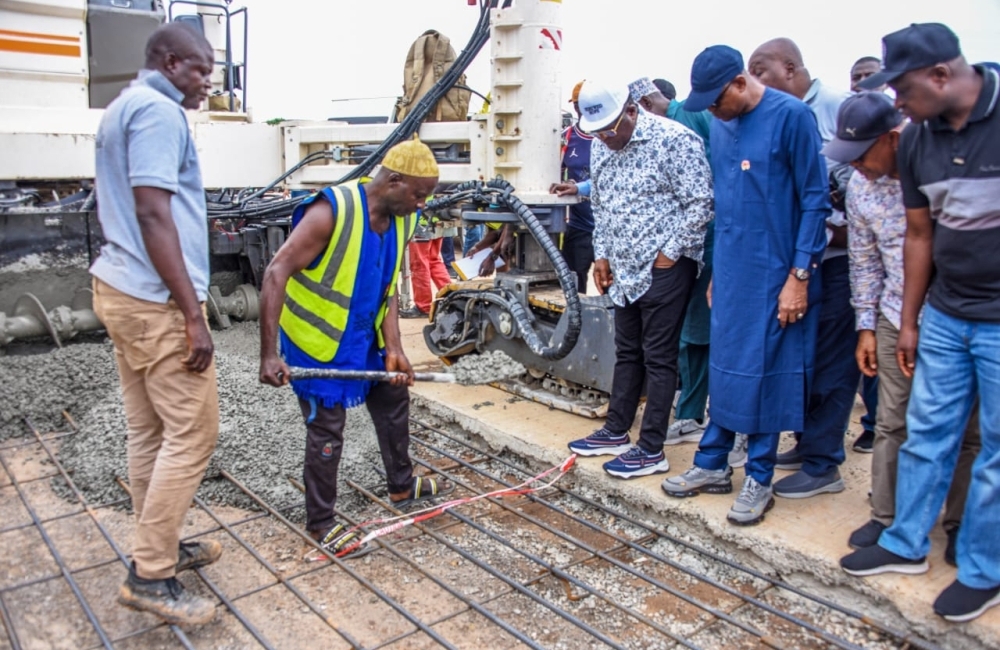
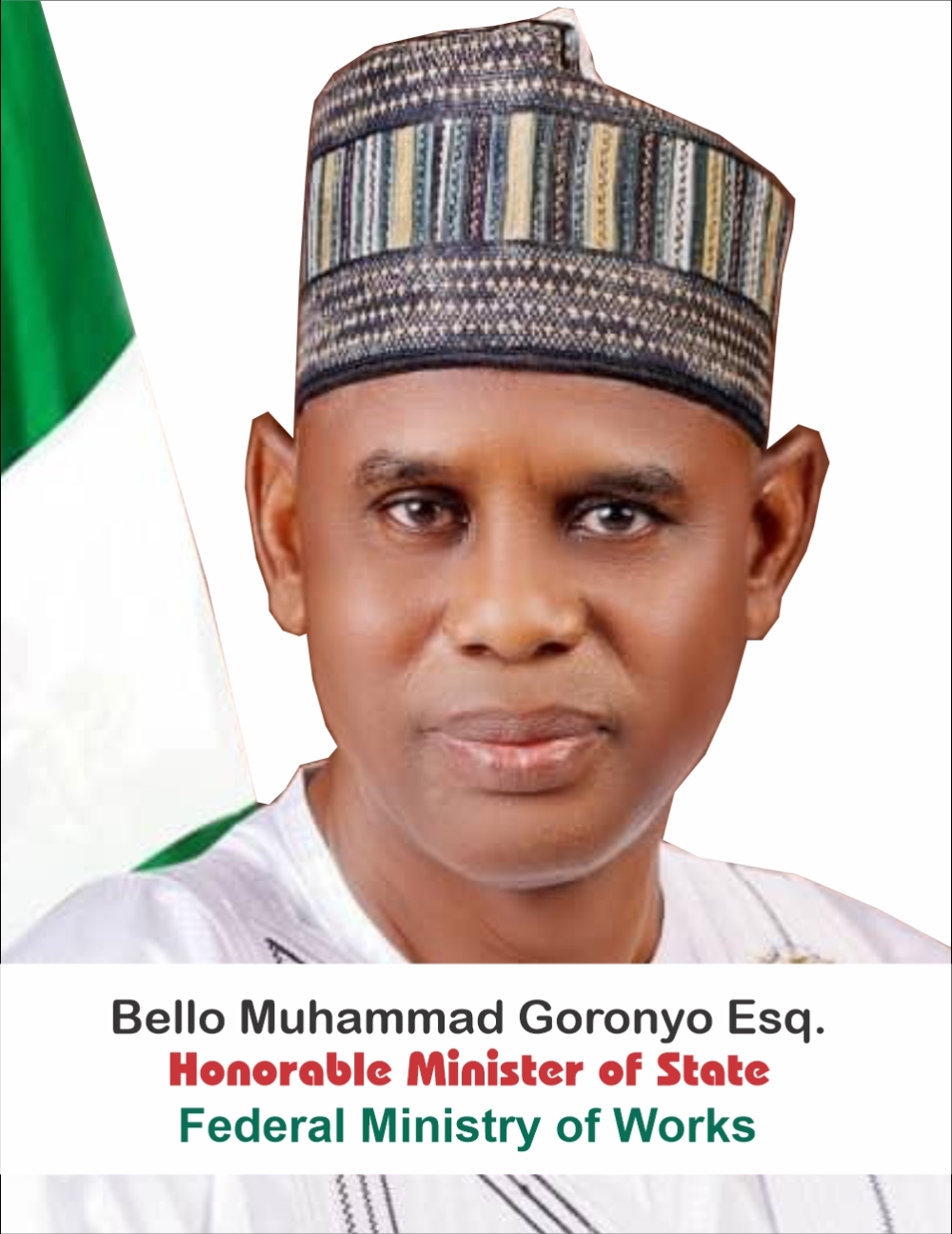
Umahi Inspects Sections One and Two of Abuja–Kaduna–Kano Road Project The Honourable Minister of Works, Senator David Umahi, CON, FNSE, FNATE, has carried out an inspection of Sections One and Two of the Abuja–Kaduna–Kano Road project, reaffirming the Federal Government’s commitment to delivering durable infrastructure to Nigerians. Speaking during the inspection today 20th September, 2025. He added that the quality of work so far is commendable. We thank President Bola Ahmed Tinubu for his unwavering support and commitment to this project. By God’s grace, we will ensure timely delivery for the benefit of Nigerians,” Senator Umahi stated. The Minister has reaffirmed the commitment of the administration of President Bola Ahmed Tinubu GCFR, to delivering durable road infrastructure that will stand the test of time. We are constructing roads that will last for 100 years — roads designed with modern engineering standards, durability, and sustainability in mind. These projects are for the future of our children and the prosperity of our nation,” the Minister said. The Honourable Minister of State for Works, Mohammed Bello Goronyo Esq, state that the Abuja–Kaduna–Kano Road is one of Nigeria’s most strategic transport corridors, linking major cities, facilitating trade, and enhancing the movement of people and goods across the North and beyond. The Federal Ministry of Works reiterates its resolve to deliver a world-class, durable road that will stand the test of time. Accompanying the Minister, the Director of Highways, Construction and Rehabilitation, Engr. Clement Ogbuagu, acknowledged that while good progress has been made on Section One, some delays persist, particularly in Section Two where only about 3% completion has been achieved against a 40% target. He emphasized the need for contractors to deploy more equipment to meet delivery timelines. Engineer Representing Works on the construction of Abuja-Kaduna- Highway, Engr. Chukwuma Kalu disclosed that Section One, which covers 40.5km (dual carriage on concrete pavement), has recorded significant progress. Of the total stretch, 22km have been completed on both sides, with work actively ongoing on other portions. He further noted that the 17.3km Kano section and the 6.63km dual carriage airport access road have both achieved major milestones, with the airport road already completed and awaiting commissioning. Clement Ezeorah AD Press For: Director, Press and Public Relations 20th September, 2025 ...
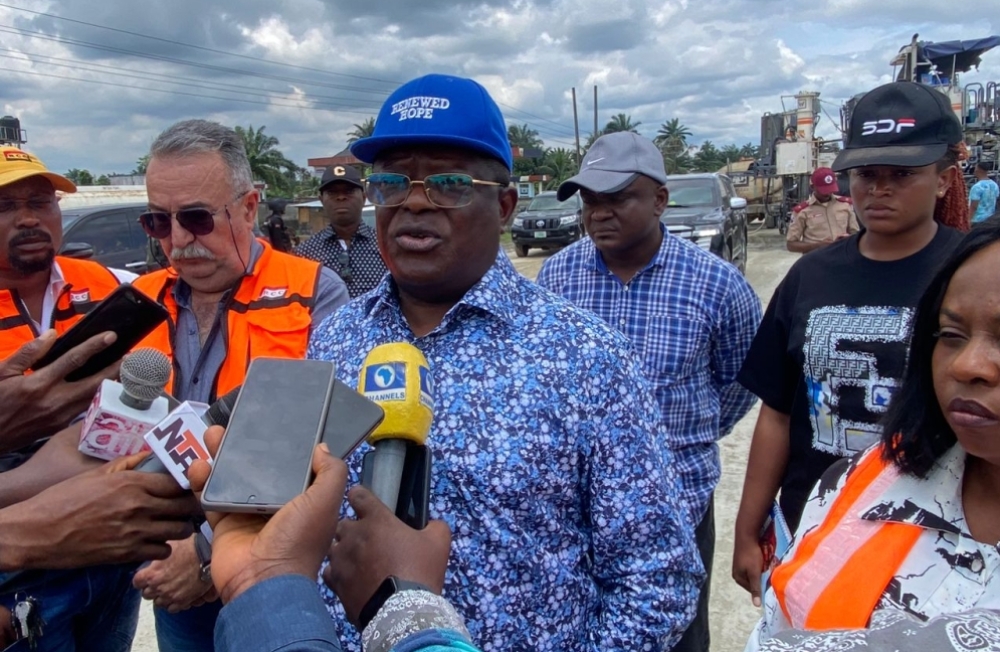
FEDERAL MINISTRY OF WORKS ADOPTS FUNDING PRIORITIZATION FRAMEWORK ON NNPCL INHERITED TAX CREDIT PROJECTS NATIONWIDE. -PROMOTES NIGERIA FIRST POLICY, SAYS CONTRACTS BELOW ₦20 BILLION TO BE DONE BY INDIGENOUS CONTRACTORS. As part of strategic plans towards sustainability in project funding and execution and in pursuance of the directive of the President of the Federal Republic of Nigeria, His Excellency, Bola Ahmed Tinubu, GCFR on strategic and systematic funding of inherited NNPCL funded projects, the Federal Ministry of Works has adopted funding prioritization framework to ensure the continued execution of road projects hitherto funded by Nigerian National Petroleum Company Ltd (NNPCL) under the Road Infrastructure Development and Refurbishment Investment Tax Credit Scheme. The Honourable Minister of Works, His Excellency, Sen. Engr. Nweze David Umahi, CON made this disclosure during his inspection visit to the ongoing dualization of the East-West Road (Section IIIA) from Eleme Junction, Port Harcourt to Onne Junction in Rivers State handled by Messrs RCC Nig Ltd dated 9th September 2025. Speaking during his visit, the Honourable Minister stated that the Federal Ministry of Works had compiled all the NNPCL inherited Tax Credit projects for strategic priority funding, noting that the most critical projects within the national economic corridor would receive precedence in the hierarchy of prioritization. “We are inspecting projects of federal government in Rivers State, and this particular one is the dualization of Eleme Junction to Onne Port Junction by RCC. Recall that one carriageway was completed and commissioned, even though there are a few things we ordered afresh like the retaining wall and hanging drainage. For the second carriageway with some bridges and flyovers, work has started on it. Let me say that this is part of the NNPC Tax Credit that has been stopped in terms of funding by NNPC. But graciously, we have compiled all the NNPC inherited Tax Credit projects, and we presented as Ministry of Works to Mr. President. And Mr. President has graciously directed that none of such works should stop now. However, as Ministry, we are going to do prioritization of the projects and look at the most critical of these projects within the national economic corridor like this one. And we are going to put it forward for immediate funding because the President directed that none of such projects should stop now.” He admonished contractors handling road projects under the Federal Ministry of Works to ensure speed, quality, compliance with specification and sustainability in project delivery and cautioned that the attention of the anti-graft agencies would be called to any case of violation of the regulations or terms and conditions set out under the contract of every project handled by the Federal Ministry of Works. He stated, “I have also noticed in some of the projects in Rivers State, and same with the Six Geo-Political zones, that contractors go ahead to put stone base and put binder course of asphalt, sometimes over 20 kilometres and leave the binder unprotected without putting wearing course. The binder is like a reinforcement to the road architecture. The wearing is the sealant that doesn't allow water to go beyond the surface. And so when you now put stone base, which has dust as designed, and you put binder, which is like a reinforcement, and you see that the composition of the binder asphalt has bigger stones, and it has holes, so the water penetrates. The moment it gets to the stone base, which has some dust, the road fails. It may technically look safe, but with time, it will definitely fail. And we've seen it in a number of roads we inspected. And what I've directed the Controller to do, and it's going to be nationwide, is that when you are putting binder and you have left it for more than two months, we are going to redo the certificate and remove all the binder and remove the stone base.” He directed that henceforth any project below the contract sum of ₦20 Billion would not be given to expatriate firms, and this he said is part of measures to promote the Nigeria First policy of Federal Government of Nigeria. He commended the construction company handling the Eleme - Onne project, Reynolds Construction Company (RCC) for the quality of work so far done and for working on the project despite the fact that NNPCL has stopped funding the project, but frowned at the slow pace of work which they said was affected by the rainy season. He restated that 15th December 2025 remains the agreed deadline for the project’s completion with no extension or Variation of Price (VoP) allowed. “On this project of Eleme Junction, the quality of the work is excellent. The pace of the work is totally not acceptable. And let me make it very, very clear to the contractor that this project can never be reviewed by a kobo. Neither can there be any variation of price or any other claims.” He expressed dismay over the destructive habit of packing heavy duty vehicles on the road by drivers and warned that forthwith punitive measures would be taken against such perpetrators. “Our roads are not designed to carry these heavy trailers that are parking on the road. And the press should help us on that. When I was coming yesterday all the way from Aba to here, I saw that the trailers are taking over the entire roads, putting their waste, destroying the pavements, and so on and so forth. So I'm going to write to our dear Governors to see what they could help us to do about it, and will also complain to the Inspector General of Police. Let us see what we can do about it. Mr. President is doing everything possible to right the wrongs in terms of road construction. We are doing quality roads now that are going to last from 50 to 100 years. But it's being destroyed by ourselves.” Earlier, the Federal Controller of Works in River State, Engr. Enwereama Tarilade (Mrs.) said the contractor handling Eleme- Onne road had completed the 15km Eket bound on the right carriageway and had moved to the left carriageway which is Port Harcourt bound for which 1km stretch had already been done on Continuously Reinforced Concrete Pavement (CRCP). Projects visited by the Honourable Minister include, the rehabilitation of Enugu – Port Harcourt, Abia/Rivers State, contract No: 6252 being handled by China Civil Engineering Construction Company Limited (CCECC), the upgrading of the 15km section of the East-West Road (Section 111A) from Port Harcourt (Eleme Junction) to Onne junction in Rivers State, contract No: 701 being handled by Messrs. RCC Nig. Ltd and multiple sections of the Enugu-Port Harcourt Expressway, including the sections handled by Arab Contractors and China Civil Engineering Construction Company Limited (CCECC). Hon. Barr. Orji Uchenna Orji Special Adviser (Media) to the Honourable Minister of Works Works ...
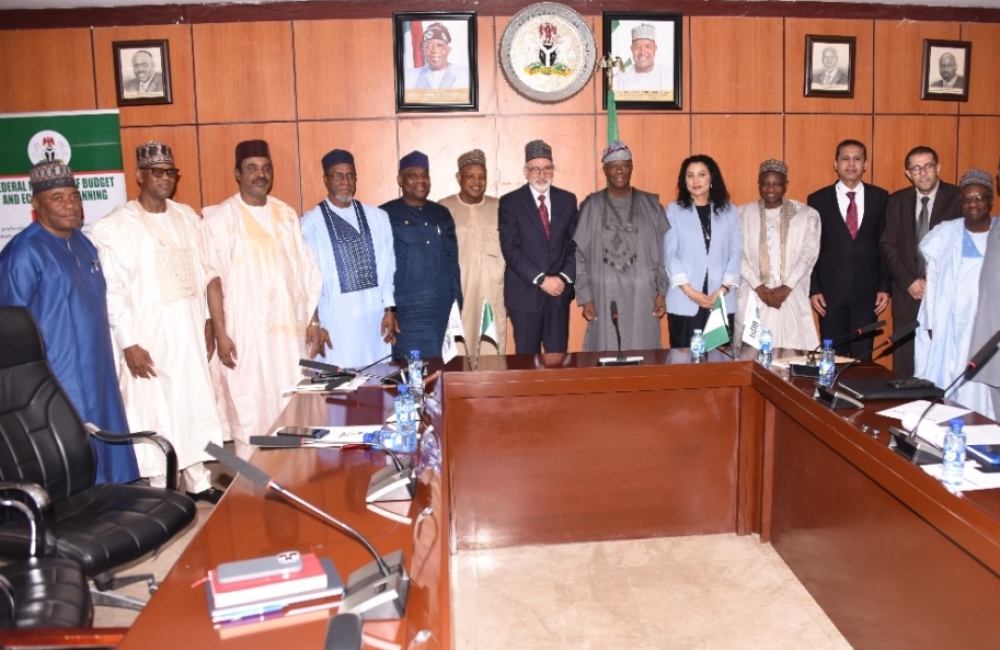
NIGERIA MOVES TO UNLOCK TRANSFORMATIVE INFRASTRUCTURE AND GROWTH WITH GLOBAL PARTNERS The Federal Government of Nigeria has reaffirmed its commitment to strengthening collaboration with the Islamic Development Bank (IsDB) to deliver transformative development projects across priority sectors, particularly infrastructure. This came during a high-level meeting with the Vice President of the Bank, relevant stakeholders, held in Abuja and hosted by the Honourable Minister of Finance and Coordinating Minister of the Economy, Mr. Wale Edun at the Ministry’s conference room, today, 1st september, 2025. In his remarks, The Honourable Minister of Finance, Wale Edun welcomed the IsDB delegation, describing the Bank as a steadfast ally in Nigeria’s development journey since 2005.“Your visit marks a significant moment in our shared journey of partnership, progress, and purpose. Despite fiscal constraints, Nigeria has continued to honor its obligations, and we deeply value the Bank’s flexibility in aligning with our realities,” he said. The Minister noted the success of IsDB interventions across education, healthcare, infrastructure, agriculture, and innovation, stressing that these projects are “lifelines for communities, engines of growth, and symbols of hope.” He underscored the alignment between Nigeria’s bold economic reforms under President Bola Ahmed Tinubu and the IsDB’s 2026–2035 Strategic Framework. The Honourable Minister of Works, Engr. David Umahi, CON, FNSE, who was represented by the Minister of State for Works, Mohammed Bello Goronyo, Esq, emphasized the administration’s prioritization of road infrastructure under the Renewed Hope Agenda. He highlighted the Ilela–Lagos–Sokoto–Badagry economic corridor, describing it as a strategic lifeline that connects Nigeria to the Niger Republic and other African countries: “This corridor is a vital economic artery that will boost trade, create jobs, and lift communities out of poverty. President Tinubu’s commitment to this project reflects his determination to drive Nigeria’s economic transformation,” he stated. The Honourable Minister of State also confirmed that construction works have commenced on the Sokoto and Kebbi sections, with Hitech Construction achieving clearance and 25 kilometers of work on the Kebbi axis. Other projects cited included the Lagos–Calabar Coastal Highway, Calabar–Nasarawa–FCT corridor, and the Abuja–Kaduna–Kano Expressway, all of which require additional financing to accelerate delivery. Responding to issues raised in terms of road infrastructure, the Operations Vice President of the Islamic Development Bank, Dr. Rami M. S. Ahmad, reaffirmed the Bank’s commitment to Nigeria’s infrastructure agenda. He stated that Infrastructure is a core pillar of our strategy, and we work from each country’s own priorities. For the road projects raised today, we will not allow delays to persist; where they can be re-scoped, we will act; where not, we will close them and move forward with new initiatives. The Ilela–Lagos–Sokoto–Badagry corridor and other key projects align with our mandate, and through the Country Engagement Framework, we are ready to accelerate their delivery,” he assured. In closing, the Honourable Minister of Finance expressed his profound gratitude to the IsDB team for their assurances and reiterated that Nigeria’s ownership and alignment of priorities under the Country’s Engagement Framework. He said, “It is our bank, our sovereignty, our projects, our priorities. Today, my colleagues from Education, Environment, Transportation, Works, Water Resources and Sanitation, and my team from the Ministry of Finance, have given a comprehensive insight into our key priorities and legacy projects. The time has come to move beyond frameworks and concept notes to implementation, beginning with the signing of the Abia State Integrated Infrastructure Development Project,” he affirmed. The Honourable Minister of State for Finance, Dr. Doris Nkiruka Uzoka-Anite, in her closing remarks, expressed her appreciation for the depth of engagement achieved during the meeting . “This dialogue has enhanced the strength of our partnership and the vast potential that lies ahead. From infrastructure and human capital to Islamic finance and the Nigerian economy, the opportunities for collaboration are both strategic and urgent. As custodians of Nigeria’s public finance, we are committed to deploying every naira transparently, efficiently, and in line with our national priorities,” she stated. Clement Ezeora For: Director Press and Public Relations. 2nd September, 2025. ...
FG COMMITTED TO BRIDGING INFRASTRUCTURE GAP IN TERTIARY INSTITUTIONS - FASHOLA
The Honourable Minister of Works and Housing, Babatunde Raji Fashola, SAN has restated Federal Government’s commitment to bridging the road infrastructure challenges in tertiary institutions across the country.
The Minister who spoke in Enugu at the official commissioning and handover ceremony of the 1.0 kilometre road project constructed at the Federal College of Dental Technology and Therapy Enugu State by his Ministry said the gap of the nation's infrastructure needs is steadily being bridged by a gradual process of rehabilitations and constructions and it has reached the tertiary institutions.
Fashola, who was represented at the occasion by the Federal Controller of Works in Enugu State, Engr. Olufemi Oyekanmi explained that the intervention by the Federal Government was to boost quality of education and renewed hope and enthusiasm with regards to attending classes as defective roads have been been restored to motorability.
"It's undebatable that the quality of education will be impacted by the quality of infrastructure and the learning environment and those who doubt it should simply listen to some feedbacks from the students of the schools where this type of intervention have taken place" the Minister said.
He disclosed that under the Tertiary Institutions road Intervention Programme initiated by his Ministry, the Federal Government is currently working on 76 roads projects in selected Federal Tertiary Institutions across the nation.
" We have successfully intervened in the internal Road networks of 46 Tertiary Federal Institutions and handed over 29 as at 2021and we now have another 17 ready to be handed over while we are currently attending to 30 roads in similar institutions across the country, making a total of 76", Fashola said.
The Minister described the construction of the internal roads by the Federal Government in the federal tertiary institutions as a pointer to President Muhammadu Buhari's administration's progressive ideal of improving the human condition by supporting education.
In his response, the Rector Federal College of Dental Technology and Therapy, Dr. John Emaimo thanked the Honourable Minister and Federal Ministry of Works and Housing for selecting the college to benefit from this laudable Government Intervention in bringing infrastructural development gap saying that it is a dream fulfilled bearing in mind the deplorable state of the roads before the intervention.
According to Dr Emaimo, infrastructure is critical to the progress of stakeholders it can attract.
He added that with this kind gesture from the Ministry, the institution wears a new look making it conducive for both teaching and learning.
The Rector appreciated the Honourable Minister yet for another project currently being executed by the Ministry which he said is the provision of street lights to illuminate the campus during night hours.
Emaimo however, requested for the Ministry's intervention in the construction of two more roads in the school premises which are in a deplorable condition.
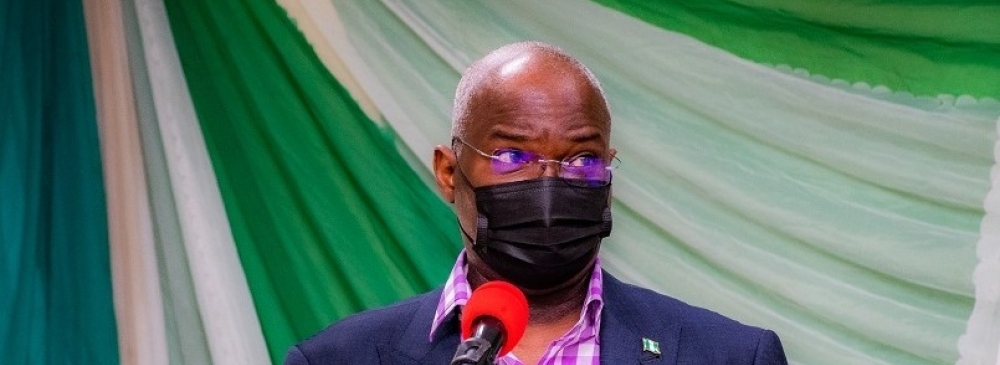
KEYNOTE SPEECH BY H.E BABATUNDE RAJI FASHOLA, SAN AT LAGOS BUSINESS SCHOOL EVENING WITH THE MINISTERS SERIES HELD ON SEPTEMBER 29, 2021
Distinguished Ladies and Gentlemen:
The compelling part of the LBS’ invitation letter to me dated August 31st 2021 signed by Dr. Franklin N. Ngwu is the part which talks about:
“…the need for more public/private sector dialogue and collaboration for Nigeria’s inclusive and sustainable economic growth and development.”
It is about those 3 (three) things: inclusiveness, sustainable growth and development that I wish to focus my intervention today.
But before I do so, let me push back against the part of the letter that says that:
“Some key constraints such as limited trust, lack of information on the opportunities available, impact of policies and business and operational frameworks of engagement limit their collaboration.”
The first question I wish to ask is “limited trust” on whose part?
My appeal to those who have a one-sided view of the public sector is to stand back and take a hard look at the antecedents of many of those who now occupy leadership positions in the public sector.
What you will see is that many of them, including me, spent a sizable part of their careers in the private sector.
Have we become unworthy of trust because we chose to serve?
And speaking of information or lack thereof about opportunities and policies, I recall that it was to this business school that we came for the launch of the Highway Development and Management Initiative (HDMI) to share information and opportunities regarding the planned concession of 12 highways spanning over 1,000 km of federal road network, and the opportunity for investment growth and job creation.
It is the largest highway concession ever undertaken on the African continent with the potential to create 5,000 direct jobs and 200,000 indirect jobs if successful.
We did not go to a foreign business school to launch the initiative; and there are many we could have gone to, if we so desired. We came to the Lagos Business School, because we wanted a homegrown success.
By way of updates, even though LBS has not come back to ask for one, I can report that out of 75 applicants, 18 have been prequalified, and will soon be requested to submit requests for proposals, environmental and social impact studies are concurrently being undertaken and the national tolling policy has been approved to guide the development of business plans.
Of course, as far as providing information about development and growth goes, many of us regularly brief the public about projects, I go on many project inspection tours to highlight what is going on.
Every quarter, the National Bureau of Statistics (NBS) releases reports about the growth situations in the economy.
What I have observed of course is that the negative results are readily acceptable and pleasing to some people, while they question the data when the same Bureau announces positive quarterly economic performances.
I will now return to the 3 (THREE) issues of:
a) inclusiveness;
b) sustainable growth and
c) development
But first, I must set the context.
Between the period 2012 to 2015 Nigeria‘s economy was reportedly growing at between 5% to 7%. But if we all take time to go back to the reviews and reports in the media at the time, the overwhelming response was that it was “jobless growth or “non-inclusive growth.”
This was the story then and it is not a new story. The other context before we proceed is to remind ourselves that at the peak of that growth, sometime in 2014, the then Minister of Finance issued a statement that Nigeria was heading towards a recession.
These were her words:
“There are some difficult moments out there in the international economy and we have noticed a downward slide in oil prices in recent weeks. Nigeria may not be so lucky to avoid recession this time as it did during the last economic meltdown.”
The question to ask is a recession under who’s watch?
My response is that it did not matter who was managing the economy, the recession was inevitable. We had consumed all the prolific and extraordinary income we earned from high prices of crude oil sales.
We did not invest them in infrastructure, new hospitals, universities, rail, bridges, broadband rollout, airports etc.
So the logical issue would be, what is the plan to get out of the recession?
Before I proceed let me quickly deal in broad strokes with some of the things that happen during a recession.
One of them is that it is the “services sector” that first feels the pinch, and when growth returns the services sector is the last to recover and that is when the feel-good factor returns. I will come back to this.
So in deciding what to do when the recession beckons or happens, the first thing to look at is who is managing the economy and what views do they espouse, because this is likely to shape the choices they will make.
Regrettably, many have again fallen into the error of believing the one-sided story that there is no ideology in Nigerian politics or in the political parties.
Nothing could be further from the truth and any worthy scholar who goes through the various party manifestoes will find not only differences but also similarities and this is one thing I commend for further study and analysis by this business school.
Whilst I will do my best not to be overly partisan, I find it difficult to effectively discharge my task without linking policy to politics.
For example, my party professes a progressive ideology and what this simply means is a “commitment to improving the human condition” and this is one difference between us and the others.
Ask them what they profess?
The other difference is that in 6 (SIX) years we have ensured that the average Nigerian remembers what we committed to: anti-corruption; economic development and security. This is a major reason why we have been held accountable.
You have to go back to 1993, (28 years ago); or further back to 1978 (43years), to find a political era where the public remembers what the parties promised during the campaign.
In MKO Abiola’s SDP, the party manifesto hinged on Energy, Rural Development, Education and Defence. In UPN, Awolowo’s 4 (FOUR) cardinal points (Free Education, Free Health Services, Integrated rural development, Employment) were examples of political promises or ideology so clearly articulated and retained.
This is another difference between us and them, and I challenge many here to ask themselves if they can remember two or three things they were promised in the 16 years before us.
With this background I will now go back to the choices for getting out of recession; because we inherited the doomsday which was foretold.
As I have said earlier, in over five years when oil sold about $100 per barrel, we did not invest in infrastructure.
The 2015 Federal Government budget left by our predecessors for Nigeria’s road network was N18 billion, less than the 2015 budget for roads in Lagos State of N31 billion. (Office of Infrastructure budget)
The said budget had a 15% capital component and 85% of the recurrent component. A budget says a lot about what the Government wants to do. Consume 85% and invest 15%, at the time that oil prices were high.
This is another area of vast policy difference between us and them because from the first budget of 2016 we committed to a minimum of 30% capital investment in the annual budget and an expansive infrastructure investment to boost growth, facilitate development and create jobs.
With oil revenues averaging $43 per barrel in 2016, the works budget for roads was cast at N200 Billion naira, an increase of 1011%.
This pattern has continued to date, where we are spending even more on infrastructure with far less resources.
We must remember that with very high oil prices the total FGN budget in 2015 was N4.4 Trillion while the first budget passed under this administration was N6.06 Trillion.
The Economic Recovery and Growth Plan (ERGP) 2017 - 2020 which was developed as the pathway to recovery from recession was underpinned by infrastructure investment as it committed to:
a) Achieving a stable microeconomic environment;
b) Creating a globally competitive economy and
c) Investing in the Nigerian people.
Apart from over 13,000 km of roads and bridges now under construction or rehabilitation nationwide, hitherto very difficult projects, like Bodo-Bonny Bridge, Lagos-Ibadan Expressway, Abuja-Kano Expressway and Second Niger Bridge now underway and heading towards completion before 2023, a generation of Nigerians can now travel by rail in their own country from Lagos to Ibadan and Abuja to Kano for the first time after a very long hiatus.
This did not happen in 16 years before us.
You may not like how we look or what we say, you may even disbelieve what we say but you cannot disbelieve what we have done with limited income on infrastructure.
This is another difference between us and them.
There is yet another difference and it relates to how we the progressives have chosen to deploy resources.
Between 1999 and 2015 all the infrastructure we are talking about today were crying out for attention.
In spite of prolific oil resources in between that period, I ask anyone to show one bridge, major highway, airport or a rail project that our country built.
I will remind you that in 2005 we choose to pay $12.09 billion to negotiate a Paris debt forgiveness when there was infrastructure crying out for attention.
However, by 2015 the debt stock we inherited was $10.3 Billion in spite of prolific oil resources.
That was a policy choice. No debt, no infrastructure while population grows.
On the contrary, with limited resources and commitment to expansionary fiscal investment and infrastructure to improve the living conditions of Nigeria, our budgets have been deficit budgets funded by debts to invest in infrastructure.
It is our belief that instead of increasing the tax burden of Nigerians, if we borrow to build infrastructure, small businesses who need broadband, rail, roads, bridges and other infrastructure will improve their efficiency and create opportunities.
This can only lead to the inclusiveness, sustainable Growth and development that my invitation letter speaks about.
The Economic Recovery and Growth Plan that we developed to address the recession that our predecessors predicted has worked.
By the second quarter of 2017 we were out of the recession that started in Quarter 2 of 2016 and we recorded 12 consecutive quarters of growth until COVID-19 struck.
By staying true to our core beliefs and by developing the Economic Sustainability Plan to deal with the COVID-19 impact, we came out of a second recession which was global and we now have a 5.1 GDP growth in Quarter 2 with services sector growing at 2.8%.
Remember I told you that the services sector is the last sector to recover after recession and this result is therefore clear evidence that the economy is on the mend and we must sustain it and expand it. In this regard I urge cautious optimism.
If you still think we are the same, let me share with you two different quotes from two sides of the divide to disabuse your minds.
The first is by the Vice-Presidential candidate of the main opposition party during the last elections in 2019.
This is what he said on August 8th 2021 about how to grow the economy.
“You cannot use infrastructure to drive economic growth…taking people out of poverty is not magic.”
But contrast President Buhari’s views expressed in Owerri on 9th September 2021 when he said:
“If we fix infrastructure, people will get on with their businesses.”
I am persuaded that President Buhari gets it.
His contemporary in the USA (a country held out as the example to follow) also gets it when he said:
“The American Jobs Plan will generate historic job growth, historic economic growth, help businesses to compete internationally, create more revenue as well. They are among the highest-value investments we can make in the nation — investing in our infrastructure.”
What limits or enhances the capacity of business is the infrastructure in the environment they operate.
The better the infrastructure the more efficient business becomes and the more productive and prosperous they will be.
If they can move goods and services in quicker time, through ports, rail and road, if they can transact financial services through reliable broadband, move fuel through new pipelines like the Ajaokuta-Kaduna pipeline project, if they can traverse about 40 kilometres on the Bodo-Bonny Bridge on land rather on canoes through the creeks, businesses will prosper and the economy will grow.
This in part is what the enablement of this private sector by the public sector means; in addition to fiscal and monetary policy.
This is a clear road to sustainable growth; and it is growth that will need more people to manage it thereby achieving inclusiveness.
Thank you for listening.
Babatunde Raji Fashola, SAN
Honourable Minister of Works and Housing
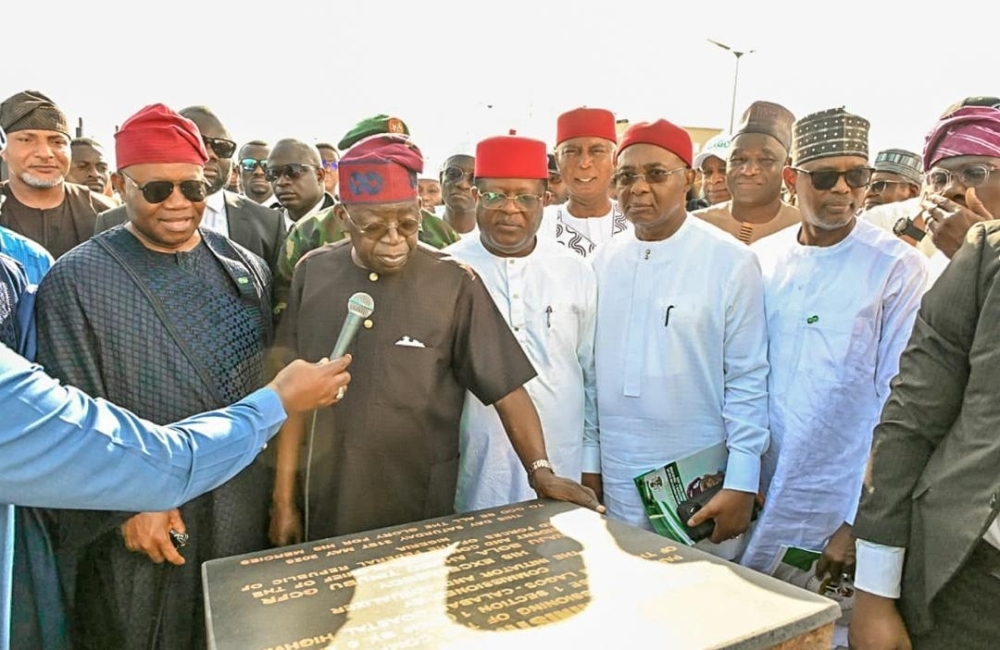
DRIVING NIGERIA’S FUTURE: CELEBRATING TWO YEARS OF TRANSFORMATIVE LEADERSHIP AND THE LAGOS-CALABAR COASTAL HIGHWAY MILESTONE
DRIVING NIGERIA’S FUTURE: CELEBRATING TWO YEARS OF TRANSFORMATIVE LEADERSHIP AND THE LAGOS-CALABAR COASTAL HIGHWAY MILESTONE
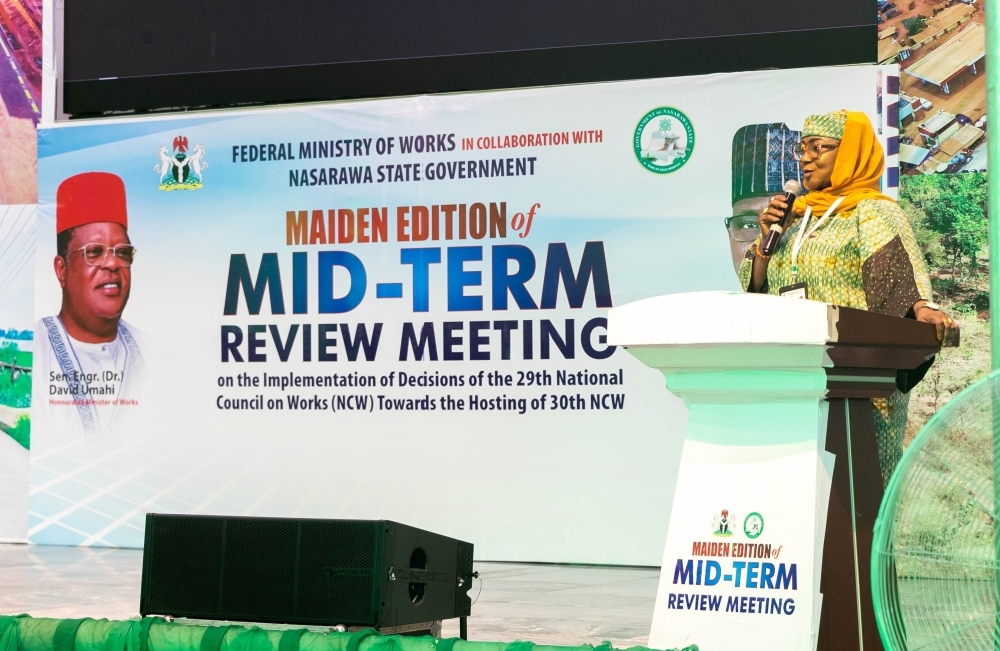
MID -TERM REVIEW MEETING ON THE IMPLIMENTATION OF THE DECISIONS REACHED AT THE 29TH NATIONAL COUNCIL ON WORKS (NCW) DAY 1
MID -TERM REVIEW MEETING ON THE IMPLIMENTATION OF THE DECISIONS REACHED AT THE 29TH NATIONAL COUNCIL ON WORKS (NCW) DAY 1