GORONYO COMMENDS SOKOTO GOVERNOR FOR DONATING 10 HILUX VEHICLES TO STRENGTHEN SECURITY ALONG SOKOTO–BADAGRY SUPERHIGHWAY
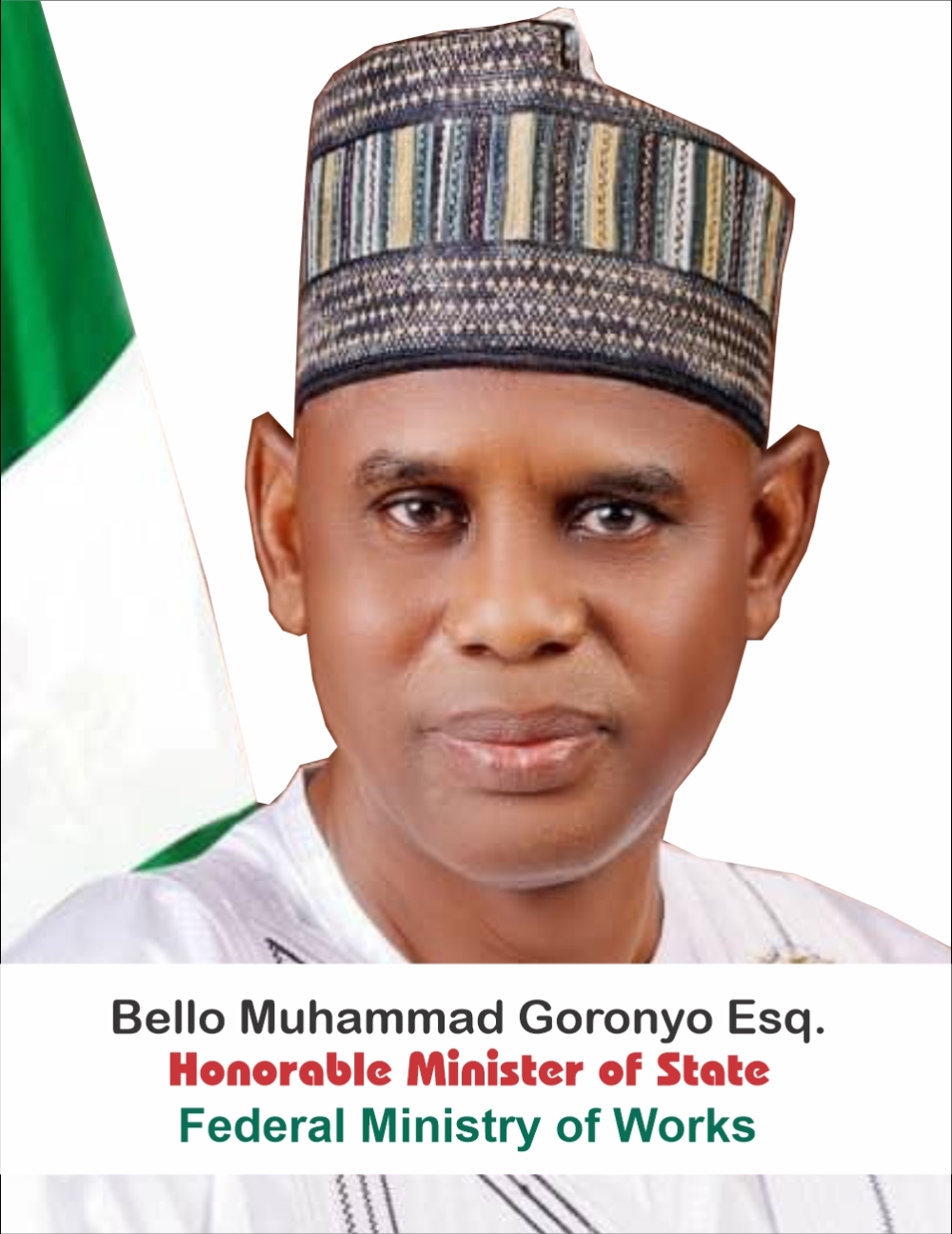
The Honourable Minister of State for Works, Rt. Hon. Bello Muhammad Goronyo, Esq., has commended the Governor of Sokoto State, Dr. Ahmed Aliyu Sokoto, PhD, for donating 10 operational Toyota Hilux vehicles to strengthen security operations along the Sokoto–Badagry Superhighway and other strategic infrastructure corridors.
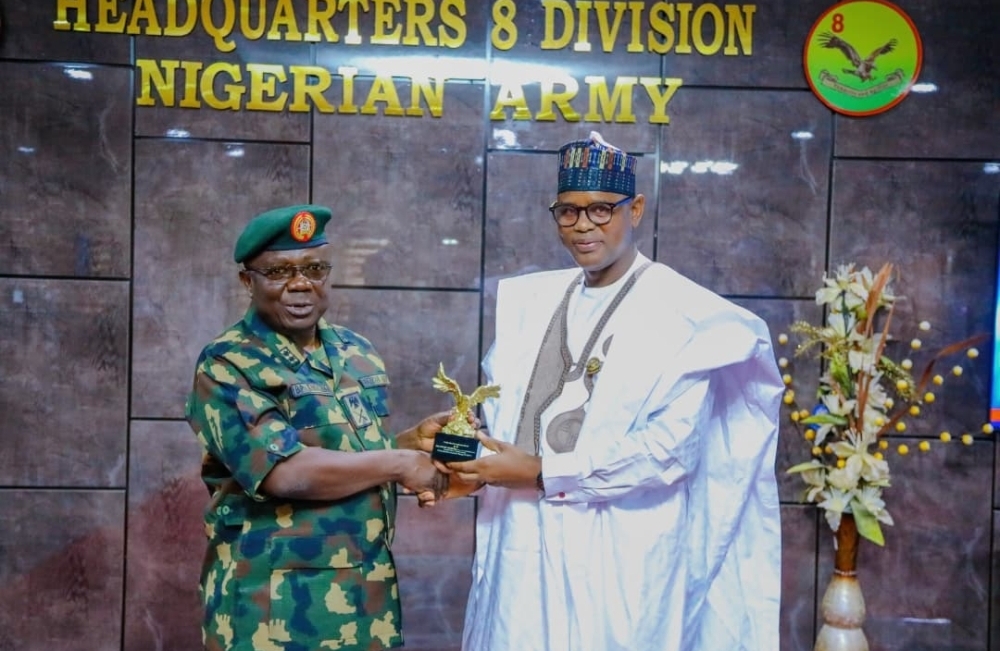
The vehicles were formally commissioned and handed over to the Nigerian Army at the Headquarters of the 8 Division, Nigerian Army, Sokoto, on Thursday, October 8, 2026, by the Honourable Minister of State for Works, on behalf of the Honourable Minister of Works, Engr. David Nweze Umahi, CON, FNSE.
The donation is expected to enhance the operational capacity of military personnel and other security agencies responsible for protecting construction workers, contractors, equipment and host communities along the highway corridor.
Speaking during the ceremony, Goronyo described the donation as a demonstration of the Sokoto State Government’s commitment to national development and the successful implementation of President Bola Ahmed Tinubu, GCFR’s Renewed Hope Agenda, particularly its landmark infrastructure projects.
The Minister emphasised that the Sokoto–Badagry Superhighway represents a long-standing national infrastructure vision that dates back several decades, with its conception traced to the era of former President Shehu Shagari in the 1970s. However, the vision remained unrealised for decades until the administration of President Bola Ahmed Tinubu, GCFR, initiated the construction of the 1,068-kilometre highway in October 2024.
He described the project as a significant step towards translating a historic aspiration into tangible infrastructure that will connect communities, expand economic opportunities and strengthen national integration.
According to Goronyo, President Tinubu’s commitment to the project demonstrates the Federal Government’s determination to bridge critical infrastructure gaps and improve connectivity between northern and southern Nigeria.
He noted that the superhighway, which traverses Sokoto, Kebbi, Niger, Kwara, Oyo, Ogun and Lagos states, is designed to facilitate the movement of people and goods, reduce transportation costs, stimulate trade, create employment and open up new economic opportunities along its route.
The Minister added that the highway would improve access to markets, schools, healthcare facilities and other essential services while supporting agriculture, commerce, industry and the development of communities across the corridor.
He stressed that the successful delivery of the project would require sustained commitment, effective coordination and cooperation among the Federal Government, state governments, security agencies, contractors and host communities.
Goronyo maintained that effective security remained essential to the timely and successful completion of the Sokoto–Badagry Superhighway. He explained that the provision of operational vehicles would strengthen the mobility and response capabilities of security personnel deployed to safeguard the project and its surrounding communities.
The Minister highlighted other strategic infrastructure projects being undertaken by the Federal Government, including the Lagos–Calabar Coastal Highway, the Calabar–Abuja/Trans-Saharan corridor, the Akwanga–Jos–Bauchi–Gombe corridor, the Abuja–Kaduna–Zaria–Kano route and the Zaria–Gusau–Sokoto corridor.
He explained that these projects form part of the Federal Government’s broader commitment to developing an integrated road network capable of supporting commerce, strengthening inter-state connections and accelerating national economic growth.
Rt. Hon. Goronyo further noted that the use of continuously reinforced concrete pavement on the Sokoto–Badagry Superhighway was intended to provide durable road infrastructure capable of serving Nigerians for decades. He added that complementary environmental and safety measures, including tree planting and solar-powered street lighting where provided for in the project, would contribute to environmental sustainability, visibility and road safety.
Goronyo commended the Nigerian Army and other security agencies for their resilience, professionalism and sacrifices in protecting lives, property and critical national infrastructure. He acknowledged the difficult conditions under which security personnel operate and urged them to remain steadfast in carrying out their constitutional responsibilities.
The Honourable Minister also expressed deep condolences to the Nigerian military over the reported loss of personnel in a bandit attack while on official duty the previous day. He described the loss as painful and extended his sympathy to the affected personnel, their colleagues and bereaved families, while praying for the peaceful repose of the departed and strength for their loved ones.
He further acknowledged the support of the National Security Adviser in addressing security challenges associated with the project, particularly through assistance and coordination aimed at strengthening security operations along the highway corridor.
Reaffirming his commitment to the Federal Government’s infrastructure development agenda, Goronyo said the Ministry of Works would continue to support the implementation of strategic projects under President Tinubu’s leadership, working in collaboration with relevant stakeholders to ensure their successful delivery.
He expressed optimism that the continued implementation of the Federal Government’s development programmes would bring lasting benefits to Nigerians, while acknowledging the complementary role of the Sokoto State Government in supporting infrastructure development and security.
In his remarks, the General Officer Commanding (GOC), 8 Division, Nigerian Army, Sokoto, Major General Bengba Paul Koughna, expressed appreciation to the Federal Government, the Federal Ministry of Works and the Sokoto State Government for the donation of the 10 Hilux vehicles.
The GOC noted that the vehicles would significantly enhance the operational mobility and response capabilities of troops deployed along the highway corridor, particularly across the approximately 440-kilometre section extending through Sokoto and Kebbi states.
He explained that troops conduct regular patrols and maintain multiple deployment points along the corridor, making the additional vehicles a valuable boost to their operational effectiveness.
He assured the Minister that the vehicles would be deployed appropriately to support security operations and protect construction workers, contractors, equipment and other stakeholders involved in the project.
The GOC also commended the representative of Hitech Construction Company, retired General Sa'ad Abubakar, for the company's involvement in the project.
The event was attended by retired Assistant Inspector-General of Police (AIG) Aliyu Garba, officials of the Federal Ministry of Works, representatives of the Sokoto State Government and other stakeholders.
The donation underscores the importance of sustained collaboration among the Federal Government, state governments, security agencies, contractors and host communities in addressing security challenges and ensuring the safe and timely delivery of strategic infrastructure projects.
The Federal Ministry of Works reiterates its commitment to working with all relevant stakeholders to protect national infrastructure and advance the objectives of President Bola Ahmed Tinubu, GCFR’s Renewed Hope Agenda for sustainable economic growth and development.

GORONYO COMMENDS SOKOTO GOVERNOR FOR DONATING 10 HILUX VEHICLES TO STRENGTHEN SECURITY ALONG SOKOTO–BADAGRY SUPERHIGHWAY The Honourable Minister of State for Works, Rt. Hon. Bello Muhammad Goronyo, Esq., has commended the Governor of Sokoto State, Dr. Ahmed Aliyu Sokoto, PhD, for donating 10 operational Toyota Hilux vehicles to strengthen security operations along the Sokoto–Badagry Superhighway and other strategic infrastructure corridors. The vehicles were formally commissioned and handed over to the Nigerian Army at the Headquarters of the 8 Division, Nigerian Army, Sokoto, on Thursday, October 8, 2026, by the Honourable Minister of State for Works, on behalf of the Honourable Minister of Works, Engr. David Nweze Umahi, CON, FNSE. Speaking during the ceremony, Goronyo described the donation as a demonstration of the Sokoto State Government’s commitment to national development and the successful implementation of President Bola Ahmed Tinubu, GCFR’s Renewed Hope Agenda, particularly its landmark infrastructure projects. The Minister emphasised that the Sokoto–Badagry Superhighway represents a long-standing national infrastructure vision that dates back several decades, with its conception traced to the era of former President Shehu Shagari in the 1970s. However, the vision remained unrealised for decades until the administration of President Bola Ahmed Tinubu, GCFR, initiated the construction of the 1,068-kilometre highway in October 2024. He described the project as a significant step towards translating a historic aspiration into tangible infrastructure that will connect communities, expand economic opportunities and strengthen national integration. According to Goronyo, President Tinubu’s commitment to the project demonstrates the Federal Government’s determination to bridge critical infrastructure gaps and improve connectivity between northern and southern Nigeria. The Minister added that the highway would improve access to markets, schools, healthcare facilities and other essential services while supporting agriculture, commerce, industry and the development of communities across the corridor. Goronyo maintained that effective security remained essential to the timely and successful completion of the Sokoto–Badagry Superhighway. He explained that the provision of operational vehicles would strengthen the mobility and response capabilities of security personnel deployed to safeguard the project and its surrounding communities. The Minister highlighted other strategic infrastructure projects being undertaken by the Federal Government, including the Lagos–Calabar Coastal Highway, the Calabar–Abuja/Trans-Saharan corridor, the Akwanga–Jos–Bauchi–Gombe corridor, the Abuja–Kaduna–Zaria–Kano route and the Zaria–Gusau–Sokoto corridor. Rt. Hon. Goronyo further noted that the use of continuously reinforced concrete pavement on the Sokoto–Badagry Superhighway was intended to provide durable road infrastructure capable of serving Nigerians for decades. He added that complementary environmental and safety measures, including tree planting and solar-powered street lighting where provided for in the project, would contribute to environmental sustainability, visibility and road safety. Goronyo commended the Nigerian Army and other security agencies for their resilience, professionalism and sacrifices in protecting lives, property and critical national infrastructure. He acknowledged the difficult conditions under which security personnel operate and urged them to remain steadfast in carrying out their constitutional responsibilities. The Honourable Minister also expressed deep condolences to the Nigerian military over the reported loss of personnel in a bandit attack while on official duty the previous day. He described the loss as painful and extended his sympathy to the affected personnel, their colleagues and bereaved families, while praying for the peaceful repose of the departed and strength for their loved ones. He further acknowledged the support of the National Security Adviser in addressing security challenges associated with the project, particularly through assistance and coordination aimed at strengthening security operations along the highway corridor. Reaffirming his commitment to the Federal Government’s infrastructure development agenda, Goronyo said the Ministry of Works would continue to support the implementation of strategic projects under President Tinubu’s leadership, working in collaboration with relevant stakeholders to ensure their successful delivery. He expressed optimism that the continued implementation of the Federal Government’s development programmes would bring lasting benefits to Nigerians, while acknowledging the complementary role of the Sokoto State Government in supporting infrastructure development and security. In his remarks, the General Officer Commanding (GOC), 8 Division, Nigerian Army, Sokoto, Major General Bengba Paul Koughna, expressed appreciation to the Federal Government, the Federal Ministry of Works and the Sokoto State Government for the donation of the 10 Hilux vehicles. The GOC noted that the vehicles would significantly enhance the operational mobility and response capabilities of troops deployed along the highway corridor, particularly across the approximately 440-kilometre section extending through Sokoto and Kebbi states. He explained that troops conduct regular patrols and maintain multiple deployment points along the corridor, making the additional vehicles a valuable boost to their operational effectiveness. He assured the Minister that the vehicles would be deployed appropriately to support security operations and protect construction workers, contractors, equipment and other stakeholders involved in the project. The GOC also commended the representative of Hitech Construction Company, retired General Sa'ad Abubakar, for the company's involvement in the project. The event was attended by retired Assistant Inspector-General of Police (AIG) Aliyu Garba, officials of the Federal Ministry of Works, representatives of the Sokoto State Government and other stakeholders. The Federal Ministry of Works reiterates its commitment to working with all relevant stakeholders to protect national infrastructure and advance the objectives of President Bola Ahmed Tinubu, GCFR’s Renewed Hope Agenda for sustainable economic growth and development.
The donation is expected to enhance the operational capacity of military personnel and other security agencies responsible for protecting construction workers, contractors, equipment and host communities along the highway corridor.
He noted that the superhighway, which traverses Sokoto, Kebbi, Niger, Kwara, Oyo, Ogun and Lagos states, is designed to facilitate the movement of people and goods, reduce transportation costs, stimulate trade, create employment and open up new economic opportunities along its route.
He stressed that the successful delivery of the project would require sustained commitment, effective coordination and cooperation among the Federal Government, state governments, security agencies, contractors and host communities.
He explained that these projects form part of the Federal Government’s broader commitment to developing an integrated road network capable of supporting commerce, strengthening inter-state connections and accelerating national economic growth.
The donation underscores the importance of sustained collaboration among the Federal Government, state governments, security agencies, contractors and host communities in addressing security challenges and ensuring the safe and timely delivery of strategic infrastructure projects.
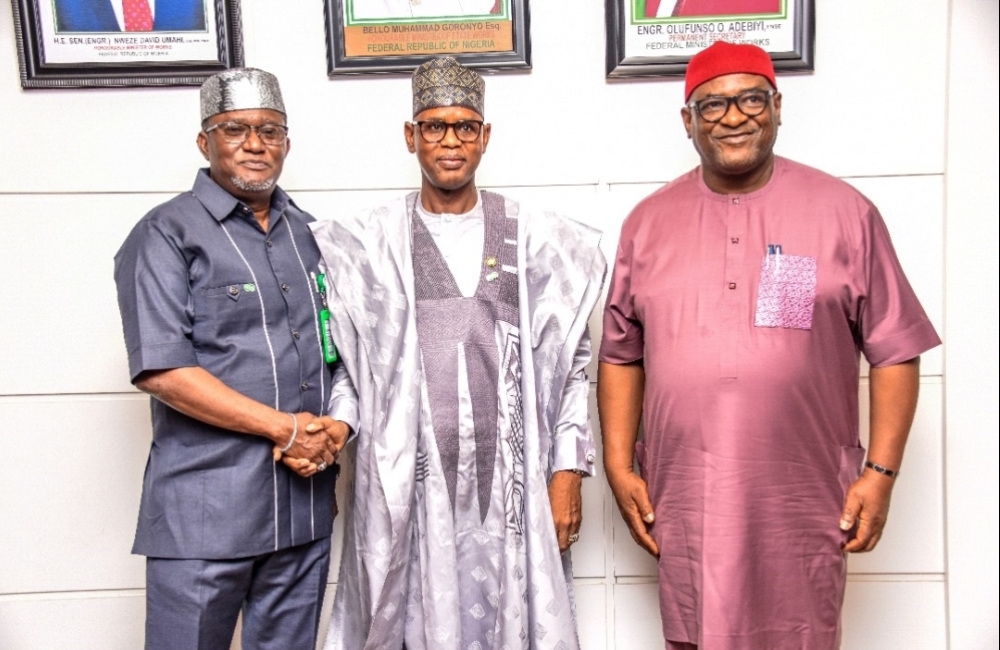
FG PRIORITISES EMERGENCY WORKS ON BENIN–SAPELE ROAD, REAFFIRMS SWIFT INTERVENTION ON FAILED OBAYANTOR STRATEGIC AXIS The Federal Ministry of Works has reiterated its commitment to urgent intervention on the severely deteriorated Benin–Sapele Road, particularly the section leading towards Obayantor in Edo State. This pledge follows a formal appeal by the Benin-Owena River Basin Development Authority (BORBDA), which highlighted the road’s deteriorating condition and its serious socio-economic impact. During a strategic meeting held at the Ministry’s headquarters in Abuja, the Honourable Minister of State for Works, Bello M. Goronyo, Esq., who represented the Honourable Minister of Works, Sen. (Engr.) David Umahi, CON, FNSE, FNATE expressed concern over the insecurity and economic paralysis stemming from the road’s poor condition. In his remarks, Goronyo stated: “I have listened with a heavy heart to your presentations. The kidnappings along that corridor, the economic losses, and the direct threat to food security are not palatable. This is not just about roads; it's about national stability and the well-being of our people. I assure you that the Ministry, under the leadership of Engr. Umahi is committed to acting swiftly and decisively.” The Managing Director of Benin-Owena River Basin Development Authority (BORBDA), Dr. Adekanmbi Samuel gave a detailed account of the challenges along the 24-kilometre stretch, emphasising the insecurity, economic dislocation, and impact on agriculture and power infrastructure. He stressed the importance of inter-agency collaboration in supporting President Bola Ahmed Tinubu’s emergency declaration on food security. Earlier, the Director of Highways, Bridges and Design, Engr. Bede Obioha, who stood in for the Permanent Secretary, acknowledged the urgency of the issues raised and commended the spirit of cooperation. “We welcome engagements like this as they help us identify critical gaps. This Ministry remains responsive and committed to resolving transport-related challenges, wherever they occur,” he affirmed, assuring that the concerns raised would be captured for prompt action. ...
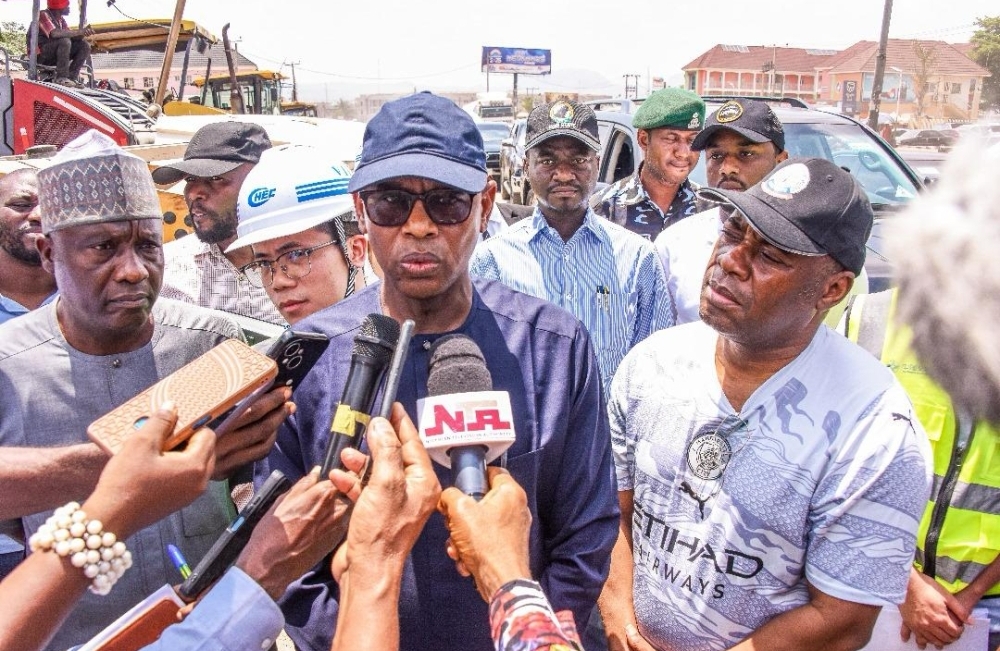
FG REAFFIRMS COMMITMENT TO TIMELY DELIVERY OF THE EXPANSION OF ABUJA (MARARRABA)-KEFFI ROAD PROJECT -ASSURES OF COMPLETION BY JUNE 2026 The Federal Government of Nigeria has reaffirmed its commitment to the timely completion of the Abuja (Mararraba)-Keffi Section of the Abuja-Keffi-Akwanga-Lafia-Makurdi Dual Carriageway. This was the outcome of the inspection conducted on the project site today, Saturday, 10th May 2025 by the Honourable Minister of State for Works (HMS), Bello Muhammad Goronyo, Esq., accompanied by the Permanent Secretary, Engr. Olufunsho O. Adebiyi and other officials. While fielding questions from the media, the Minister confirmed that the project constitutes Section I of the contract, which spans 43.65 kilometres on one side and totals 87.3 kilometres for both carriageways. According to him, this road corridor is a critical segment of the larger Abuja–Lafia-Makurdi-Enugu–Port Harcourt route designed to enhance mobility, reduce travel time, and stimulate economic activities across the FCT, Nasarawa, Benue, Enugu, Abia, Imo and Rivers States. Commenting after the inspection, Goronyo expressed satisfaction with the current pace of work, having achieved 42% completion. He remained optimistic that by the June 2026 dateline, the project would be completed, assuring Nigerians of the Federal Government’s commitment to delivering life-transforming infrastructure that will enhance economic growth, improve regional connectivity, and enhance the quality of life. “This is a commendable progress. Our goal is to ensure that the full stretch from Abuja to Port Harcourt is completed by June 2026. We appreciate President Bola Ahmed Tinubu, GCFR for prioritising this critical and life-changing infrastructure that would significantly enhance the national economy and facilitate the movement of goods and services,” the Minister disclosed. He also assured that funding will not hinder the project’s execution. “This is a priority project under a special funding arrangement. Once certified payment claims are submitted, the Ministry is ready to process and disburse funds without delay,” he further stated. Earlier, the Federal Controller of Works (FCW) for the FCT, Engr. Yakubu Usman provided a technical update on the project. It features a two-way six-lane structure with outer shoulders but lacks inner shoulders, which the reconstruction aims to improve for better traffic flow and safety. According to him, they have done the site clearing, and scarification, while the stone base and binder coarse are at 80% completion. “We are also advancing work on the median drains and rigid shoulders,” he said. Acknowledging challenges posed by high traffic and densely populated areas along the corridor, the Controller disclosed that they are partnering with the Federal Road Safety Corps (FRSC) and other law enforcement agencies to ensure a free flow of traffic while carrying out their job. He also informed the audience that the contractor has resorted to working only at night in critical areas to minimise disturbances to public activities during the daytime. The Project Manager, China Habour Engineering Company (Nig.) Ltd. (CHEC), Mr. Ronald Liao, expressed confidence that with the support from the Ministry and relevant stakeholders, the company will deliver the project in a record time, according to the project’s design. ...
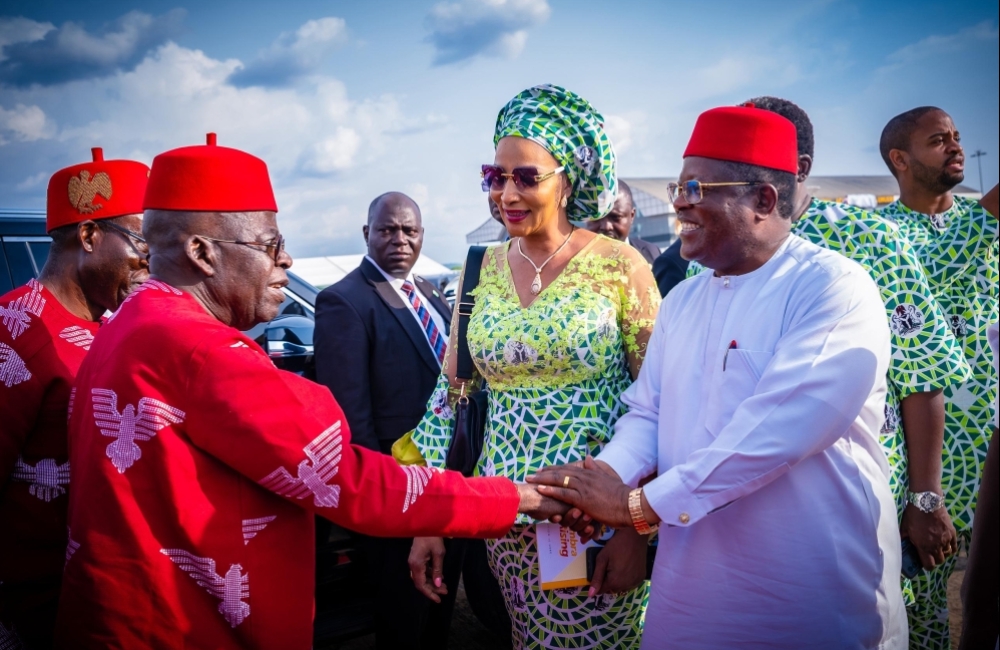
THANK YOU, MR PRESIDENT FOR INSPIRING GENERATIONS OF NIGERIAN NATIONALITIES WITH A PURPOSEFUL AND ALL- INCLUSIVE LEADERSHIP. YOUR STATE VISIT TO ANAMBRA STATE ON 8TH MAY 2025 UNDERPINS YOUR SENSE OF EGALITARIANISM -WORKS MINISTER, SEN.UMAHI The Honourable Minister of Works, Sen. Engr. Nweze David Umahi CON profoundly thanked the President of the Federal Republic of Nigeria for his State Visit to Anambra State, South East of Nigeria, on 8th May 2025. Mr. President's sense of inclusive leadership and commitment to an egalitarian nation speaks volumes in his words during the event, "Anambra has huge potential, and with Soludo, we can all work together to fast-track the vision." "We will continue to partner with your State to deliver shared prosperity to Ndi Anambra and all Nigerians." The Honourable Minister deeply appreciates Mr. President and assures him that as a people of gratitude, Anambra State and indeed South East will continue to cherish and honour him and will overwhelmingly reciprocate his unwavering love for Ndigbo come 2027 General Elections. He expresses gratitude to Mr. President for prioritizing South East in the national development architecture of the Renewed Hope administration and for guaranteeing its actualization in policy and implementation. By Mr. President's words in Anambra State," We are working to build critical infrastructure — roads, rail, and power — and ensure that every corner of Nigeria, including Anambra, feels the impact of governance that works. The Presidential Power Initiative and the ongoing digital economy drive will open more doors for the resourceful people of this State," he has continued to inspire generations of Nigerian nationalities with a purposeful and inclusive leadership and this underpins his sense of egalitarianism. God bless Mr. President. ...
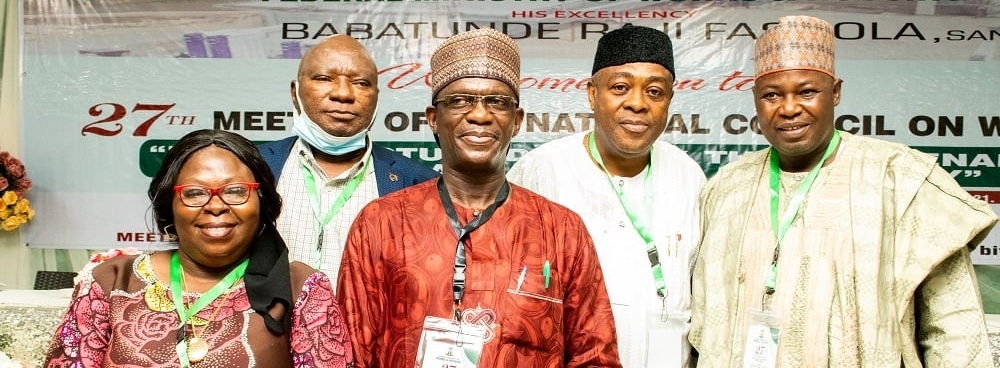
National Council On Works Kicks Off In Bauchi
The 27th National Council on Works has kicked off in Bauchi, Bauchi State capital today, Monday, September 20th, 2021
The four- day Council Meeting has the theme:” Infrastructure Delivery; the Maintenance Economy and National Prosperity.”
In his opening remarks at the technical session, the Director, Planning, Research and Statistics of Federal Ministry of Works and Housing, Jide Ode-Martins, described the theme for this year’s Council as timely, considering the collective resolve to address the challenges in road development in the country within available resources.
He explained that the first 2 days of the meeting will be the technical meeting of the Directors, followed by the meeting of the Permanent Secretaries that will fine-tune the recommendations of the Directors' meeting and other stakeholders.
The outcome of the Permanent Secretaries' meeting, he added, will be presented to the Council meeting of States' Commissioners and heads of relevant agencies under the Chairmanship of the Honourable Minister of Works and Housing for final deliberation.
Accordingly, Ode-Martins stated that the responsibility of the technical meeting of the Directors and other stakeholders was to create a solid and resourceful foundation by reviewing diligently the memoranda submitted by stakeholders.
He called on all the participants to make necessary contributions towards a successful Council Meeting.
“Esteemed delegates and officials, the timing of this meeting is very significant as it affords us the opportunity to think through and make necessary provisions in our various institutions towards adequate infrastructure delivery and cultivate maintenance culture to improve national prosperity,” he said.
Earlier, in his welcome address the Permanent Secretary Bauchi State Ministry of Works and Transport, Engr Stephen Abubakar, said that the theme of the meeting was suitable to the present situation in the country where there was the need to rethink infrastructure delivery and its maintenance for socio-economic development of the nation.
He further said that the meeting would provide the required platform for participants in the works sector to articulate policies that would provide the enabling environment and guide the path that would lead the country in bridging infrastructure gaps through innovative delivery and effective maintenance culture.
In attendance at the opening ceremony were critical stakeholders of the Works sector from the 36 states of the federation and the Federal Capital Territory, Abuja and representatives of the private sector.
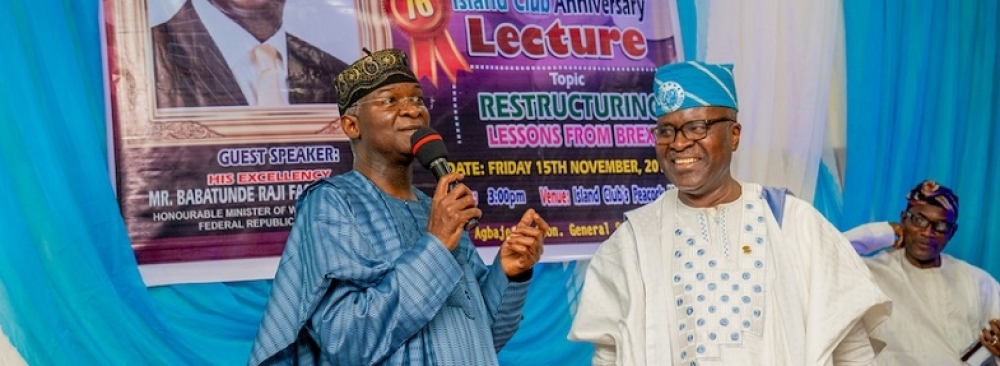
Restructuring For A Better Life – Lessons From BREXIT, Being Address Delivered By H.E, Babatunde Raji Fashola, SAN At The 2019 Island Club 76th Anniversary Lecture
Caveat
I must commence this address by issuing a caveat or a series of them namely:
a) That I started writing this piece intended as a public contribution to the restructuring debate in January 2019.
b) The views I express here are personal to me and do not reflect the position of the Government in which I serve or that of the All Progressives Congress of which I am a member.
c) The views are also informed by further reflections on positions I have taken on the need to strengthen our federal system of Government and to do so based not on emotions or political interests, but in the interest of improving the quality of life of Nigerians and for the purpose of developing Nigeria.
d) More importantly to state is that in seeking to solve a problem, we must look at many options, analyse their strengths and weaknesses and resist the temptation to jump at what first appears as a “solution” because it may not be the solution after all.
The quest for a better life has been an unending aspiration of the human civilization and will remain so till the end of time- that is if time ever ends.
From the agrarian to the industrial and now the information technology age, all the peoples of all nations are seeking a better life.
But the quest for a better life has led to many choices, sometimes well thought out and in some cases not so well thought out.
Some have sought constitutional amendments only to realize that a new document does not a better life procure. Some have sought geographical demarcations and creation of new nations, states and local governments only to realize that a new territory does not necessarily deliver a better life.
Some have sought increased control of resources and wealth only to find out that more wealth does not necessarily translate into a better life. These are facts of life, yet the quest for a better life, being a natural human longing and seeking, must continue.
There are a few things that Nigeria and Britain share in common in their quest for a better life and their coincidental reach for new political and economic realignments that currently dominate their public discourse in the name of “Restructuring” and “Brexit” respectively.
First to be noted is that both nations as they currently exist are not originals and this is true of many nations (Texas). (Netherlands).
Nigeria’s recent history of statehood or nationhood is still very fresh in the memory as having evolved as an amalgamation of many territories of diverse ethnic and religious dispositions in 1914.
But it is a story that dates back much longer; first to the British conquest of Lagos in 1861, the Berlin Conference of 1883-1885 and then to the Southern and Northern Protectorates that were the predecessors to the 1914 amalgamation.
This saw many Muslims, Christians, animists and people of diverse languages bound together in a household where a better life has now become a common aspiration.
It is important to point out that in Britain or the United Kingdom as they are also known, England was the kingdom, and that is why till date there is only a Queen of England not of Britain. The Scottish, Welsh, Irish who together with England constitute Britain are not English people. They have Christians and Muslim citizens, Anglicans, Catholics and Protestants.
While this speech may not be able to delve into the detail of their diversity and historical origins, it will suffice for comparison to point out that crude oil is largely to be found on the soil of the Scottish who continuously express an intention to leave the union.
And Britain as we know it today first emerged in 1801 when it united with the neighbouring Kingdom of Ireland, forming the United Kingdom of Great Britain and Ireland. This was renamed the United Kingdom of Great Britain and Northern Ireland following the secession of the Irish Free State in 1922.
In perhaps the same way that Nigeria has moved from two (2) protectorates and one (1) colony to three regions, four regions, 12 states, 19 states to 36 states, Britain in its original form has had to concede independence to the southern part of Ireland now known as the Republic of Ireland while Northern Ireland remains a part of the United Kingdom.
This was the result of the Good Friday Peace Agreement that secured a truce after many years of conflict between Catholics and Protestants in Ireland which spilled to several parts of the United Kingdom and resulted in bombings and acts of terror in the 1970s, similar to some of what we have experienced in the North East of Nigeria.
In spite of these, POLITICAL REALIGNMENTS, the quest for a better life exists in both countries – Nigeria and the UK. There are problems of unemployment, security, health care, homelessness, quality of education, cost of living and business competitiveness to mention but a few in both countries.
What is different is the scale of the problem, characterized by how the resources have been invested or misused, the level of development, which is manifest in the quality of infrastructure that supports transport, energy, health care, education and law enforcement.
What does not change is the quest for a better life on both sides, and interestingly, the political leadership has weaponized this quest for maximum benefit.
In the United Kingdom, the answer to the quest for a better life is in seeing Britain leave the European Union, a union they joined reluctantly in 1973.
So, to the people of Britain, “Brexit” (one word) was sold as a politically nebulous term that suggested to the ordinary people that the free movement of other Europeans into Britain was responsible for the lack of jobs.
That the amount they were paying as membership fees of the union was part of the reason why there was not enough money to spend at home on British education and healthcare.
That the need to subordinate their laws to the European parliament affected the British government’s ability to properly protect their own people.
It was a fascinating proposition. Their constitutional arrangement required that a referendum be conducted to ask the people to decide.
In the quest for a better life, the people voted in the referendum that Britain should leave or exit from the European Union. So was formed Brexit.
The people voted for a political Rearrangement in the belief that it would deliver economic and social benefits, and therefore a better life.
But, at the time they were voting, nobody told or reminded the people, that:
Most of the insulin that diabetic patients used to treat themselves in Britain came from France and the cost might go up.
Some of the best medical personnel in Britain were Europeans who might leave. ( 5,000 Nurses from Europe have since left the United Kingdom , as alleged by a member of Parliament on the 29th October 2019 and Nigeria and some other countries are paying the price with 2-3 year contracts being offered to their medical personnel to fill the Gap).
40 per cent of their food comes from Europe.
If they travelled to European cities, they may require visas to enter, or will have to share the same queue with Asians, Africans and other nationalities at immigration points at airports and may lose their right to use the European entry point.
Needless to reiterate, while it is doubtful that the people will all have voted for the risk of high cost of insulin, high cost of food or loss of their right of entry, the vagueness of the details of Brexit as presented by the political spin masters, has certainly left the country in some quandary.
Some people are now saying it was not well explained to them. Some have gone to court to stop the process but were unsuccessful and some are now saying they want a fresh referendum.
The political class that set the stage for Brexit now say there is no going back. The people have spoken in a referendum, and that it is a threat to democracy not to do their bidding.
Here is the tyranny of democracy’s fixation with the will of the majority and its supremacy. The majority is not always right while their supremacy is not always unimpeachable.
While this debate goes on about how to Brexit after 3 years of the Referendum to leave, businesses are either Relocating or shutting down, Jobs are also being lost , and uncertainty is hobbling investment decisions.
Of course, because things are no longer what they used to be, those who described us as “fantastically corrupt” are now “visiting us fantastically”. The Prime Minister and the Prince of Wales have been here.
Their views have not changed. We are simply a market that can replace what they might be losing in Europe as a result of Brexit.
So, while we roll out cultural troupes, take them to entertainment spots and queue to take selfies , they are looking for where there is food supply, skilled labour, and possibly a new source of insulin that will be cheaper than that of France, post-Brexit.
How we react to this opportunity is another matter for another conversation, but it is one that must take place very quickly. This new friendship must be defined by mutually beneficial parameters.
But this takes me now to Restructuring, which is also one word, like Brexit.
The proponents of restructuring have not been specific. Some of them, with very great respect, it appears that some of them simply want what they were used to in their more youthful days which was a parliamentary system of government and not a presidential system of Government. There is nothing wrong with this, after all we are often victims of habits that are difficult to change.
However, a much younger generation did not experience the parliamentary system and may be taken in by some arguments such as cost of getting elected and the cost of legislative work. In a parliamentary system, you may have a Prime Minister in the saddle for 16 straight years for as long as he is the leader of his party. Mrs. Margaret Thatcher was Prime Minister for 16 years for example. Given our current realities and diversity as a people, is that desirable in our land?
True as the cost of legislation may be as a factor, this generation must be told in clear terms that it was during the Parliamentary system that the political crisis of the 1960s started, and with a combination of other factors, led to a civil war in which many died.
They must read up about it, and demand more explanation as to why it did not prevent our division from resulting in a full blown civil war.
Of course we must not forget that the UK Parliamentary system has produced 4 (Four) Prime Ministers in the last 12 (Twelve years) including the incumbent. Do we want such rapid political leadership changes like this? What does it portend for policy consistency and continuity?
All I can add is that empirical evidence has shown that diversity such as we have, is better managed with a federal arrangement and that this generation should look before they leap.
A federal arrangement reduces suspicion, hate, and acrimony and prevents hostilities. It makes for greater stability over all and collaborative working of the federating units, forging a sense of belonging in its trail and setting the tone for competitive spirit.
However, when the protagonists of restructuring are pressed to say what they mean, some say they want a more federal union and that what we have is a unitary government masquerading as a federal one.
So, their argument becomes an argument of political arrangement. The issue is, therefore, not so much the objective but the artery road, shun of bypass to the objective goal of restructuring.
When the constitutional amendment to allow for the creation of state police was voted down, very few of the champions of a wholly federal arrangement raised a whimper. This was a big item of restructuring to reform law enforcement.
I have previously said and I repeat my views that multi-level policing by whatever name called, is something that I agree with.
What is a true federal arrangement without decentralized law enforcement, when you have a decentralized judiciary and law making arrangement? Shouldn’t states that make their own laws have their own agencies to enforce them and local governments that make bylaws have their own community policing?
Put simply, it seems that some of the protagonists of Restructuring want a true federation but prefer a unitary police. Even at that, the structure of the police system is not on its own a guaranty of efficiency.
The unitary British political system has operated a decentralised policing system which is now being considered for wholesale merger in order to save costs.
With rising crime, especially gang violence and knife attacks, such as a recent report of 13 knife stabbings over a 24-hour period, thorough reflection requires one to ask whether simple structural re-arrangement will resolve the knife attack problems.
As we grapple with the issue of a minimum wage, I expect the voices of the Restructurers, apostles of true federation, and those who want control of resources to stand with REASON, that the wages should not be uniform if the resources and the cost of living are not uniform.
This is a position I have previously advocated publicly, that states must be allowed to decide their own wages, and that wages must move from the Exclusive to the Concurrent list of the Constitution.
Sadly, I have not heard those voices raised at the same decibel as they have argued for restructuring.
My position on state police, wages and other issues also make a protagonist, but not all protagonists will agree with me, because they also want something different.
For yet some other people, the appeal of restructuring is the opportunity to agitate for more states and more local governments. That may be legitimate.
But the aspiration must answer some questions like, which states will be carved up? What is their viability? How do we solve the problems of existing ones that are at the point that wages of the public servants cannot be paid?
It might interest members of the public to know that boundary disputes from states creation that took place in 1967 and after that are still unresolved before the National Boundaries Commission, as some asset sharing and ownership issues have also persisted from states created after the 1967 episode.
It is perhaps helpful to also point to the fact that some of the states created over two decades ago such as Anambra, Bayelsa, Nasarawa, Zamfara and Ekiti feel that they are not fairly treated because there are no Federal Secretariats in their state.
The Buhari Administration is now completing and in the process of furnishing some of these secretariats while new ones have recently been awarded.
For yet another group of the protagonists of restructuring, the argument is in favour of a weaker centre and stronger states as federating units.
Apart from the case which is appropriately made for a change in the revenue allocation formula, they hinge the argument on the case that the President is too powerful. In fact, some have argued that the Nigerian president is the most powerful in the world; however, recent facts do not support this assertion.
We are witnesses to the fact a president once seized local government funds and the Supreme Court, an arm of Government that is set up as a check and balance on excessive powers and abuse of same, rightly declared that there was no constitutional power to do so.
Although the order to release the money was not immediately complied with, another president who recognised the limits of presidential power appropriately ordered the release of the funds.
We are living witnesses to how difficult it has been for these so called all powerful presidents to get their Budget passed without alterations, (some of which are so fundamental) by the parliament.
I leave you to decide whether the all-embracing “powers” of the Nigerian president is a “fact” or a contrived “myth” to bolster the case for restructuring.
I also urge you to read the Nigerian constitution and see for yourself the power and duties of the Nigeria president. If you do, as I have done, you will find 48 items of mention concerning the office of the president.(Duties, functions of the President- See Annexure I).
It seems that in the determination to support the unfounded argument about the enormous powers of the President, those who make the case, conveniently lump Powers with Functions and Duties.
Power is the legal right or authorization to act or not to act. It is the ability conferred on a person by law to alter, by an act of will, the rights, duties, liabilities and other relations, either of that person or another. On the other hand, the term ‘Function’ is the duty of the office.
The summary of references to the President show:-
a) Powers exercisable by the President = 23
b) Powers exercisable by the President, subject to National Assembly = 9
c) Power exercisable by the President, subject to other institutions = 4
d) Duties and Functions = 9
e) Restriction on the powers of the President = 3
Total = 48
For yet another group of Restructurers, they want their own country created by excising their zone. I only need to say that they should look closely at the break-up of Yugoslavia, the Soviet Union, and lately Sudan, to see whether it has delivered on the expectation of a better life.
In addition to that, they must look at the potential of what they might gain as being separate nations, to what they might leave behind from inter-marriage and families that they have created in other parts of Nigeria.
Recently the Cable News Network featured the story of the emotional reunion of an octogenarian mother with a son she had left behind when Korea was broken up into North and South as different nations in the 1940s.
And it is not just about people, it extends to resources and sustenance that contribute to better life. Think of whether you want to live in a new country and have to spend money to import some of the things you could get by driving just an hour without a border or the need for a visa.
That is the reality of Brexit today.
Before writing this piece, I thought it might be worthwhile to find out what ordinary Nigerians, as distinct from political actors know about Restructuring.
I commissioned a survey, in December 2018, which was a repeat of a similar one , in late 2017.
Just over 2 in 5 of the respondents are aware of the ongoing restructuring debate in the country. Even after prompting, a third of the sample still remain unfamiliar with the term (Restructuring.)
33% Don’t know what restructuring means.
15% Think that it means amending the constitution.
14% think that it means reorganising/rebuilding the country.
8% think that it means devolution of power to the states.
6% think that it means changing the revenue allocation formula.
6% think that it means reverting to Regional Government.
3% think it means increasing Federal Resources to selected states that are viable.
2% think that it means abolition of Federal Character and adoption of merit based appointment.
2% think that it means restructuring the economy.
While the findings may not vitiate the imperative of restructuring, what these point out is that there is a great deal of work to be done by its protagonists. Restructuring is inherently desirable.
Those not overtly enthusiastic even when they grasp what restructuring means, what are their fears? We must make efforts to allay their fears. Because a leader leads, carrying his vision of a higher goal and a better life even when a larger section of the citizenry are yet to see his cause clearly, it means the call for restructuring requires greater public education. It is in this way we would not plunge the country into intractable confusion, to put it mildly.
Let me say emphatically that the quest for a better life in Nigeria is legitimate and salutary. That is because there is so much more that we can do and will do.
However, it seems to me that while the quest for a better life may be assisted by amending some parts of the constitution, on its own it will not deliver a better life. A better life is the commonwealth that is produced by what I call common contribution. In other words, it is the result of hard work and dedicated productivity. It is what we produce that we can distribute.
For example, how much do we produce in terms of human activity and how will amending some parts of the Constitution on their own, translate to increased national productivity?
How many of our people in public and private sector who are contracted for an 8(Eight) hour daily work shift, actually work for 4(four hours)?
A better life is not a miracle product. It is the harvest of the investment of labour.
While considering numbers, it might be useful to see how they impact education.
The default argument for poor quality education is Government.
That is true to the extent that Government is the regulator, responsible for setting standards and all. But how many schools does Government own? The record indicates that there are a total of 165 universities in Nigeria; (not including a few recently approved ones) 43 belong to the Federal Government; 47 to the state Governments and 75 are private universities.
At the secondary level, there are 104 unity schools owned by the federal Government; this is a drop in the ocean, compared to the number of secondary and primary schools owned by state governments and private organisations nationwide.
Let me use the data from Lagos that I can claim some degree of familiarity with to make this case of responsibility.
There were a total of 8,274 schools primary and secondary in Lagos State. The state government owned a total of 1,681, made up of 1,045 primary and 636 secondary, representing 20 (%) per cent of the total number of schools.
The remaining were owned by the private sector, individuals, non-profit organisation and religious missions. These numbers show where the bulk of responsibility for foundational education lies, with us, the private people, entrepreneurs and less with Government.
The same is also true of the health sector where critical life saving intervention, like ante-natal care, immunization of babies, sanitation and refuse management all lie with the Local Government system under our Constitution.
Do we wish to restructure and pass these to the federal government, whose powers we say are already too much, or will we get down to work and make these primary health centres do their work of preventing disease, supporting wellbeing and deterring illness, or do we want to blame the constitution?
Let me remind all of us that we already have in our constitution a provision that seeks to promote the equitable distribution of opportunities called the Federal Character provision.
Has it solved the problem of access to opportunities and jobs?
The Supreme Court of Nigeria has also advanced the cause for restructuring in its judgement in the case popularly called the Resource Control Case by which certain oil producing states get 13% extra revenue from the distribution pool.
Has it achieved a better life for the peoples of those states?
I think the jury will be out for a long time on this one.
These are some of the hard facts.
They point clearly to where the responsibility for a better life lies. While admittedly a document may point the way; while it may show direction, it is we who must tread the path it shows to us. A good document not backed by the right attitude does not take a people far.
So, in addition to restructuring our political and administrative arrangements, we must restructure our attitude and our mind set. A better life does not necessarily exist in a new document without the right political education, a change of attitude and our inflexible commitment to public good.
Hearty felicitations to the Island Club at 76, and long the Federal Republic of Nigeria .
Babatunde Raji Fashola, SAN
Honourable Minister of Works and Housing
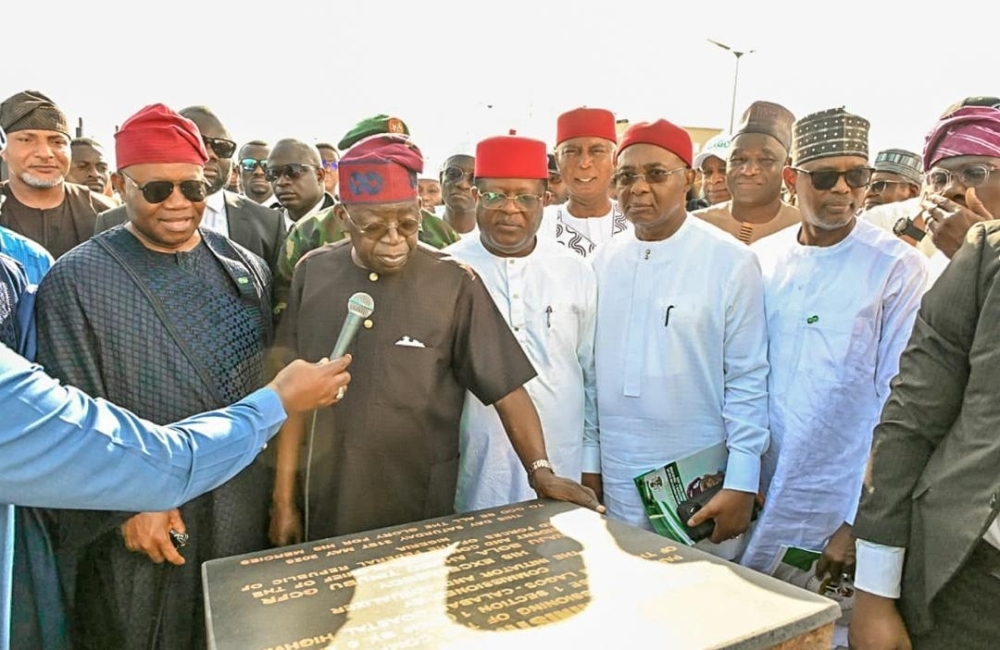
DRIVING NIGERIA’S FUTURE: CELEBRATING TWO YEARS OF TRANSFORMATIVE LEADERSHIP AND THE LAGOS-CALABAR COASTAL HIGHWAY MILESTONE
DRIVING NIGERIA’S FUTURE: CELEBRATING TWO YEARS OF TRANSFORMATIVE LEADERSHIP AND THE LAGOS-CALABAR COASTAL HIGHWAY MILESTONE
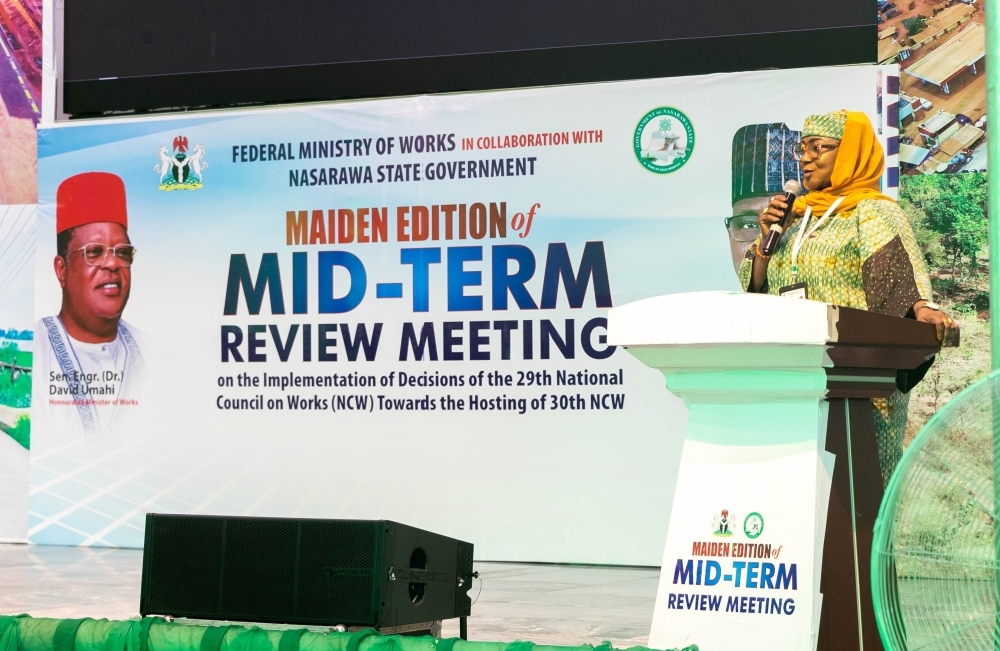
MID -TERM REVIEW MEETING ON THE IMPLIMENTATION OF THE DECISIONS REACHED AT THE 29TH NATIONAL COUNCIL ON WORKS (NCW) DAY 1
MID -TERM REVIEW MEETING ON THE IMPLIMENTATION OF THE DECISIONS REACHED AT THE 29TH NATIONAL COUNCIL ON WORKS (NCW) DAY 1