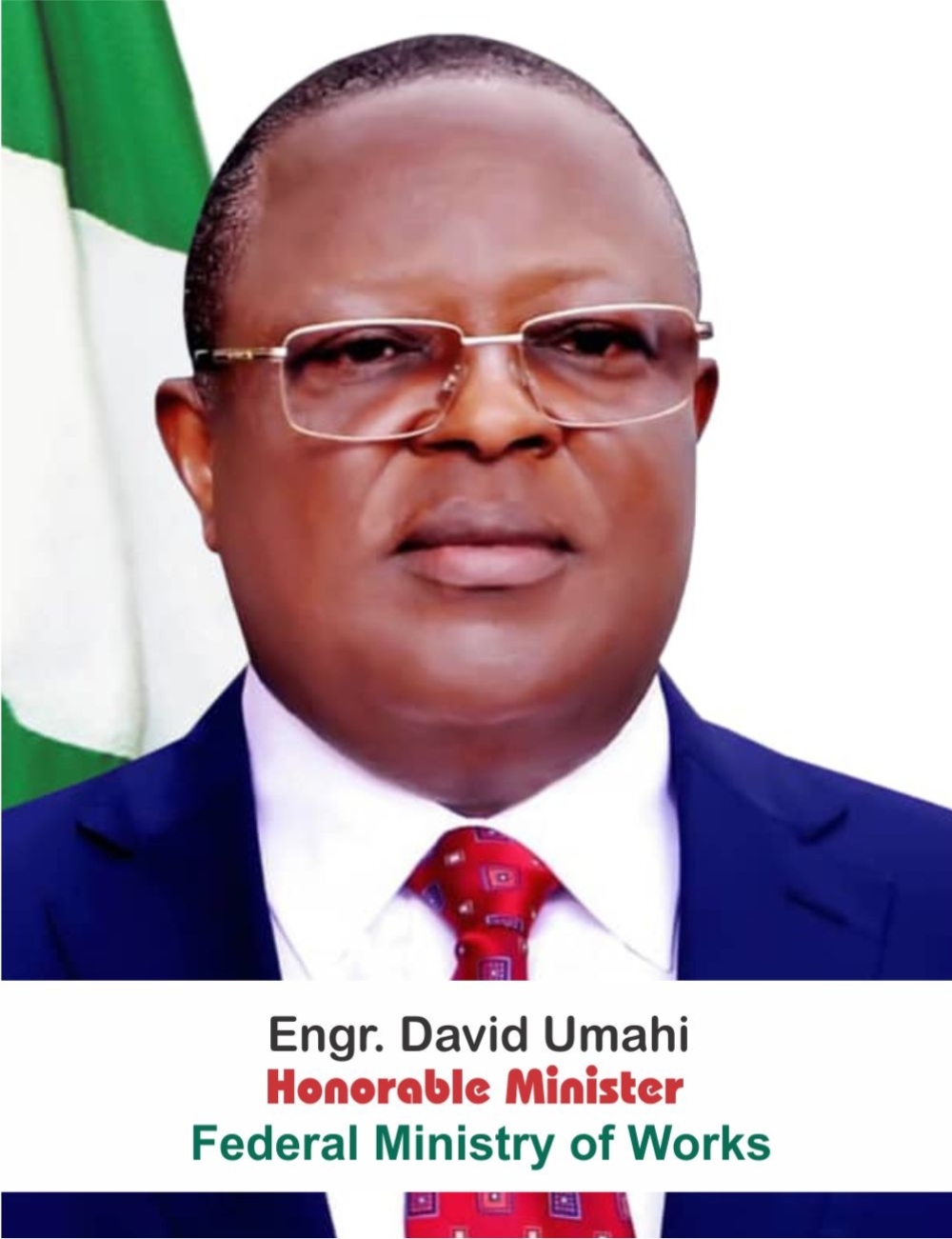
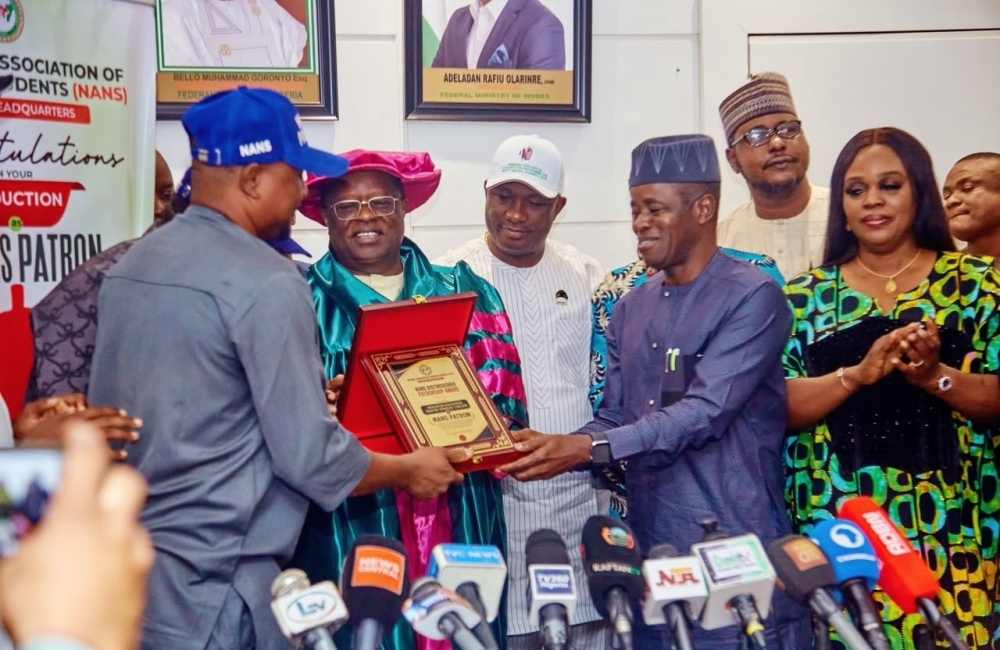
“THE WORST IS OVER; OUR GDP IS GROWING MORE THAN OUR POPULATION. THAT MEANS WE HAVE A FUTURE” - UMAHI TELLS NANS
— As Nigerian Students Induct Him as Grand Patron, Hail Him as “One of the Finest” in Tinubu’s Renewed Hope Cabinet
The Minister of Works, Senator Engr. David Umahi, CON, has declared that Nigeria is now seeing stronger economic outlook under President Bola Ahmed Tinubu, noting that the country’s Gross Domestic Product (GDP) is now growing faster than its population.
Umahi made the declaration on Monday, August 10, 2026, at the headquarters of the Federal Ministry of Works in Abuja, while speaking after he was formally inducted as Patron of the National Association of Nigerian Students (NANS).
The minister described the development as a positive indication of Nigeria’s economic prospects, saying, “I was enthused to find out that our GDP is growing more than our population. That means we have a future.”
The NANS leadership, led by its President, Dist. Comr. Akinteye Babatunde Afeez, GCNS, had earlier commended Umahi for his contributions to national infrastructure and described him as “a worthy member of the Renewed Hope Cabinet and, indeed, as one of the finest public servants Nigeria has produced in the contemporary era.”
The students said the recognition was not merely ceremonial but a reflection of Umahi’s visible contribution to road infrastructure and national development under President Bola Ahmed Tinubu’s administration.
According to NANS, the roads and bridges being delivered under Umahi’s supervision are directly connected to the lives of Nigerian students, affecting their mobility, access to educational institutions, examinations, internships, businesses and employment opportunities.
The students specifically cited major projects including the Abuja-Kaduna-Kano Expressway, Abuja-Kaduna-Minna route, Enugu-Port Harcourt Expressway and Lagos-Calabar Coastal Highway as examples of projects they said demonstrate the Federal Government’s commitment to improving national connectivity.
Afeez also disclosed that NANS had studied project reports of the Federal Ministry of Works covering the period between May 2023 and May 2026 and expressed its intention to embark on nationwide project tours to inspect completed and rehabilitated projects.
He said the students would use their platforms to communicate the impact of the projects to millions of Nigerian students, Nigerians and the wider world.
Responding, Umahi challenged Nigerian students and young people to look beyond political sentiments and examine the policies and achievements of the Tinubu administration objectively.
“We have had somebody say, ‘President Tinubu is tired.’ How do you know he is tired? I am part of President Tinubu. The Minister of Interior, the FCT, all the ministers and all the SSAs are vibrant and working. So how do you just jump at that conclusion?”
The minister urged Nigerians to demand concrete alternatives from those criticising the administration.
“If you say that the President is not doing well, what is your alternative?” he asked, stressing that political promises must be backed by clear plans and a credible mission.
He also called on students and other young Nigerians to take a position on issues affecting the country, arguing that remaining neutral in the face of visible progress was not always the right approach.
“You may say that you are not politicians or that you will not take sides, but this is the time to take sides in our national affairs. It is time to take a stand,” Umahi said.
On the economy, the minister acknowledged that the macroeconomy was only beginning to recover but urged Nigerians to consider the condition of the economy before the present administration took office and assess the reforms objectively.
“You may say that the macroeconomy is just beginning to recover. What was it like before the President took over? Everybody agrees that the macroeconomy is being fixed. It is up to you to dissect the ongoing reforms and take a position.”
Umahi also pointed to developments in the education sector, saying the stability being witnessed under the Tinubu administration had created an environment in which students were able to continue their studies without the disruption of nationwide strikes.
“For the first time, students never went on strike. Never. Look at the stability of Nigeria. That has never happened throughout the history of this country.”
“Where is the subsidy money?” Umahi explains
Addressing questions surrounding the removal of fuel subsidy and where the resulting resources were being deployed, Umahi pointed to the scale of ongoing infrastructure projects across the country.
He cited the Abuja-Kaduna-Zaria-Kano road, which he said covers 375 kilometres and, when measured as a dual carriageway, amounts to 750 kilometres.
According to the minister, more than ₦200 billion has already been spent on the project, with 480 kilometres of the dual carriageway completed and further sections nearing completion.
“For the first time, we have been able to complete 118 kilometres of concrete pavement within 30 months. That has never happened,” he said.
The Minister said the remaining works were expected to be completed by November, noting that the two projects on the route have a combined cost of ₦752 billion, with more than 80 percent already paid.
He also highlighted the Sokoto-Zamfara-Zaria corridor, the Benue-Ninth Mile road, and the Bodo - Bonny Island road as examples of projects receiving significant attention under the Tinubu administration.
On the Bonny Island project, he said:
“For the first time, people will move from the island to the mainland in Bonny Island, where the LNG is produced. A project costing ₦280 billion under President Bola Ahmed Tinubu has been completed. The 39.7-kilometre road is fully done, and the people of Bonny are very happy. They are no longer dying at sea. They are now driving through the land.”
The minister also spoke extensively about the administration’s legacy road projects, including the Lagos-Calabar Coastal Highway and the expanded Northeast Fourth Legacy Project.
He disclosed that the Northeast project, originally running from Akwanga through Jos, Bauchi, Gombe and Biu, had been extended through Yobe to Maiduguri, adding another 400 kilometres to the project.
Umahi defended the Lagos-Calabar Coastal Highway against criticisms, saying the project was strategically important to the Niger Delta and would be completed.
“I do not know why people are attacking the Lagos-Calabar Coastal Highway. After all, this is coming from the Niger Delta, where the oil is coming from. Why is nobody attacking the other three Legacy Projects, but this one is being attacked? That is unfair and unrealistic. That project will be completed. In fact, over 50 percent of the entire stretch is already under construction.”
The minister also used the occasion to speak about the development of the Southeast, saying President Tinubu had deliberately embarked on projects aimed at integrating the region into the national infrastructure network.
“The Southeast, for the first time, is being remembered, and I thank the people in the Southeast because sometimes I say, ‘Listen, our people should not be sentimental.’”
He said the administration’s approach to the region was intentional and urged the people of the Southeast to work with other parts of the country.
“The President has a good intention to integrate the people of the Southeast, and I have to be very honest with you. If I were not a minister from the Southeast, we would not have been able to get the projects we have secured. It is intentional on the part of Mr. President. Go and right the wrongs of the Southeast.”
Umahi cited the Enugu-Onitsha Expressway and Enugu-Port Harcourt Expressway among the major projects transforming connectivity in the region.
He also disclosed that President Tinubu had approved the re-scoping and reconstruction of the Lokoja-Benin-Warri corridor, covering a total of 401 kilometres.
The minister was particularly direct in urging the students to support President Tinubu in the 2027 election, arguing that Nigerians should support the administration if they believe its policies are producing results.
“I want you to take a side. If you say you are on the list of a coalition and you say that what we are doing is good, then we have to take a stand to vote for the President in the coming election.”
“Let him finish. Let him take back our country. Let him reposition our country.”
Umahi also urged Nigerians to look beyond political rhetoric and focus on practical solutions to the country’s challenges.
“Listening to others should not mean allowing yourselves to be insulted or blackmailed. Cheap talk will not solve our problems. Nobody is saying what he or she can do differently. The worst is over. The darkest part of the night is an hour before dawn.”
He pointed to the decline in food prices as one of the developments Nigerians should consider in assessing the economy, recalling that a 50-kilogramme bag of rice, which he said had risen above ₦80,000 and at some point reached ₦100,000, was now selling at about ₦58,000.
Umahi also stressed the administration’s commitment to transparency in the execution of road projects, saying the Ministry of Works had opened its projects to scrutiny by anti-corruption agencies.
“Now, why are we doing this? Transparency. We have turned these projects over to the ICPC. They have gone round. We are ready for constructive criticism, and where necessary, we will make amends.”
He added that the Ministry had also written to the Economic and Financial Crimes Commission (EFCC) to inspect its projects. “We have nothing to hide in this administration.”
The minister urged NANS to organise a major student engagement across the geopolitical zones where students could ask questions directly and hear the government’s explanations on its policies and projects.
“Let me defend this administration. Organise it and let me come. Move students from across the zone to a central point where we can talk to them and address their concerns. We have to deliberate on the issues. We have to debate them. Ask your questions, and we will answer them.”
He said he would attend such engagements with some ministers and Senior Special Assistants to the President, stressing that students were important stakeholders in the country’s future.
Umahi further challenged young Nigerians to take responsibility for protecting public infrastructure and contributing positively to national development. “See something, say something. Together, we can take back our country because it belongs to us.”
He said the responsibility for the performance of government should be placed on the officials directly responsible for specific sectors, rather than on the President for every operational issue.
“I am here because the President gave me the responsibility to be in charge of roads and bridges. If I do not do it, I should be the one to be blamed, not the President. I am not the President. The President has divided himself into a number of his appointees. These appointees should be the ones to answer and take responsibility.”
The minister concluded by thanking the students for the recognition and expressing his readiness to deepen collaboration with NANS.
“I want to thank you very much.“
He described the students as important partners in the national development process and encouraged them to remain informed, ask questions and hold leaders accountable.
The NANS President, in his address, said the association considered Umahi worthy of its patronage because of his record of public service, infrastructure delivery and commitment to national development.
He said the roads being constructed under Umahi’s leadership would outlive the present administration and continue to serve generations of Nigerians.
“History will not remember public officers merely because they occupied important offices. History will remember them for what they built, what they changed and the lives they touched.”
Afeez formally welcomed Umahi into the NANS family as Patron, describing the partnership between the student body and the Federal Ministry of Works as an opportunity to bring government projects closer to young Nigerians and deepen informed national discourse.

“THE WORST IS OVER; OUR GDP IS GROWING MORE THAN OUR POPULATION. THAT MEANS WE HAVE A FUTURE” - UMAHI TELLS NANS — As Nigerian Students Induct Him as Grand Patron, Hail Him as “One of the Finest” in Tinubu’s Renewed Hope Cabinet The Minister of Works, Senator Engr. David Umahi, CON, has declared that Nigeria is now seeing stronger economic outlook under President Bola Ahmed Tinubu, noting that the country’s Gross Domestic Product (GDP) is now growing faster than its population. Umahi made the declaration on Monday, August 10, 2026, at the headquarters of the Federal Ministry of Works in Abuja, while speaking after he was formally inducted as Patron of the National Association of Nigerian Students (NANS). The minister described the development as a positive indication of Nigeria’s economic prospects, saying, “I was enthused to find out that our GDP is growing more than our population. That means we have a future.” The NANS leadership, led by its President, Dist. Comr. Akinteye Babatunde Afeez, GCNS, had earlier commended Umahi for his contributions to national infrastructure and described him as “a worthy member of the Renewed Hope Cabinet and, indeed, as one of the finest public servants Nigeria has produced in the contemporary era.” The students said the recognition was not merely ceremonial but a reflection of Umahi’s visible contribution to road infrastructure and national development under President Bola Ahmed Tinubu’s administration. According to NANS, the roads and bridges being delivered under Umahi’s supervision are directly connected to the lives of Nigerian students, affecting their mobility, access to educational institutions, examinations, internships, businesses and employment opportunities. The students specifically cited major projects including the Abuja-Kaduna-Kano Expressway, Abuja-Kaduna-Minna route, Enugu-Port Harcourt Expressway and Lagos-Calabar Coastal Highway as examples of projects they said demonstrate the Federal Government’s commitment to improving national connectivity. Afeez also disclosed that NANS had studied project reports of the Federal Ministry of Works covering the period between May 2023 and May 2026 and expressed its intention to embark on nationwide project tours to inspect completed and rehabilitated projects. He said the students would use their platforms to communicate the impact of the projects to millions of Nigerian students, Nigerians and the wider world. Responding, Umahi challenged Nigerian students and young people to look beyond political sentiments and examine the policies and achievements of the Tinubu administration objectively. “We have had somebody say, ‘President Tinubu is tired.’ How do you know he is tired? I am part of President Tinubu. The Minister of Interior, the FCT, all the ministers and all the SSAs are vibrant and working. So how do you just jump at that conclusion?” The minister urged Nigerians to demand concrete alternatives from those criticising the administration. “If you say that the President is not doing well, what is your alternative?” he asked, stressing that political promises must be backed by clear plans and a credible mission. He also called on students and other young Nigerians to take a position on issues affecting the country, arguing that remaining neutral in the face of visible progress was not always the right approach. “You may say that you are not politicians or that you will not take sides, but this is the time to take sides in our national affairs. It is time to take a stand,” Umahi said. On the economy, the minister acknowledged that the macroeconomy was only beginning to recover but urged Nigerians to consider the condition of the economy before the present administration took office and assess the reforms objectively. “You may say that the macroeconomy is just beginning to recover. What was it like before the President took over? Everybody agrees that the macroeconomy is being fixed. It is up to you to dissect the ongoing reforms and take a position.” Umahi also pointed to developments in the education sector, saying the stability being witnessed under the Tinubu administration had created an environment in which students were able to continue their studies without the disruption of nationwide strikes. “For the first time, students never went on strike. Never. Look at the stability of Nigeria. That has never happened throughout the history of this country.” “Where is the subsidy money?” Umahi explains Addressing questions surrounding the removal of fuel subsidy and where the resulting resources were being deployed, Umahi pointed to the scale of ongoing infrastructure projects across the country. He cited the Abuja-Kaduna-Zaria-Kano road, which he said covers 375 kilometres and, when measured as a dual carriageway, amounts to 750 kilometres. According to the minister, more than ₦200 billion has already been spent on the project, with 480 kilometres of the dual carriageway completed and further sections nearing completion. “For the first time, we have been able to complete 118 kilometres of concrete pavement within 30 months. That has never happened,” he said. The Minister said the remaining works were expected to be completed by November, noting that the two projects on the route have a combined cost of ₦752 billion, with more than 80 percent already paid. He also highlighted the Sokoto-Zamfara-Zaria corridor, the Benue-Ninth Mile road, and the Bodo - Bonny Island road as examples of projects receiving significant attention under the Tinubu administration. On the Bonny Island project, he said: “For the first time, people will move from the island to the mainland in Bonny Island, where the LNG is produced. A project costing ₦280 billion under President Bola Ahmed Tinubu has been completed. The 39.7-kilometre road is fully done, and the people of Bonny are very happy. They are no longer dying at sea. They are now driving through the land.” The minister also spoke extensively about the administration’s legacy road projects, including the Lagos-Calabar Coastal Highway and the expanded Northeast Fourth Legacy Project. He disclosed that the Northeast project, originally running from Akwanga through Jos, Bauchi, Gombe and Biu, had been extended through Yobe to Maiduguri, adding another 400 kilometres to the project. Umahi defended the Lagos-Calabar Coastal Highway against criticisms, saying the project was strategically important to the Niger Delta and would be completed. “I do not know why people are attacking the Lagos-Calabar Coastal Highway. After all, this is coming from the Niger Delta, where the oil is coming from. Why is nobody attacking the other three Legacy Projects, but this one is being attacked? That is unfair and unrealistic. That project will be completed. In fact, over 50 percent of the entire stretch is already under construction.” The minister also used the occasion to speak about the development of the Southeast, saying President Tinubu had deliberately embarked on projects aimed at integrating the region into the national infrastructure network. “The Southeast, for the first time, is being remembered, and I thank the people in the Southeast because sometimes I say, ‘Listen, our people should not be sentimental.’” He said the administration’s approach to the region was intentional and urged the people of the Southeast to work with other parts of the country. “The President has a good intention to integrate the people of the Southeast, and I have to be very honest with you. If I were not a minister from the Southeast, we would not have been able to get the projects we have secured. It is intentional on the part of Mr. President. Go and right the wrongs of the Southeast.” Umahi cited the Enugu-Onitsha Expressway and Enugu-Port Harcourt Expressway among the major projects transforming connectivity in the region. He also disclosed that President Tinubu had approved the re-scoping and reconstruction of the Lokoja-Benin-Warri corridor, covering a total of 401 kilometres. The minister was particularly direct in urging the students to support President Tinubu in the 2027 election, arguing that Nigerians should support the administration if they believe its policies are producing results. “I want you to take a side. If you say you are on the list of a coalition and you say that what we are doing is good, then we have to take a stand to vote for the President in the coming election.” Umahi also urged Nigerians to look beyond political rhetoric and focus on practical solutions to the country’s challenges. “Listening to others should not mean allowing yourselves to be insulted or blackmailed. Cheap talk will not solve our problems. Nobody is saying what he or she can do differently. The worst is over. The darkest part of the night is an hour before dawn.” He pointed to the decline in food prices as one of the developments Nigerians should consider in assessing the economy, recalling that a 50-kilogramme bag of rice, which he said had risen above ₦80,000 and at some point reached ₦100,000, was now selling at about ₦58,000. Umahi also stressed the administration’s commitment to transparency in the execution of road projects, saying the Ministry of Works had opened its projects to scrutiny by anti-corruption agencies. “Now, why are we doing this? Transparency. We have turned these projects over to the ICPC. They have gone round. We are ready for constructive criticism, and where necessary, we will make amends.” He added that the Ministry had also written to the Economic and Financial Crimes Commission (EFCC) to inspect its projects. “We have nothing to hide in this administration.” The minister urged NANS to organise a major student engagement across the geopolitical zones where students could ask questions directly and hear the government’s explanations on its policies and projects. “Let me defend this administration. Organise it and let me come. Move students from across the zone to a central point where we can talk to them and address their concerns. We have to deliberate on the issues. We have to debate them. Ask your questions, and we will answer them.” He said he would attend such engagements with some ministers and Senior Special Assistants to the President, stressing that students were important stakeholders in the country’s future. Umahi further challenged young Nigerians to take responsibility for protecting public infrastructure and contributing positively to national development. “See something, say something. Together, we can take back our country because it belongs to us.” He said the responsibility for the performance of government should be placed on the officials directly responsible for specific sectors, rather than on the President for every operational issue. “I am here because the President gave me the responsibility to be in charge of roads and bridges. If I do not do it, I should be the one to be blamed, not the President. I am not the President. The President has divided himself into a number of his appointees. These appointees should be the ones to answer and take responsibility.” The minister concluded by thanking the students for the recognition and expressing his readiness to deepen collaboration with NANS. “I want to thank you very much.“ He described the students as important partners in the national development process and encouraged them to remain informed, ask questions and hold leaders accountable. The NANS President, in his address, said the association considered Umahi worthy of its patronage because of his record of public service, infrastructure delivery and commitment to national development. He said the roads being constructed under Umahi’s leadership would outlive the present administration and continue to serve generations of Nigerians. “History will not remember public officers merely because they occupied important offices. History will remember them for what they built, what they changed and the lives they touched.” Afeez formally welcomed Umahi into the NANS family as Patron, describing the partnership between the student body and the Federal Ministry of Works as an opportunity to bring government projects closer to young Nigerians and deepen informed national discourse.
“Let him finish. Let him take back our country. Let him reposition our country.”
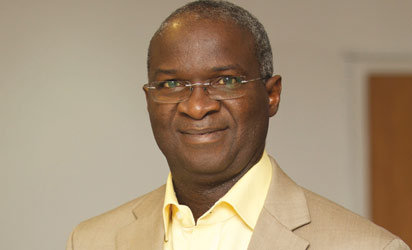
Fashola campaigns for external borrowing to finance Capital Projects The Minister of Power, Works and Housing,Babatunde Raji Fashola, SAN has thrown his weight behind external borrowing to finance capital projects. The Minister made the disclosure while delivering his address at the 2nd Annual Nigerian Mining Week at the Nigerian Air Force Conference in Abuja on Tuesday 17th October, 2017. Fashola, who recalled that in 2016, the Federal Government committed the sum of N1.2 trillion on capital projects, which is an increase from 15% to 30%, emphasized the need to source for loans to finance the development of critical infrastructure for the Federal Government to fulfill its campaign promises. While commending the leadership of the Mines sector for the amazing milestones recorded within “so short a time”, the Minister noted that very little can be achieved within the Power industry without inputs from the sector. He said, “as we roll out transmission stations, towers, we install transformers, whether it is steel casing for the transformers, whether it is copper winding inside it, all of these stem from the operations of the mining industry”. The Minister of Mines and Steel Development, Dr. Kayode Fayemi, earlier on commended the “Nigerian Mining Week,” as a networking platform and a learning turf for existing businesses. Fayemi noted that a recent World Risk Report published by the Mining Journal indicated that Nigeria has made remarkable improvements in both hard and perceived risk factors. He added that, “the Nigerian mining jurisdiction is now considered to have a better investment risk profile than Russia, China, India and several other leading jurisdictions”. Various stakeholders took their turns to discuss the challenges facing the sector and the need to collaborate amongst themselves towards the sustainable development of the sector. In attendance were the Governor of Taraba State, Darius Ishaku, the Ohinoyi of Ebiraland, Alhaji Ado Ibrahim, Senior Partner, PriceWaterhouse Coopers (PWC), Uyi Akpata, representative of the Kaduna State Governor, Mallam Nasir El-Rufa’I, Mrs. Amina Sijuade, amongst others. ...
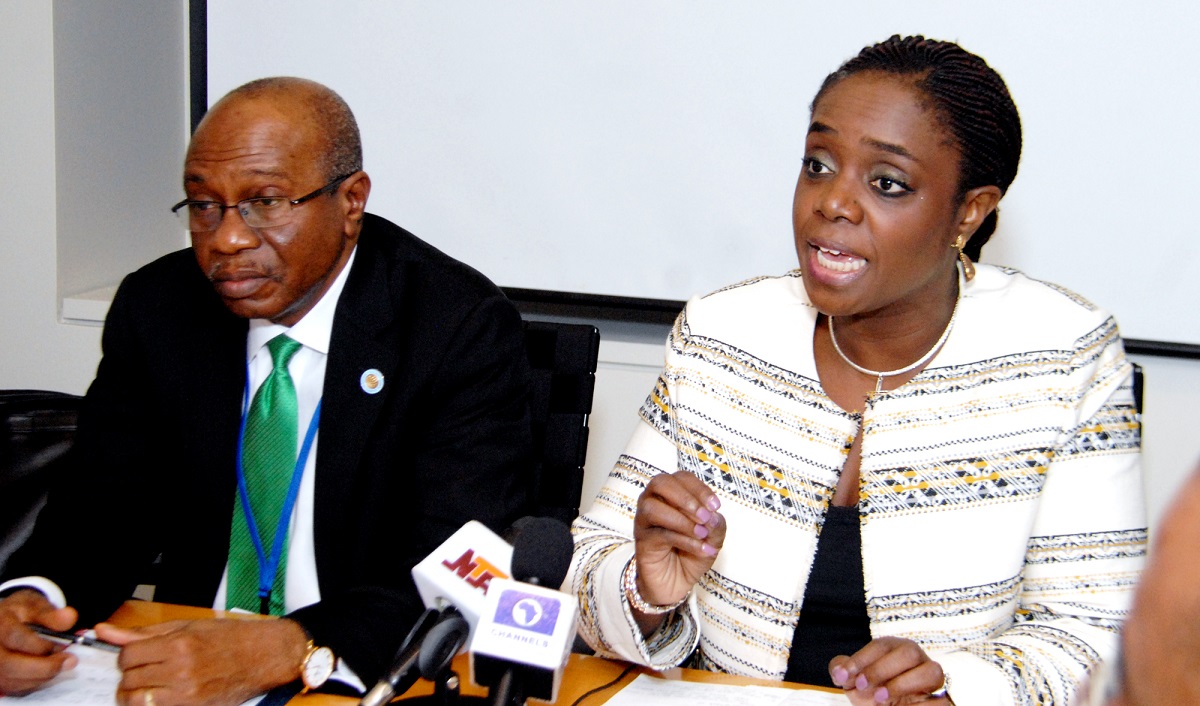
Nigeria won’t be reckless with foreign borrowings – Adeosun ….IMF, World Bank project higher growth for Sub-Saharan Africa, Global Economy in 2018 The Honourable Minister of Finance, Mrs. Kemi Adeosun, disclosed on Sunday that the Federal Government would not be reckless with foreign borrowings as it maintains an expansionary fiscal policy. The Minister also revealed that the International Monetary Fund (IMF) and the World Bank Group have projected a positive outlook of higher growth for the Sub-Saharan Africa and global economy in 2018. Adeosun made this known in Washington D.C. at a Joint Media Briefing with the Governor of the Central Bank of Nigeria, Mr. Godwin Emefiele, at the end of the 2017 Annual Meetings of the International Monetary Fund and the World Bank Group. She stated that the Federal Government adopted an expansionary fiscal policy with an enlarged budget in order to deliver a fundamental structural change to the economy, thereby reducing the country’s exposure to crude oil. “Why are we borrowing? Mobilising revenue aggressively was not advisable, nor indeed possible, in a recessed economy. But as Nigeria now reverts to growth, our revenue strategy will be accelerated. “This is being complimented by a medium-term debt strategy that is focusing more on external borrowings to avoid crowding out the private sector. “This would also reduce the cost of debt servicing and shift the balance of our debt portfolio from short-term to longer-term instruments. This Government will be very prudent around debt. We won’t borrow irresponsibly,” said Adeosun, who led the Nigerian delegation to the 2017 Annual Meetings of the IMF and the World Bank. The Minister participated in both the International Monetary and Financial Committee (IMFC) and Development Committee (DC) meetings, the two highest decision making organs of the Bretton-woods Institutions. She revealed that developments in the global economy since the Spring meetings were reviewed, noting that growth had picked up in 2017 even though not even. “Global growth is estimated to be 3.6 per cent for Fiscal Year 2017, while Sub-Saharan Africa (SSA) is projected to grow at 2.6 per cent and outlook is for higher growth in Fiscal Year 2018. “However, down side risks remain in the medium-term with high policy uncertainty, geopolitical tensions. Inflation remains subdued,” she added. Providing further details on the IMF and World Bank meeting, Minister Adeosun said the overarching policy priorities for the entire membership was to boost potential output and improve income distribution while improving financial sector resilience. The two Bretton-wood institutions, according to her, urged commodity exporters like Nigeria, to pursue structural policy reforms to unlock the country’s potentials and stimulate aggregate supply as well as enhance the diversification process. On the Development Committee (DC) meeting, she said members discussed the need to enhance the capacity of the International Bank for Reconstruction and Development (IBRD) and International Finance Corporation (IFC) to meet their obligations of supporting the financing needs of client countries and to prevent a slowdown in lending. “At the DC where I spoke on behalf of Angola, Nigeria and South Africa, I urged the international community particularly the Bretton-wood Institutions to change the narrative on Africa which always portray the continent as Low Income Countries (LIC). “Indeed, there are some Middle Income Countries represented by this constituency and so there is the need for the Bank to deploy instruments, policies and programs that will address the peculiar needs of these countries,” she said. Responding on the issue of investing in women, Adeosun remarked that the women remained the best investment any nation could make. “The multiplier effect of such investment is significant. We need to make more opportunities available to our women. They are the economic drivers of our nation. We have enormous talents in Nigeria, and the Federal Government will invest in human capital,” she added. The CBN Governor, Mr. Godwin Emefiele, who also participated at the IMF and World Bank meetings, confirmed improvement in the Nigerian economy. “The fundamentals we are seeing show that there is a lot of stability in the foreign exchange market, and having come down from high level to the level we are now, and the currency is just fluctuating between N359/N365 to dollar. “We think it is good level compared to where we are coming from. We think it is important to note that as reserves get stronger, as economic fundamentals get stronger, there is no doubt that the naira will get stronger and we will see more appreciation in the currency,” Emefiele said. He assured that the CBN would continue to focus on the banking system to ensure there were no significant threats that would affect the strategic health of the banking system. He further said that the CBN would continue to support the Federal Government’s efforts to reduce unemployment and create jobs. END ...
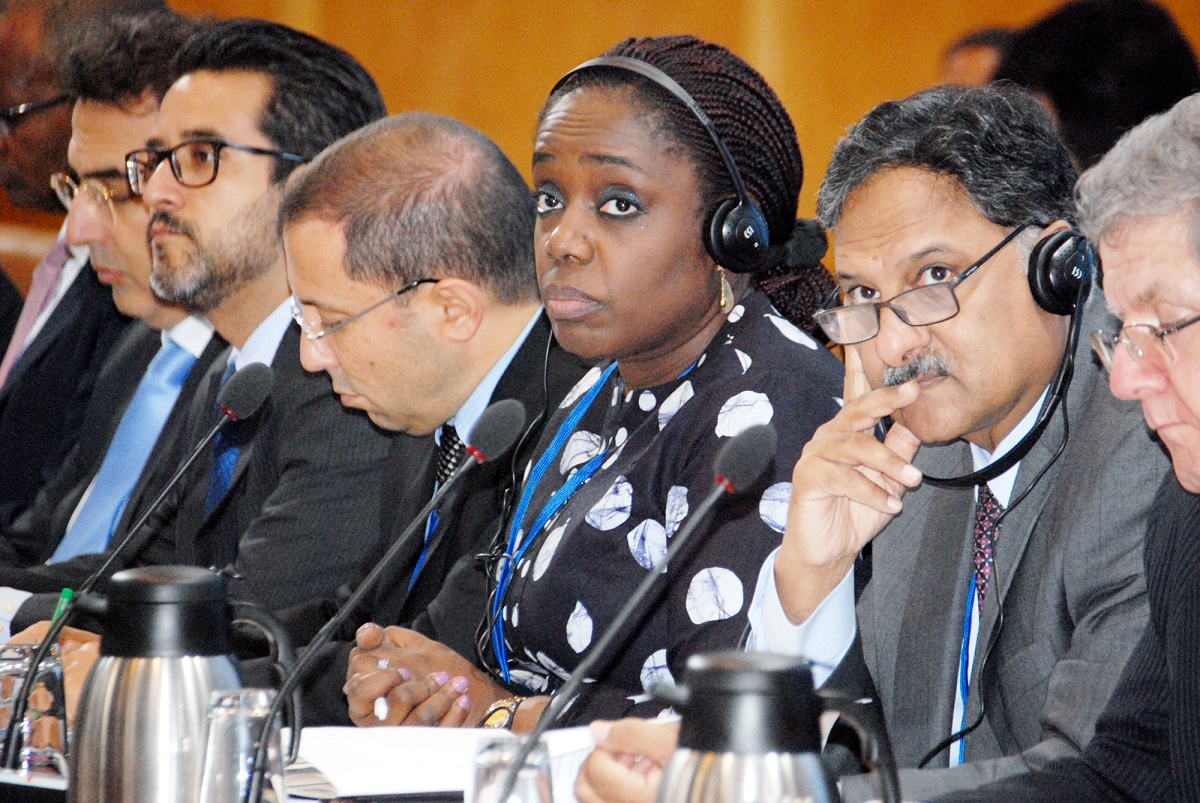
Infrastructural Devt: Nigeria asks World Bank, IMF to scale up Renewable Energy Nigeria has asked the World Bank Group and the International Monetary Fund (IMF) to scale up the provision of and access to renewable energy in order to deliver development results and meet global climate goals. Nigeria’s position on renewable energy and regional integration was presented by the Honourable Minister of Finance, Mrs. Kemi Adeosun, during the G24 Finance Ministers and Central Bank Governors meeting in Washington D.C., United States. Adeosun stated that scaling up renewable energy was a “win-win area” to deliver development results and contribute to the global climate goals. She said, “We have a major energy infrastructure gap to meet the needs of industrialization. Providing access to energy to all parts of Nigeria, both urban and rural, is a priority. “If we succeed, we estimate that this could unleash the development potentials of two-third of our population of 180 million.” The Minister added that generation of renewable energy was a financially attractive option for reaching rural populations. She further emphasized the need for business models from other countries to serve as a template in the provision of affordable energy. While canvassing the reinforcement of regional integration process by the World Bank and the IMF, Adeosun said the process would boost trade between countries and serve as a potential growth driver. “We believe that part of the solution must be regional, multi-country initiatives on infrastructure development. Though complex and often not easy to undertake, there are also successful cases of such projects. “For instance, a coastal super highway from Lagos to Dakar in West Africa would cut across 11 economic territories. Another Trans-Sahel highway from Northwest Nigeria to Mauritania would provide access and boost economic activities of land-lock countries like Niger, Burkina Faso and Mali,” stated Adeosun while speaking on behalf of Nigeria and 30 other countries during the G24 Ministers and Governors meeting. The IMF Managing Director, Christine Lagarde, advised low-income countries to be very cautious in dealing with investors, noting that there was a huge surge yields on the path of investors. The Chief Executive Officer of the World Bank, Kristalina Georgieva, urged developing countries to look at other sources of finance rather than dependence on the Paris Club. Georgieva said, “It is imperative for us to maximize finance for development and also critical for us think of comparative strength for significant finance to flow into developing countries.” On energy deficiency, she counselled developing countries to identify what could be done to create favourable environment for renewable energy. In a communiqué at the end of its meeting, the G24 Ministers and Governors urged the World Bank Group and the IMF to continue strengthening their assistance in improving domestic resource mobilisation and enhancing its contribution to inclusive growth through progressive tax policies, as well as more efficient and better targeted public spending. The Body reiterated the importance of scaling up infrastructure investments to achieve sustainable development goals. “We welcome the support of the IMF, the World Bank and other international Financial Institutions in increasing the efficiency of public investments in infrastructure, as well as their impact in improving connectivity, including at the regional level, and addressing distributional and climate objectives,” it stated. The G24 Ministers and Governors also called on Multilateral Development Banks (MDBs) to deliver on their ‘Joint Declaration of Aspirations on Actions to Support Infrastructure Investments’, including through concrete and time-bound actions. This, it added, will help to develop new risk mitigation instruments and infrastructure investment as an asset class. “We support a quota-based, adequately-resourced IMF that is less dependent on borrowed resources. We call for at least maintaining the current lending capacity of the IMF,” the group said. The group also called for strengthening the efforts of the IMF and the World Bank towards greater representation of under-represented regions and countries in recruitment and career progression, including at the managerial levels. END ...
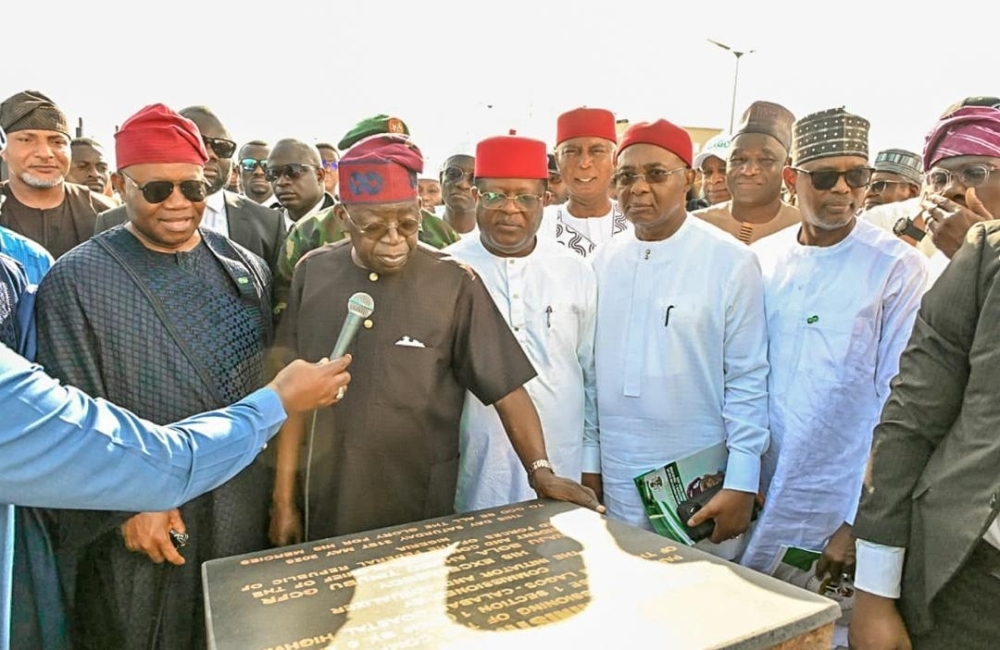
DRIVING NIGERIA’S FUTURE: CELEBRATING TWO YEARS OF TRANSFORMATIVE LEADERSHIP AND THE LAGOS-CALABAR COASTAL HIGHWAY MILESTONE
DRIVING NIGERIA’S FUTURE: CELEBRATING TWO YEARS OF TRANSFORMATIVE LEADERSHIP AND THE LAGOS-CALABAR COASTAL HIGHWAY MILESTONE
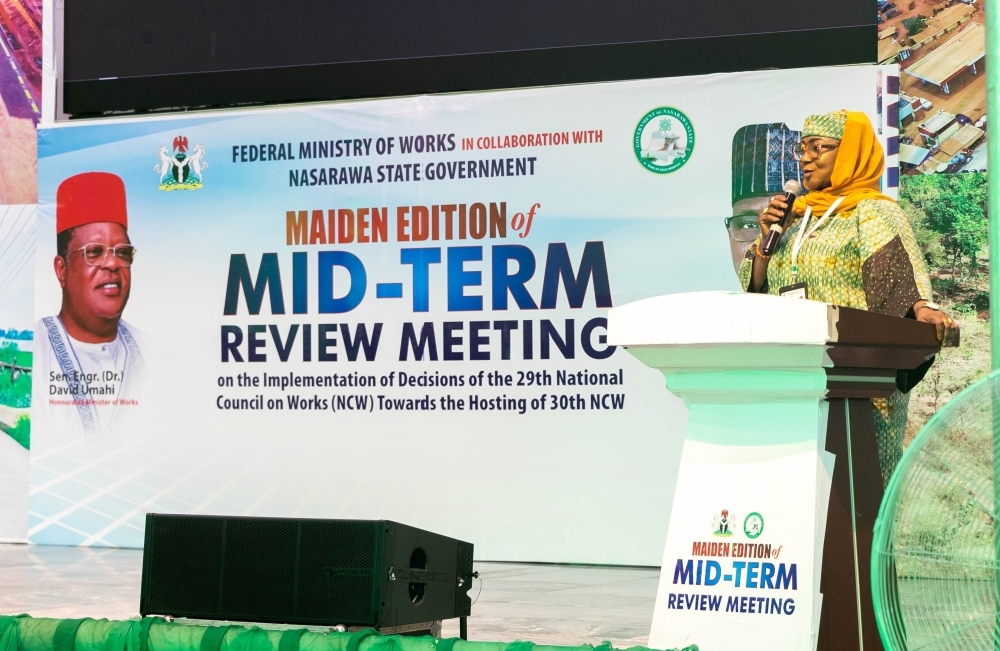
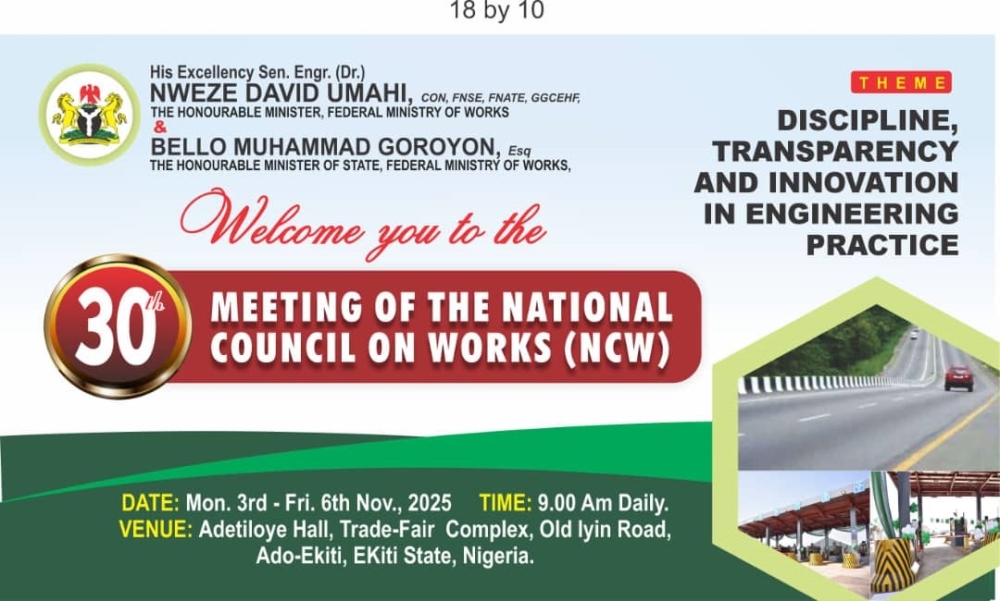
MID -TERM REVIEW MEETING ON THE IMPLIMENTATION OF THE DECISIONS REACHED AT THE 29TH NATIONAL COUNCIL ON WORKS (NCW) DAY 1
MID -TERM REVIEW MEETING ON THE IMPLIMENTATION OF THE DECISIONS REACHED AT THE 29TH NATIONAL COUNCIL ON WORKS (NCW) DAY 1