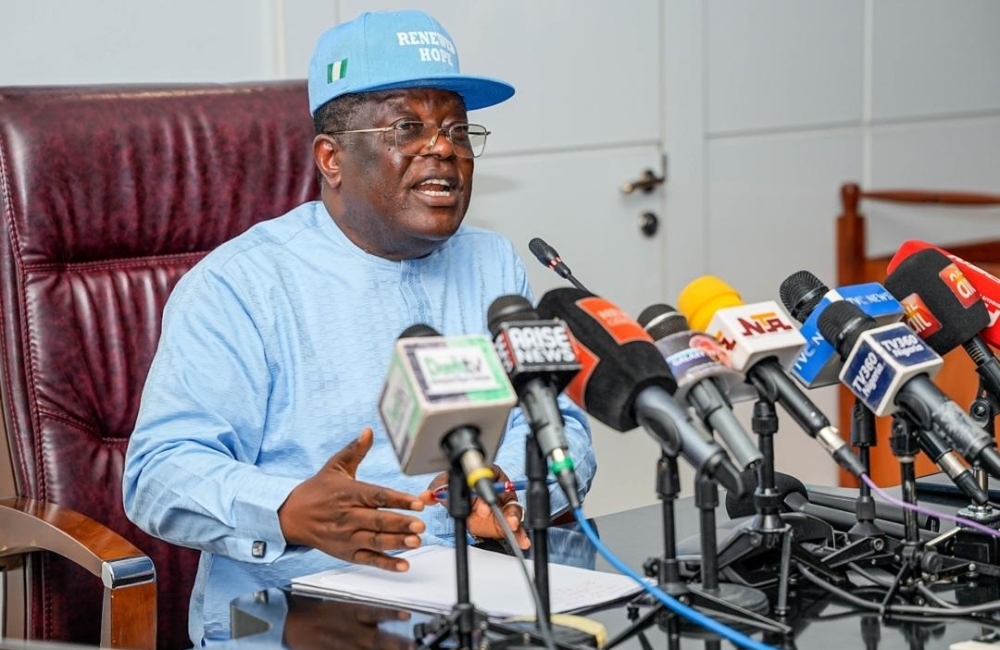
UMAHI HIGHLIGHTS IMPACT OF TINUBU’S LEGACY PROJECTS, SAYS INFRASTRUCTURE INVESTMENTS ARE TRANSFORMING NIGERIA
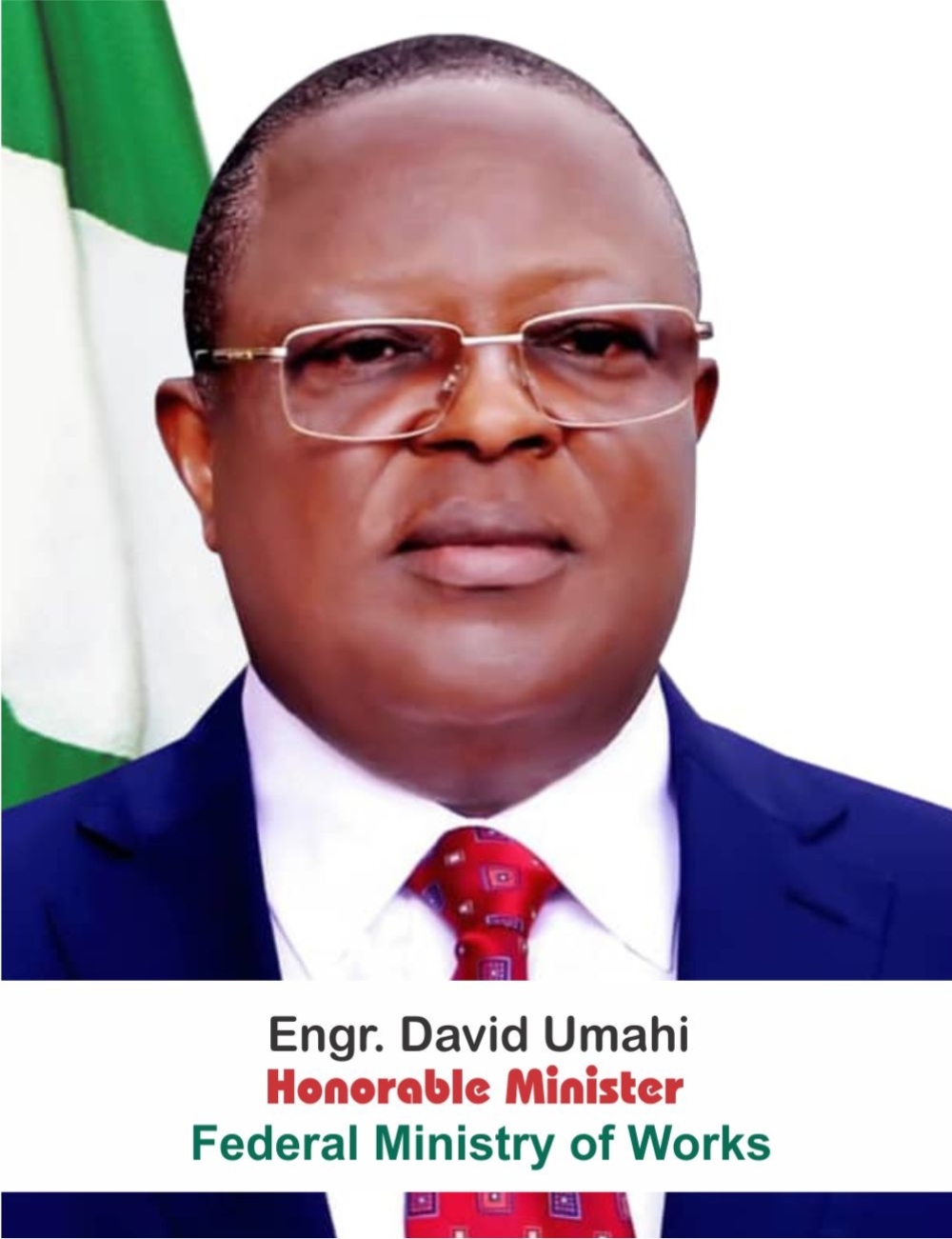
The Honourable Minister of Works, Engr. David Umahi, CON, FNSE, FNATE, has highlighted the progress and transformative impact of the major infrastructure projects being executed by the President Bola Ahmed Tinubu-led Administration, describing them as strategic investments aimed at reshaping Nigeria’s transportation network, strengthening national connectivity and stimulating economic growth.
Umahi said this on Wednesday, 7 October 2026, in Abuja, during a *Press Conference,* where he updated on the Tinubu Administration's *four Legacy Road Projects,* ongoing federal road interventions, completed projects, procurement processes, and the Ministry’s efforts to ensure value for money in the development of infrastructure.
The Minister identified the four legacy projects as the Lagos-Calabar Coastal Highway, Sokoto-Badagry Superhighway, Calabar-Ebonyi-Abuja Highway (the Trans-Saharan Route/North-South connectivity corridor, and the Dualisation of Akwanga-Jos-Bauchi-Gombe-Biu-Maiduguri Road.
According to him, the projects were conceived as strategic national infrastructure to connect all six (6) geopolitical zones, facilitate the movement of people and goods, open up economic opportunities, and strengthen Nigeria’s long-term development.
Giving an update on the Lagos-Calabar Coastal Highway, Umahi disclosed that Section 1, covering 47 kilometres, has been completed, while significant progress has also been recorded on Section 2, covering approximately 55 kilometres.
He explained that pavement works on Section 2 were nearing completion, while major flyovers, overpasses and underpasses were being constructed to address complex traffic, environmental and engineering challenges along the corridor.
The Minister said some parts of the alignment had to be redesigned to accommodate existing and planned rail, road and industrial infrastructure, particularly around the Dangote Refinery and Lekki Deep Seaport axis. He stressed that the objective was to develop an integrated transportation system rather than an isolated road project. On the Ondo State axis, Umahi explained that the alignment was redesigned in some locations because of difficult terrain, deep pits and challenging subsoil conditions. He said the redesign was aimed at ensuring durability, safety and cost-effectiveness, with substantial filling and ground improvement works ongoing in some areas.
The Minister further disclosed that President Tinubu had directed that the continuation of the Lagos-Calabar Coastal Highway be aligned with the existing East-West Road in parts of the Niger Delta area.
He described the decision as a strategic engineering intervention that would address the increasing impact of flooding and climate change on the vital infrastructure. According to him, critical sections of the East-West Road would be raised to accommodate present and anticipated flood levels and ensure the continued functionality of the strategic route.
Umahi also dwelled on the importance of the Construction of the Benin City Bypass and other sections of the littoral corridor in reducing congestion and improving movement across the South-South zone.
On the Sokoto-Badagry Superhighway, the Minister said the project was designed to establish a major economic corridor linking Ilelah in Sokoto State with Badagry in Lagos State. He noted that various sections of the highway were at different stages of construction, with significant progress recorded across the Sokoto, Kebbi, Oyo, Ogun and Badagry axes, while those of Niger and Kwara States are commencing soon.
Umahi said the strategic importance of the project is beyond road construction, noting that the corridor would unlock agricultural, industrial, tourism and other economic opportunities. He added that the Federal Government was exploring opportunities for complementary investments, including agriculture, housing, tourism and other economic activities along the major infrastructure corridors.
Speaking on the third legacy project, the ancient Trans-Saharan Route, Engr. Umahi explained that it was designed to strengthen connectivity between the coastal axis and the northern parts of the country, thereby facilitating the movement of people, goods and services across the South-South, South East and North Central geopolitical zones.
He disclosed that substantial progress had been recorded on the initial sections, while additional sections had been approved to make the corridor more economically viable and attractive to potential financiers.
On the fourth legacy project, the Minister said the Akwanga-Jos-Bauchi-Gombe-Biu-Maiduguri single carriageway is being expanded as a major northern connectivity route. He explained that the scope had been extended to cover an additional spur from Jos to Ibi in Taraba State, with design and procurement processes ongoing.
Responding to questions from journalists on the number of completed projects, the Minister listed several major road and bridge projects completed or ready for commissioning across the country. Among the projects, he mentioned Section I of the Lagos-Calabar Coastal Highway, the Kwanar Danja-Hadejia Road, the Kaduna-Pambeguwa Road, the Lafia Bypass, the Bodo-Bonny Road with Bridges along the Opobo Channel, among many others.
He also listed the completed first lot of the Lagos-Calabar Coastal Highway, the Gombe-Potiskum rehabilitation project, sections of the Azare road linking Jigawa and Bauchi, the five-span Ampoha Bridge, the 23-kilometre, 23-span flyover project at Ekpoma-Benin axis, and a three-span, 75-metre dualised bridge structure.
Umahi further disclosed that several sections of the Lagos-Badagry and Lagos-Ibadan, Lagos-Shagamu-Ore corridors had been completed, while other sections were at advanced stages of completion.
He assured journalists that the Ministry was updating its compendium of completed and ongoing projects. “*We have quite a lot of projects. We have completed projects and we have ongoing projects. We are updating the compendium and it will be made available on the Ministry’s website and circulated to the public,”* he assured.
The Minister reiterated the Federal Ministry of Works' increasing adoption of concrete pavement on major highways, saying the need for greater durability and reduced maintenance costs is driving the policy.
According to him, the Ministry is developing infrastructure that would serve Nigerians for several decades and provide better value for public resources. He reiterated that concrete pavement provides longer durability guarantees, when properly designed and constructed, compared with the recurring maintenance challenges associated with conventional asphalt pavement.
Addressing questions concerning the procurement process for the Lagos-Calabar Coastal Highway, Umahi explained that the Ministry followed an applicable procurement framework. He said the special procurement approach was necessitated by the unique engineering requirements of constructing a major highway through a difficult coastal terrain.
According to him, the Ministry identified the need for a contractor with a proven track record in executing similar coastal infrastructure and subsequently made a recommendation to the Bureau of Public Procurement (BPP). He disclosed that the BPP reviewed the recommendation and gave its clearance, while the Federal Executive Council remained the final approving authority.
Umahi said the Ministry subjected the contractor's bid to scrutiny by comparing proposed rates with prevailing market prices for materials and other inputs. He stressed that both indigenous and expatriate contractors were subjected to the same pricing and evaluation principles.
*“We put everybody on the same platform. We sent the proposals to the Bureau of Public Procurement. They reviewed it and where they felt that the rates went beyond their expected maxima, they called our attention to it, and we reviewed the rates accordingly,”* he explained.
The Minister also disclosed that substantial progress had been recorded on the Outstanding Sections of the Abuja-Kaduna-Zaria-Kano Expressway, with all the sections completed except the Jere-Kaduna portion advancing steadily. He revealed that the Ministry is installing solar-powered lighting along the 375-kilometre Expressway to improve night visibility, thereby enhancing safety and security. He also said that the improved condition of the highway, alongside security interventions, was contributing to safer and more efficient movement along the corridor.
The Minister disclosed that the Ministry had commenced an *“Operation Rescue”* on the Benin-Asaba Expressway following challenges associated with the road and its existing concession arrangement. He said the Federal Government had intervened to restore mobility, while plans were being developed for a comprehensive reconstruction of the entire alignment, using continuously reinforced concrete pavement (CRCP). He stressed that Nigerians should not continue to suffer because of unresolved contractual or concession-related issues.
The Minister, particularly, highlighted the Federal Government's increased infrastructure investment in the South East, saying the Tinubu Administration had demonstrated a clear commitment to reintegrating the hitherto neglected zone into the national infrastructure development programme. He said several major road projects had either been approved, commenced, or completed by the present administration.
Umahi, who is from the zone, said it might not have the highest number of federal projects compared with other geopolitical zones, but it was no longer being left behind.
*“We can't continue to live in denial. What we have been crying for is being given. The people of the South East are being fully reintegrated into the national infrastructure development plan,”* he emphasised.
He cited the completion of the Second Niger Bridge, the rehabilitation of the 1st Niger Bridge, ongoing construction of major Bypasses and other federal road projects in the zone as evidence of the administration's commitment.
The Minister maintained that infrastructure development should be viewed from the perspective of national integration rather than regional politics. He stated that the Federal Government's infrastructure agenda was intended to ensure that every part of Nigeria benefited from strategic investments in roads, bridges and other transportation infrastructure.
On the Tax-Credit Scheme’s projects inherited from the previous administrations, Umahi explained that the Federal Government had taken proactive measures to address them, especially where private-sector partners were no longer able to sustain previously approved financing arrangements.
He warned contractors, who had received mobilisation or project funds but failed to deploy the funds on the work that the Ministry would take appropriate steps to recover such funds. He stressed that accountability, performance and value for money remained central to the Ministry's project execution strategy.
The Minister also addressed the ongoing intervention on the First Niger Bridge, explaining that measures were being introduced to improve traffic management and protect the structural integrity of the bridge. He said the Ministry was installing appropriate traffic management infrastructure, CCTV cameras and other security measures at its Asaba and Onitsha ends. According to Umahi, the measures were necessary because bridges are designed primarily for dynamic as opposed to static loads, explaining that prolonged traffic gridlock can create additional structural and safety challenges. He said remedial works, repainting and other maintenance activities were also being undertaken to ensure the long-term usage of the structure.
Umahi further explained that the Federal Government's road development strategy included environmental considerations, such as the planting of trees along major highways and the installation of solar-powered street lighting. He said the initiative would help improve visibility and the environment, provide shade, and contribute to the reduction of harmful emissions along major transport corridors.
The Minister also linked infrastructure development to the broader economic reforms of the Renewed Hope Agenda of the Tinubu Administration, saying improved roads and connectivity would support agricultural production, industrialisation, trade, commerce, tourism and investment. He maintained that the Federal Government's infrastructure investments were part of a broader strategy to move economic growth from the macroeconomic level to the grassroots.
On the financing of the major legacy projects, Umahi assured Nigerians that the Federal Government had put mechanisms in place to ensure that the projects are adequately funded to completion.
He revealed that significant portions of the projects had been funded, while loan-financing arrangements were being implemented for the remaining components.
He noted that the administration was determined not to embark on projects without ensuring that there was a credible financing mechanism for their completion.
*“We don't start what we will not finish. And we will not finish what we have not started,”* he stated.
The Minister reaffirmed the commitment of the Ministry to completing inherited projects, while simultaneously delivering new strategic infrastructure under the Tinubu Administration. He said the legacy projects were not merely road construction schemes but long-term investments designed to transform Nigeria's economic landscape, improve connectivity, strengthen national integration and security, and create opportunities for millions of Nigerians.
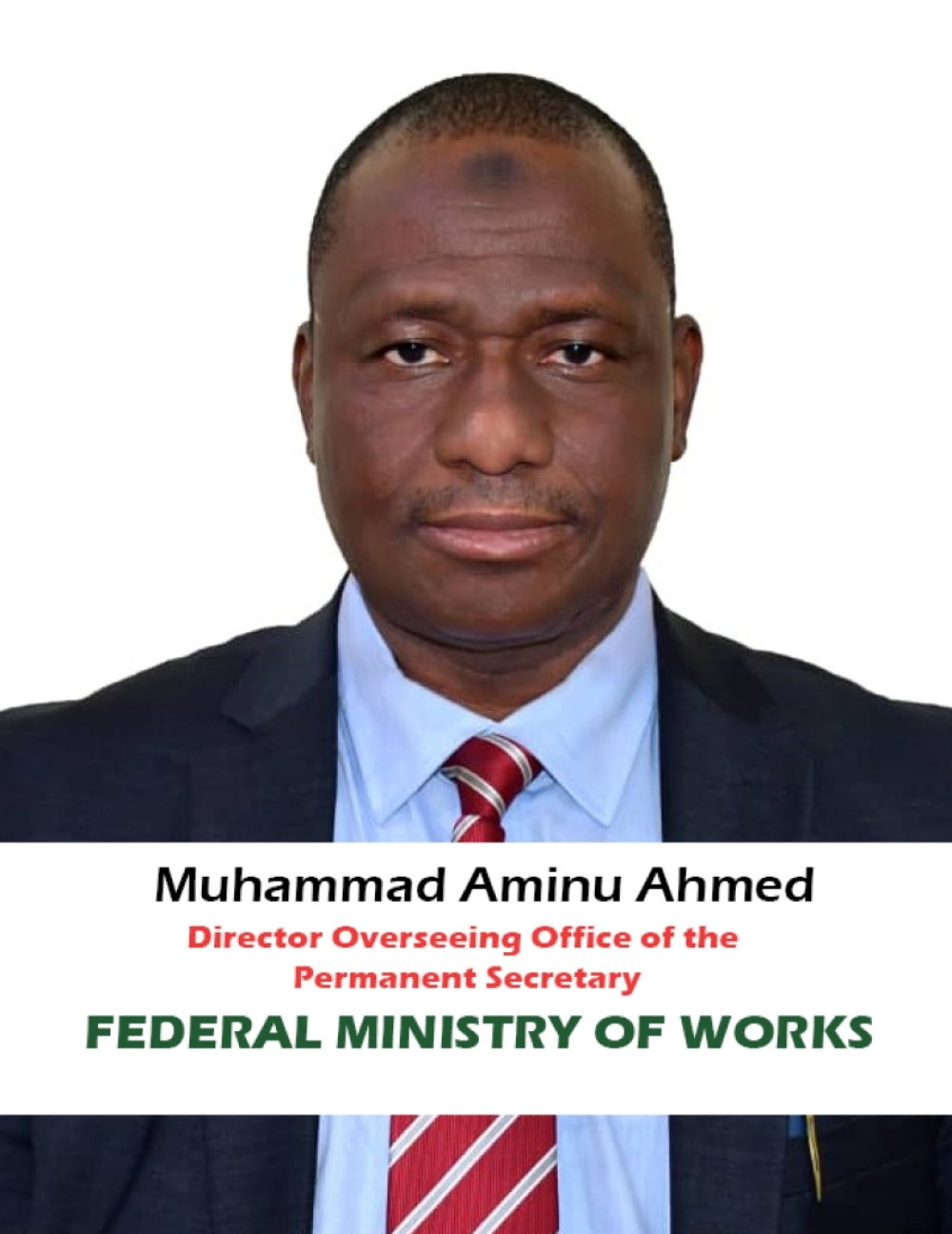
In his closing remarks, the *Director Overseeing the Office of the Permanent Secretary (DOOPS), Mohammed Aminu Ahmed, FCNA,* expressed appreciation to the Minister, members of the media, and all participants for attending. He commended the media for its continued partnership with the Ministry in informing Nigerians about government infrastructure projects and encouraged it to continue to provide constructive criticism on the Ministry's activities.

UMAHI HIGHLIGHTS IMPACT OF TINUBU’S LEGACY PROJECTS, SAYS INFRASTRUCTURE INVESTMENTS ARE TRANSFORMING NIGERIA The Honourable Minister of Works, Engr. David Umahi, CON, FNSE, FNATE, has highlighted the progress and transformative impact of the major infrastructure projects being executed by the President Bola Ahmed Tinubu-led Administration, describing them as strategic investments aimed at reshaping Nigeria’s transportation network, strengthening national connectivity and stimulating economic growth. Umahi said this on Wednesday, 7 October 2026, in Abuja, during a *Press Conference,* where he updated on the Tinubu Administration's *four Legacy Road Projects,* ongoing federal road interventions, completed projects, procurement processes, and the Ministry’s efforts to ensure value for money in the development of infrastructure. The Minister identified the four legacy projects as the Lagos-Calabar Coastal Highway, Sokoto-Badagry Superhighway, Calabar-Ebonyi-Abuja Highway (the Trans-Saharan Route/North-South connectivity corridor, and the Dualisation of Akwanga-Jos-Bauchi-Gombe-Biu-Maiduguri Road. According to him, the projects were conceived as strategic national infrastructure to connect all six (6) geopolitical zones, facilitate the movement of people and goods, open up economic opportunities, and strengthen Nigeria’s long-term development. Giving an update on the Lagos-Calabar Coastal Highway, Umahi disclosed that Section 1, covering 47 kilometres, has been completed, while significant progress has also been recorded on Section 2, covering approximately 55 kilometres. He explained that pavement works on Section 2 were nearing completion, while major flyovers, overpasses and underpasses were being constructed to address complex traffic, environmental and engineering challenges along the corridor. The Minister said some parts of the alignment had to be redesigned to accommodate existing and planned rail, road and industrial infrastructure, particularly around the Dangote Refinery and Lekki Deep Seaport axis. He stressed that the objective was to develop an integrated transportation system rather than an isolated road project. On the Ondo State axis, Umahi explained that the alignment was redesigned in some locations because of difficult terrain, deep pits and challenging subsoil conditions. He said the redesign was aimed at ensuring durability, safety and cost-effectiveness, with substantial filling and ground improvement works ongoing in some areas. The Minister further disclosed that President Tinubu had directed that the continuation of the Lagos-Calabar Coastal Highway be aligned with the existing East-West Road in parts of the Niger Delta area. He described the decision as a strategic engineering intervention that would address the increasing impact of flooding and climate change on the vital infrastructure. According to him, critical sections of the East-West Road would be raised to accommodate present and anticipated flood levels and ensure the continued functionality of the strategic route. Umahi also dwelled on the importance of the Construction of the Benin City Bypass and other sections of the littoral corridor in reducing congestion and improving movement across the South-South zone. On the Sokoto-Badagry Superhighway, the Minister said the project was designed to establish a major economic corridor linking Ilelah in Sokoto State with Badagry in Lagos State. He noted that various sections of the highway were at different stages of construction, with significant progress recorded across the Sokoto, Kebbi, Oyo, Ogun and Badagry axes, while those of Niger and Kwara States are commencing soon. Umahi said the strategic importance of the project is beyond road construction, noting that the corridor would unlock agricultural, industrial, tourism and other economic opportunities. He added that the Federal Government was exploring opportunities for complementary investments, including agriculture, housing, tourism and other economic activities along the major infrastructure corridors. Speaking on the third legacy project, the ancient Trans-Saharan Route, Engr. Umahi explained that it was designed to strengthen connectivity between the coastal axis and the northern parts of the country, thereby facilitating the movement of people, goods and services across the South-South, South East and North Central geopolitical zones. He disclosed that substantial progress had been recorded on the initial sections, while additional sections had been approved to make the corridor more economically viable and attractive to potential financiers. On the fourth legacy project, the Minister said the Akwanga-Jos-Bauchi-Gombe-Biu-Maiduguri single carriageway is being expanded as a major northern connectivity route. He explained that the scope had been extended to cover an additional spur from Jos to Ibi in Taraba State, with design and procurement processes ongoing. Responding to questions from journalists on the number of completed projects, the Minister listed several major road and bridge projects completed or ready for commissioning across the country. Among the projects, he mentioned Section I of the Lagos-Calabar Coastal Highway, the Kwanar Danja-Hadejia Road, the Kaduna-Pambeguwa Road, the Lafia Bypass, the Bodo-Bonny Road with Bridges along the Opobo Channel, among many others. He also listed the completed first lot of the Lagos-Calabar Coastal Highway, the Gombe-Potiskum rehabilitation project, sections of the Azare road linking Jigawa and Bauchi, the five-span Ampoha Bridge, the 23-kilometre, 23-span flyover project at Ekpoma-Benin axis, and a three-span, 75-metre dualised bridge structure. Umahi further disclosed that several sections of the Lagos-Badagry and Lagos-Ibadan, Lagos-Shagamu-Ore corridors had been completed, while other sections were at advanced stages of completion. He assured journalists that the Ministry was updating its compendium of completed and ongoing projects. “*We have quite a lot of projects. We have completed projects and we have ongoing projects. We are updating the compendium and it will be made available on the Ministry’s website and circulated to the public,”* he assured. The Minister reiterated the Federal Ministry of Works' increasing adoption of concrete pavement on major highways, saying the need for greater durability and reduced maintenance costs is driving the policy. According to him, the Ministry is developing infrastructure that would serve Nigerians for several decades and provide better value for public resources. He reiterated that concrete pavement provides longer durability guarantees, when properly designed and constructed, compared with the recurring maintenance challenges associated with conventional asphalt pavement. Addressing questions concerning the procurement process for the Lagos-Calabar Coastal Highway, Umahi explained that the Ministry followed an applicable procurement framework. He said the special procurement approach was necessitated by the unique engineering requirements of constructing a major highway through a difficult coastal terrain. Umahi said the Ministry subjected the contractor's bid to scrutiny by comparing proposed rates with prevailing market prices for materials and other inputs. He stressed that both indigenous and expatriate contractors were subjected to the same pricing and evaluation principles. *“We put everybody on the same platform. We sent the proposals to the Bureau of Public Procurement. They reviewed it and where they felt that the rates went beyond their expected maxima, they called our attention to it, and we reviewed the rates accordingly,”* he explained. The Minister also disclosed that substantial progress had been recorded on the Outstanding Sections of the Abuja-Kaduna-Zaria-Kano Expressway, with all the sections completed except the Jere-Kaduna portion advancing steadily. He revealed that the Ministry is installing solar-powered lighting along the 375-kilometre Expressway to improve night visibility, thereby enhancing safety and security. He also said that the improved condition of the highway, alongside security interventions, was contributing to safer and more efficient movement along the corridor. The Minister disclosed that the Ministry had commenced an *“Operation Rescue”* on the Benin-Asaba Expressway following challenges associated with the road and its existing concession arrangement. He said the Federal Government had intervened to restore mobility, while plans were being developed for a comprehensive reconstruction of the entire alignment, using continuously reinforced concrete pavement (CRCP). He stressed that Nigerians should not continue to suffer because of unresolved contractual or concession-related issues. The Minister, particularly, highlighted the Federal Government's increased infrastructure investment in the South East, saying the Tinubu Administration had demonstrated a clear commitment to reintegrating the hitherto neglected zone into the national infrastructure development programme. He said several major road projects had either been approved, commenced, or completed by the present administration. *“We can't continue to live in denial. What we have been crying for is being given. The people of the South East are being fully reintegrated into the national infrastructure development plan,”* he emphasised. He cited the completion of the Second Niger Bridge, the rehabilitation of the 1st Niger Bridge, ongoing construction of major Bypasses and other federal road projects in the zone as evidence of the administration's commitment. The Minister maintained that infrastructure development should be viewed from the perspective of national integration rather than regional politics. He stated that the Federal Government's infrastructure agenda was intended to ensure that every part of Nigeria benefited from strategic investments in roads, bridges and other transportation infrastructure. On the Tax-Credit Scheme’s projects inherited from the previous administrations, Umahi explained that the Federal Government had taken proactive measures to address them, especially where private-sector partners were no longer able to sustain previously approved financing arrangements. He warned contractors, who had received mobilisation or project funds but failed to deploy the funds on the work that the Ministry would take appropriate steps to recover such funds. He stressed that accountability, performance and value for money remained central to the Ministry's project execution strategy. The Minister also addressed the ongoing intervention on the First Niger Bridge, explaining that measures were being introduced to improve traffic management and protect the structural integrity of the bridge. He said the Ministry was installing appropriate traffic management infrastructure, CCTV cameras and other security measures at its Asaba and Onitsha ends. According to Umahi, the measures were necessary because bridges are designed primarily for dynamic as opposed to static loads, explaining that prolonged traffic gridlock can create additional structural and safety challenges. He said remedial works, repainting and other maintenance activities were also being undertaken to ensure the long-term usage of the structure. Umahi further explained that the Federal Government's road development strategy included environmental considerations, such as the planting of trees along major highways and the installation of solar-powered street lighting. He said the initiative would help improve visibility and the environment, provide shade, and contribute to the reduction of harmful emissions along major transport corridors. The Minister also linked infrastructure development to the broader economic reforms of the Renewed Hope Agenda of the Tinubu Administration, saying improved roads and connectivity would support agricultural production, industrialisation, trade, commerce, tourism and investment. He maintained that the Federal Government's infrastructure investments were part of a broader strategy to move economic growth from the macroeconomic level to the grassroots. On the financing of the major legacy projects, Umahi assured Nigerians that the Federal Government had put mechanisms in place to ensure that the projects are adequately funded to completion. He noted that the administration was determined not to embark on projects without ensuring that there was a credible financing mechanism for their completion. The Minister reaffirmed the commitment of the Ministry to completing inherited projects, while simultaneously delivering new strategic infrastructure under the Tinubu Administration. He said the legacy projects were not merely road construction schemes but long-term investments designed to transform Nigeria's economic landscape, improve connectivity, strengthen national integration and security, and create opportunities for millions of Nigerians. In his closing remarks, the *Director Overseeing the Office of the Permanent Secretary (DOOPS), Mohammed Aminu Ahmed, FCNA,* expressed appreciation to the Minister, members of the media, and all participants for attending. He commended the media for its continued partnership with the Ministry in informing Nigerians about government infrastructure projects and encouraged it to continue to provide constructive criticism on the Ministry's activities.
According to him, the Ministry identified the need for a contractor with a proven track record in executing similar coastal infrastructure and subsequently made a recommendation to the Bureau of Public Procurement (BPP). He disclosed that the BPP reviewed the recommendation and gave its clearance, while the Federal Executive Council remained the final approving authority.
Umahi, who is from the zone, said it might not have the highest number of federal projects compared with other geopolitical zones, but it was no longer being left behind.
He revealed that significant portions of the projects had been funded, while loan-financing arrangements were being implemented for the remaining components.
*“We don't start what we will not finish. And we will not finish what we have not started,”* he stated.
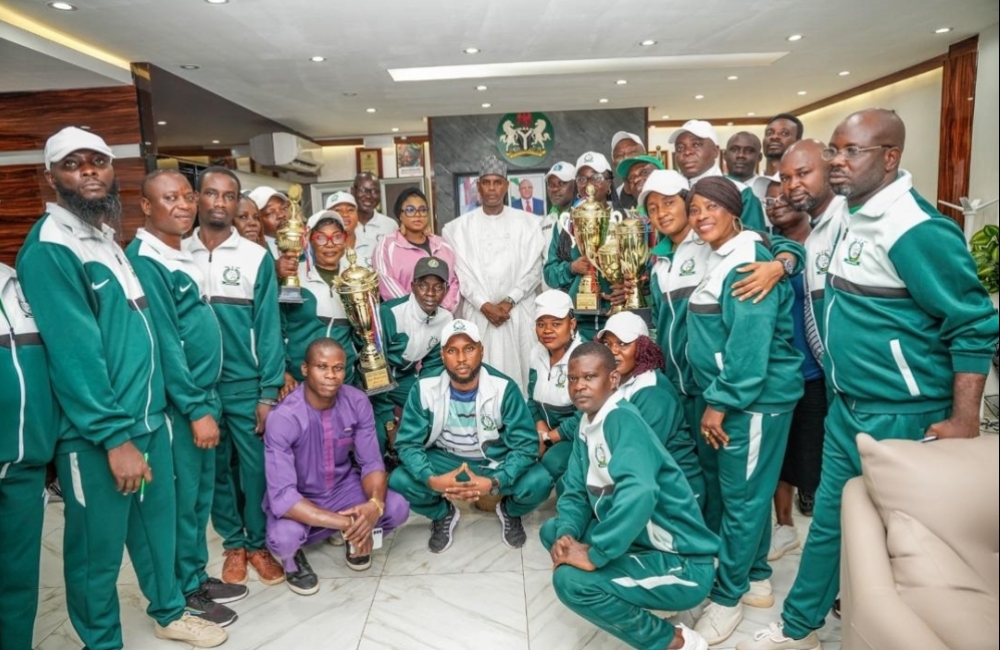
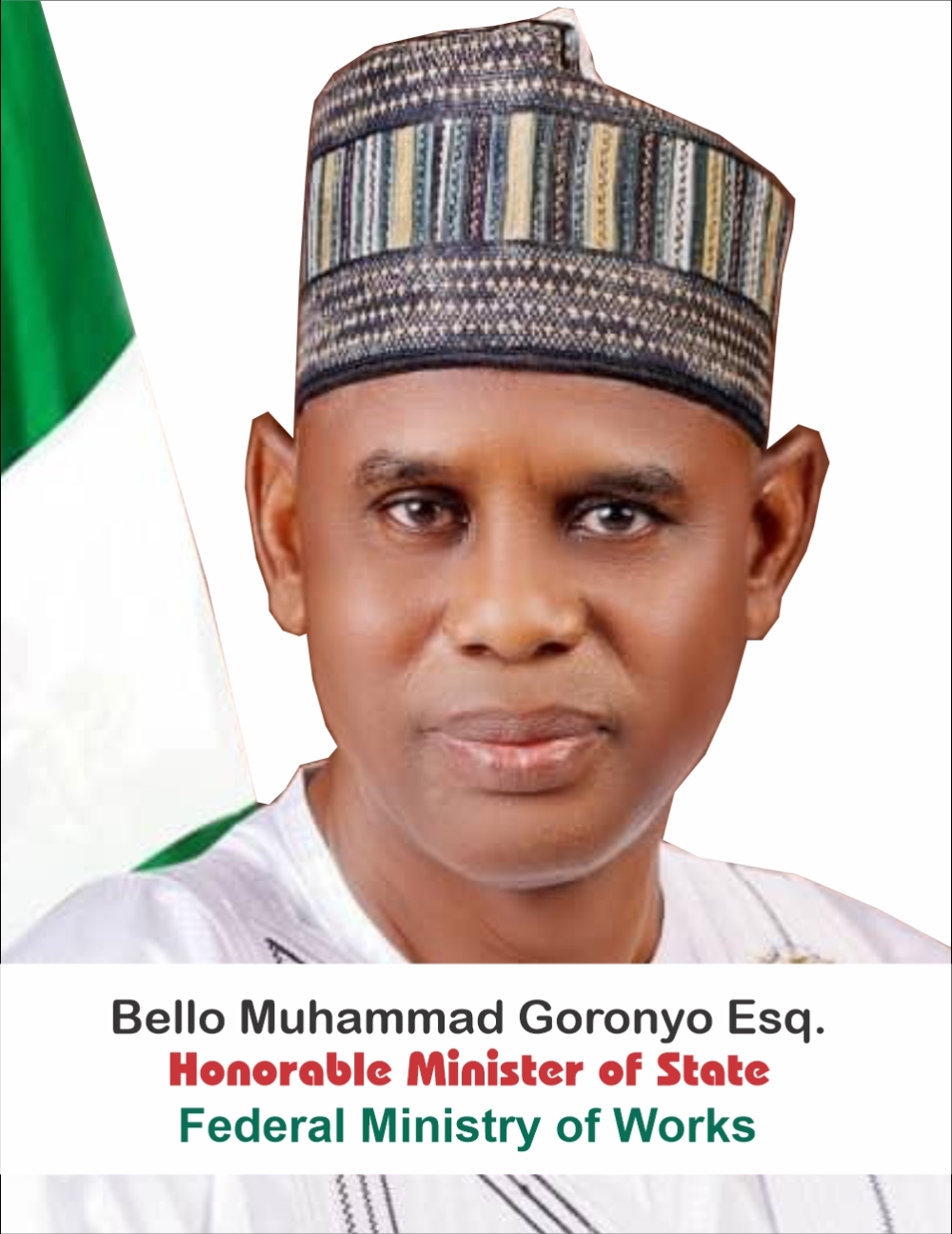
WORKS MINISTRY SPORTS CLUB COMMENCES 2026 SPORTS WEEK, COMMENDS UMAHI, GORONYO AND MANAGEMENT FOR SUPPORT The Federal Ministry of Works Sports Club has commenced its 2026 Sports Week with a series of activities aimed at promoting physical fitness, staff welfare, unity, teamwork, and excellence amongst the Ministry’s employees. As part of the Sports Week activities, the Sports Club, led by its officials and members, paid courtesy visits to key management officials of the Ministry today, Monday, 31 August 2026. The visits provided an opportunity for the Club to appreciate the leadership of the Ministry for its continued support for sports development, staff welfare and the activities of the Sports Club. Receiving the Sports Club’s delegation, *the Honourable Minister of State for Works, Bello Muhammad Goronyo, Esq.,* commended the Club for its achievements and contributions to the image of the Ministry, through its participation in various sporting competitions. The Minister of State congratulated the Club on its successes and assured the team of the Ministry's continued support. He expressed that the achievements of the Sports Club were not only about winning trophies but also about promoting the physical and mental well-being of staff, noting that a healthy workforce was essential to the effective discharge of their responsibilities. According to him, the Ministry would continue to encourage and support sporting activities that would keep staff physically fit, while also projecting the Ministry positively at national and inter-ministerial competitions. He congratulated the Sports Club for its commitment and urged its members to sustain the tempo and continue bringing glory to the Ministry. The delegation also paid a courtesy visit to *the Director Overseeing the Office of the Permanent Secretary (DOOPS), Alhaji Aminu Ahmed,* who assured them of his willingness to support its activities within the resources available to the Ministry. The *DOOPS* expressed optimism about the future of the Club and promised to do his best to support its programmes and activities. He, particularly, welcomed the planned hosting of future sporting activities in Kano, his home state, assuring the Club of the necessary support and hospitality within his capacity. Alhaji Ahmed also expressed his commitment to addressing some of the challenges confronting the Club, while acknowledging the current financial constraints facing the Ministry. In his remarks, the Director of Human Resource Management and Chairman of the Federal Ministry of Works’ Sports Club, Malam Ahmad Muhammad Tukur, appreciated the management of the Ministry for its continued support and urged members of the Sports Club to remain committed to excellence and the spirit of sportsmanship. He assured the Club of his continued support and encouraged members to maintain discipline, teamwork, and dedication, stressing that their achievements represented not only the Sports Club but the entire Ministry. The Sports Club also expressed appreciation to the Honourable Minister of Works, Sen. Engr. David Umahi, CON, FNSE, FNATE, and the Minister of State, Bello Muhammad Goronyo, Esq. for their encouragement of sporting activities and passion for staff welfare. A major highlight of the Sports Week was the launch of the Federal Ministry of Works Sports Club’s magazine, Sport Waves, which received financial support from *a former Senator Yakubu Lado,* in collaboration with the *Director, Highways, Bridges and Design (B&D), Engr. Musa Saidu.* *Senator Lado* supported the publication of the Sport Waves magazine with the sum of *₦5 million* and pledged to transfer the funds to the Sports Club's account. He also promised to advertise his company in the next edition of the magazine. The gesture was described by the Sports Club as a significant boost to its efforts to promote sporting activities, document its achievements and further strengthen its relationship with stakeholders. Speaking during the commencement of the Sports Week activities, the Sports Manager, Mr. Fakande Ayorinde Adeniyi, said the Club decided to begin the celebration with *Courtesy Visits* to senior officials of the Ministry as a demonstration of respect and appreciation for their support. He further stated that the Sports Club would continue to work closely with the Ministry's management to sustain its achievements and make the Ministry proud. The Assistant Sports Manager, Mr. Tayo Omotosho, also expressed appreciation to the management and other supporters of the Club, noting that their encouragement had continued to boost the morale of members and inspire them to achieve more. He assured the leadership of the Ministry that the Sports Club would remain committed to excellence and continue to represent the Federal Ministry of Works positively at every sporting engagement. The 2026 Sports Week is expected to feature a range of sporting and fitness activities designed to promote healthy living, teamwork, friendship, and unity among staff of the Ministry. The Sports Club reaffirmed its commitment to using sports as a veritable platform for staff development, physical fitness, team spirit, and the positive representation of the Federal Ministry of Works. ...
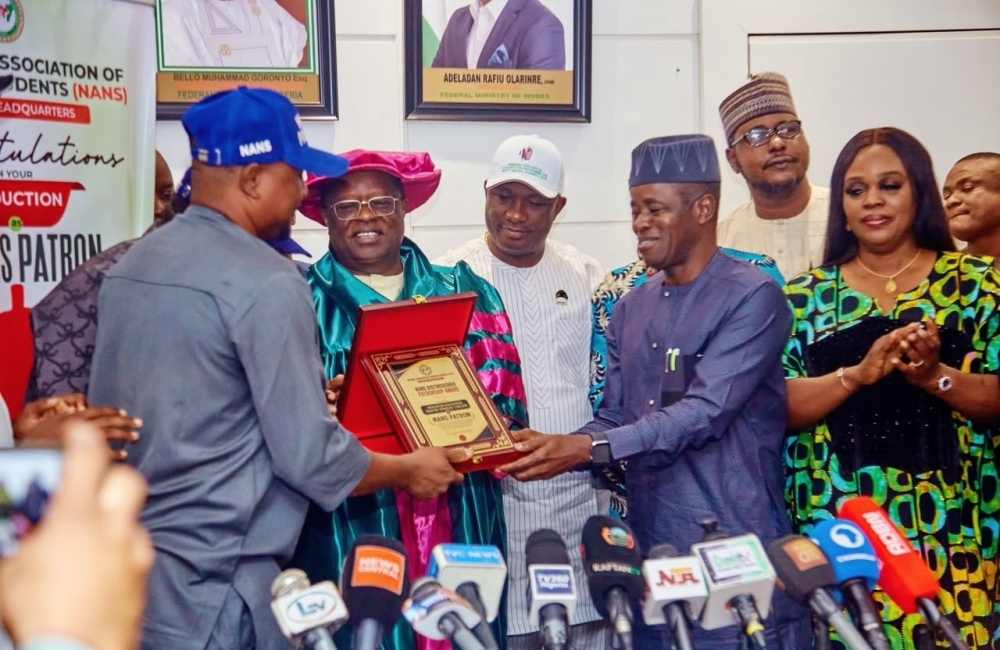
“THE WORST IS OVER; OUR GDP IS GROWING MORE THAN OUR POPULATION. THAT MEANS WE HAVE A FUTURE” - UMAHI TELLS NANS — As Nigerian Students Induct Him as Grand Patron, Hail Him as “One of the Finest” in Tinubu’s Renewed Hope Cabinet The Minister of Works, Senator Engr. David Umahi, CON, has declared that Nigeria is now seeing stronger economic outlook under President Bola Ahmed Tinubu, noting that the country’s Gross Domestic Product (GDP) is now growing faster than its population. Umahi made the declaration on Monday, August 10, 2026, at the headquarters of the Federal Ministry of Works in Abuja, while speaking after he was formally inducted as Patron of the National Association of Nigerian Students (NANS). The minister described the development as a positive indication of Nigeria’s economic prospects, saying, “I was enthused to find out that our GDP is growing more than our population. That means we have a future.” The NANS leadership, led by its President, Dist. Comr. Akinteye Babatunde Afeez, GCNS, had earlier commended Umahi for his contributions to national infrastructure and described him as “a worthy member of the Renewed Hope Cabinet and, indeed, as one of the finest public servants Nigeria has produced in the contemporary era.” The students said the recognition was not merely ceremonial but a reflection of Umahi’s visible contribution to road infrastructure and national development under President Bola Ahmed Tinubu’s administration. According to NANS, the roads and bridges being delivered under Umahi’s supervision are directly connected to the lives of Nigerian students, affecting their mobility, access to educational institutions, examinations, internships, businesses and employment opportunities. The students specifically cited major projects including the Abuja-Kaduna-Kano Expressway, Abuja-Kaduna-Minna route, Enugu-Port Harcourt Expressway and Lagos-Calabar Coastal Highway as examples of projects they said demonstrate the Federal Government’s commitment to improving national connectivity. Afeez also disclosed that NANS had studied project reports of the Federal Ministry of Works covering the period between May 2023 and May 2026 and expressed its intention to embark on nationwide project tours to inspect completed and rehabilitated projects. He said the students would use their platforms to communicate the impact of the projects to millions of Nigerian students, Nigerians and the wider world. Responding, Umahi challenged Nigerian students and young people to look beyond political sentiments and examine the policies and achievements of the Tinubu administration objectively. “We have had somebody say, ‘President Tinubu is tired.’ How do you know he is tired? I am part of President Tinubu. The Minister of Interior, the FCT, all the ministers and all the SSAs are vibrant and working. So how do you just jump at that conclusion?” The minister urged Nigerians to demand concrete alternatives from those criticising the administration. “If you say that the President is not doing well, what is your alternative?” he asked, stressing that political promises must be backed by clear plans and a credible mission. He also called on students and other young Nigerians to take a position on issues affecting the country, arguing that remaining neutral in the face of visible progress was not always the right approach. “You may say that you are not politicians or that you will not take sides, but this is the time to take sides in our national affairs. It is time to take a stand,” Umahi said. On the economy, the minister acknowledged that the macroeconomy was only beginning to recover but urged Nigerians to consider the condition of the economy before the present administration took office and assess the reforms objectively. “You may say that the macroeconomy is just beginning to recover. What was it like before the President took over? Everybody agrees that the macroeconomy is being fixed. It is up to you to dissect the ongoing reforms and take a position.” Umahi also pointed to developments in the education sector, saying the stability being witnessed under the Tinubu administration had created an environment in which students were able to continue their studies without the disruption of nationwide strikes. “For the first time, students never went on strike. Never. Look at the stability of Nigeria. That has never happened throughout the history of this country.” “Where is the subsidy money?” Umahi explains Addressing questions surrounding the removal of fuel subsidy and where the resulting resources were being deployed, Umahi pointed to the scale of ongoing infrastructure projects across the country. He cited the Abuja-Kaduna-Zaria-Kano road, which he said covers 375 kilometres and, when measured as a dual carriageway, amounts to 750 kilometres. According to the minister, more than ₦200 billion has already been spent on the project, with 480 kilometres of the dual carriageway completed and further sections nearing completion. “For the first time, we have been able to complete 118 kilometres of concrete pavement within 30 months. That has never happened,” he said. The Minister said the remaining works were expected to be completed by November, noting that the two projects on the route have a combined cost of ₦752 billion, with more than 80 percent already paid. He also highlighted the Sokoto-Zamfara-Zaria corridor, the Benue-Ninth Mile road, and the Bodo - Bonny Island road as examples of projects receiving significant attention under the Tinubu administration. On the Bonny Island project, he said: “For the first time, people will move from the island to the mainland in Bonny Island, where the LNG is produced. A project costing ₦280 billion under President Bola Ahmed Tinubu has been completed. The 39.7-kilometre road is fully done, and the people of Bonny are very happy. They are no longer dying at sea. They are now driving through the land.” The minister also spoke extensively about the administration’s legacy road projects, including the Lagos-Calabar Coastal Highway and the expanded Northeast Fourth Legacy Project. He disclosed that the Northeast project, originally running from Akwanga through Jos, Bauchi, Gombe and Biu, had been extended through Yobe to Maiduguri, adding another 400 kilometres to the project. Umahi defended the Lagos-Calabar Coastal Highway against criticisms, saying the project was strategically important to the Niger Delta and would be completed. “I do not know why people are attacking the Lagos-Calabar Coastal Highway. After all, this is coming from the Niger Delta, where the oil is coming from. Why is nobody attacking the other three Legacy Projects, but this one is being attacked? That is unfair and unrealistic. That project will be completed. In fact, over 50 percent of the entire stretch is already under construction.” The minister also used the occasion to speak about the development of the Southeast, saying President Tinubu had deliberately embarked on projects aimed at integrating the region into the national infrastructure network. “The Southeast, for the first time, is being remembered, and I thank the people in the Southeast because sometimes I say, ‘Listen, our people should not be sentimental.’” He said the administration’s approach to the region was intentional and urged the people of the Southeast to work with other parts of the country. “The President has a good intention to integrate the people of the Southeast, and I have to be very honest with you. If I were not a minister from the Southeast, we would not have been able to get the projects we have secured. It is intentional on the part of Mr. President. Go and right the wrongs of the Southeast.” Umahi cited the Enugu-Onitsha Expressway and Enugu-Port Harcourt Expressway among the major projects transforming connectivity in the region. He also disclosed that President Tinubu had approved the re-scoping and reconstruction of the Lokoja-Benin-Warri corridor, covering a total of 401 kilometres. The minister was particularly direct in urging the students to support President Tinubu in the 2027 election, arguing that Nigerians should support the administration if they believe its policies are producing results. “I want you to take a side. If you say you are on the list of a coalition and you say that what we are doing is good, then we have to take a stand to vote for the President in the coming election.” “Let him finish. Let him take back our country. Let him reposition our country.” Umahi also urged Nigerians to look beyond political rhetoric and focus on practical solutions to the country’s challenges. “Listening to others should not mean allowing yourselves to be insulted or blackmailed. Cheap talk will not solve our problems. Nobody is saying what he or she can do differently. The worst is over. The darkest part of the night is an hour before dawn.” He pointed to the decline in food prices as one of the developments Nigerians should consider in assessing the economy, recalling that a 50-kilogramme bag of rice, which he said had risen above ₦80,000 and at some point reached ₦100,000, was now selling at about ₦58,000. Umahi also stressed the administration’s commitment to transparency in the execution of road projects, saying the Ministry of Works had opened its projects to scrutiny by anti-corruption agencies. “Now, why are we doing this? Transparency. We have turned these projects over to the ICPC. They have gone round. We are ready for constructive criticism, and where necessary, we will make amends.” He added that the Ministry had also written to the Economic and Financial Crimes Commission (EFCC) to inspect its projects. “We have nothing to hide in this administration.” The minister urged NANS to organise a major student engagement across the geopolitical zones where students could ask questions directly and hear the government’s explanations on its policies and projects. “Let me defend this administration. Organise it and let me come. Move students from across the zone to a central point where we can talk to them and address their concerns. We have to deliberate on the issues. We have to debate them. Ask your questions, and we will answer them.” He said he would attend such engagements with some ministers and Senior Special Assistants to the President, stressing that students were important stakeholders in the country’s future. Umahi further challenged young Nigerians to take responsibility for protecting public infrastructure and contributing positively to national development. “See something, say something. Together, we can take back our country because it belongs to us.” He said the responsibility for the performance of government should be placed on the officials directly responsible for specific sectors, rather than on the President for every operational issue. “I am here because the President gave me the responsibility to be in charge of roads and bridges. If I do not do it, I should be the one to be blamed, not the President. I am not the President. The President has divided himself into a number of his appointees. These appointees should be the ones to answer and take responsibility.” The minister concluded by thanking the students for the recognition and expressing his readiness to deepen collaboration with NANS. “I want to thank you very much.“ He described the students as important partners in the national development process and encouraged them to remain informed, ask questions and hold leaders accountable. The NANS President, in his address, said the association considered Umahi worthy of its patronage because of his record of public service, infrastructure delivery and commitment to national development. He said the roads being constructed under Umahi’s leadership would outlive the present administration and continue to serve generations of Nigerians. “History will not remember public officers merely because they occupied important offices. History will remember them for what they built, what they changed and the lives they touched.” Afeez formally welcomed Umahi into the NANS family as Patron, describing the partnership between the student body and the Federal Ministry of Works as an opportunity to bring government projects closer to young Nigerians and deepen informed national discourse. ...
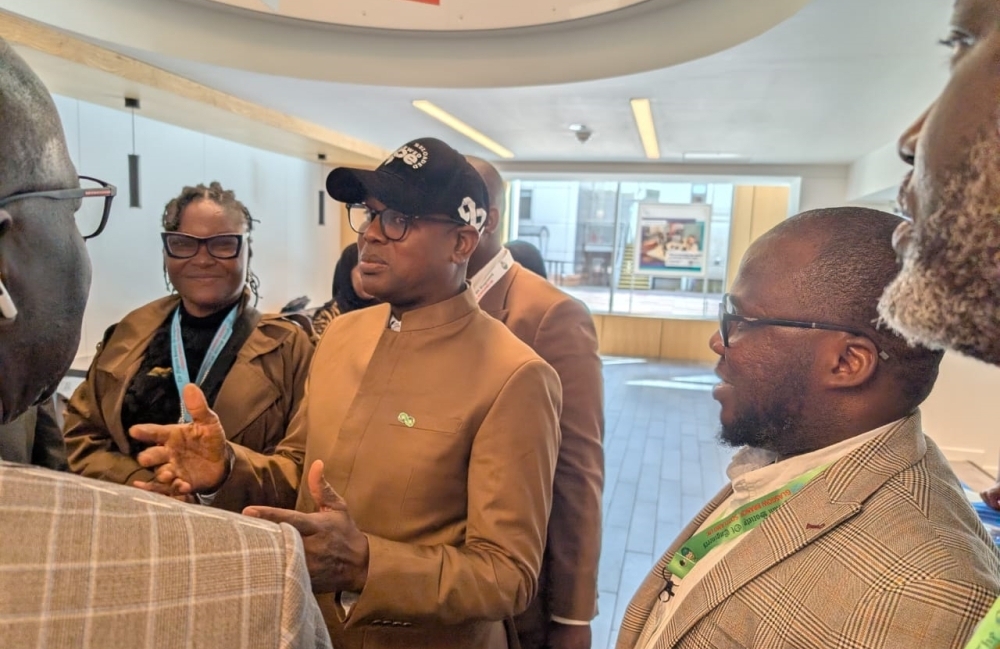
GORONYO: ENGINEERING INNOVATION, QUALITY ROADS CRITICAL TO NIGERIA’S ECONOMIC TRANSFORMATION — Says Tinubu’s Flagship Highway Projects Will Connect Nigeria, Drive Trade and Create Prosperity The Honourable Minister of State for Works, Rt. Hon. Bello Muhammad Goronyo, Esq., has called on Nigerian engineers, innovators, professionals in the diaspora and international development partners to deploy their expertise and innovations towards accelerating Nigeria’s infrastructure development and economic transformation. Goronyo made the call while speaking at the 2026 UK Engineering Conference in Glasgow, Scotland, themed “Engineering Innovation for National Impact.” The Minister described engineering as more than technical expertise, stressing that it remains a critical foundation for Nigeria’s national development, economic growth and prosperity. He said Nigeria, with its large population, abundant resources and immense human capital, could only achieve sustainable transformation by embracing innovation, professionalism and deliberate investment in infrastructure. According to him, “Roads lead to prosperity. They are not just pathways of asphalt and concrete; they are the arteries of commerce, agriculture and industry, carrying the lifeblood of our economy.” Goronyo noted that quality road infrastructure serves as a major enabler of economic growth, facilitates movement of people and goods, reduces transportation costs, creates employment opportunities and strengthens trade across the country. He said the Federal Government, under the leadership of President Bola Ahmed Tinubu, has demonstrated unprecedented commitment to infrastructure development through significant investments in road construction, rehabilitation and maintenance. The Minister highlighted the Federal Government’s flagship legacy highway projects, describing them as strategic infrastructure corridors designed to strengthen connectivity among Nigeria’s geopolitical zones and unlock economic opportunities. He listed the projects to include the 750-kilometre Lagos–Calabar Coastal Highway; the 1,068-kilometre Sokoto–Badagry Superhighway; the Trans-Sahara Trade Route (Calabar–Abuja); and the 1,100-kilometre Akwanga–Jos–Maiduguri Superhighway. Goronyo explained that the projects were not merely roads, but strategic economic lifelines designed to integrate communities, facilitate trade, strengthen regional connectivity and stimulate economic activities. He further emphasised the importance of professional standards, regulatory compliance and accountability in the engineering sector, noting that the Federal Ministry of Works remains committed to ensuring that public infrastructure is delivered to the highest standards. Goronyo said the Ministry had fully endorsed the proactive regulatory philosophy of the Council for the Regulation of Engineering in Nigeria (COREN), including stronger sanctions for professional misconduct, technical monitoring mechanisms and enhanced professional development through the Engineering Residency Programme. He stated that the Ministry, under the leadership of the Honourable Minister of Works, Engr. (Sen.) David Nweze Umahi, CON, was intensifying project audits and technical oversight to ensure that only qualified, competent and duly registered professionals are entrusted with critical public infrastructure projects. Goronyo urged Nigerian engineers to see themselves as guardians of public safety and national development, stressing that engineering excellence must remain central to the delivery of durable and sustainable infrastructure. He also extended an invitation to Nigerian engineers in the diaspora and international partners to bring their expertise, innovations, investments and global experience to Nigeria. “Nigeria is open for business. Bring your talents, innovations and investments. Join us through Public-Private Partnerships, tax credit schemes and engineering collaborations. Together, we can build roads and bridges that do more than connect cities; they can connect dreams, aspirations, opportunities and prosperity,” he said. Rt. Hon. Goronyo expressed appreciation to the Nigerian Society of Engineers, Glasgow Branch, for the invitation and for providing a platform for Nigerian engineers and international professionals to exchange ideas on how engineering can contribute to national development. He reaffirmed the Federal Government’s commitment to supporting President Tinubu’s vision of a Nigeria where movement is seamless, logistics are efficient, infrastructure is sustainable and prosperity is widely shared. ...
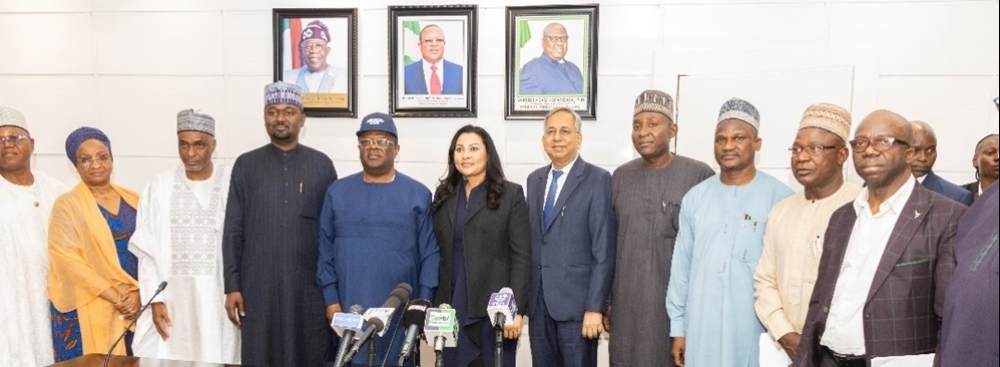
Meeting of Cement Manufacturers – Dangote Cement Plc, BUA Cement Plc, Larfarge Africa Plc & Cement Producers Association with the Honourable Minister of Industry, Trade & Investment, Dr. Doris Uzoka-Anite and the Honourable Minister of Works, Sen. Engr. Nweze David Umahi, CON held at the Office of the Honourable Minister of Works, Mabushi, Abuja on Monday, 19th February, 2024
1. The meeting noted the challenges of the manufacturers like:
a. Cost of gas;
b. High import duty on spare parts;
c. Bad road network;
d. High foreign exchange; and
e. Smuggling of cement to neighbouring nations.
2. The government noted the challenges and reacted as follows:
a. Federal Ministry of Industry, Trade and Investment to seek some remedies from Mr. President on cost of gas and import duties.
b. Federal Ministry of Works to give more attention to fixing of the roads, especially around the locations of the manufacturers.
c. On the issue of smuggling cement, the Federal Ministry of Industry, Trade and Investment to deepen the already started engagement with the National Security Adviser on how to stop the smuggling.
3. The cement manufacturers and the Government noted that the current high price of cement is abnormal in some locations nationwide. Ideally, cement retail prices should not cost more than ₦7,000.00 to ₦8,000.00/ 50kg bag of cement. Therefore, the three cement manufacturers: Dangote Cement Plc, BUA Cement Plc and Larfarge Africa Plc have agreed that cement cost will not be more than between ₦7,000.00 and ₦8,000.00/50kg bag depending on the location.
4. Going forward, Government advised cement manufacturers to set up a price monitoring mechanism to ensure compliance, and manufacturers have willingly accepted to do so and to sanction any of her distributors or retailers found wanting.
5. Government expects the agreed price to drop after securing government's interventions on the challenges of the manufacturers on gas, import duty, smuggling, and better road network.
6. The meeting agreed to reconvene in 30 days to review progress made.

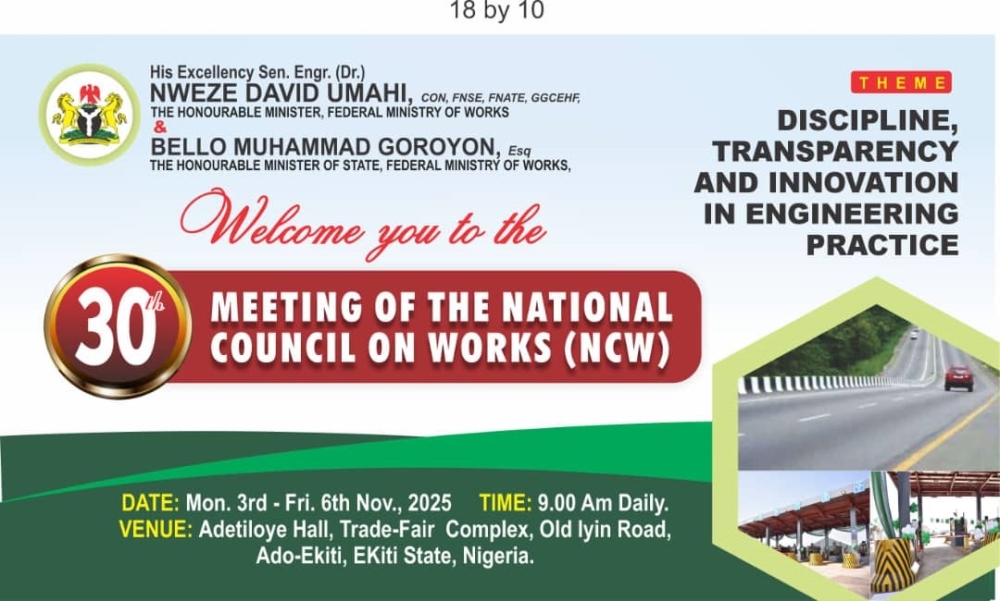
Welcome Remarks By The Director, Planing Research And Statistics At The 29th Edition Of National Council On Works Holding In Abakaliki, Ebonyi State From Monday 15th – Friday 19th July, 2024
PROTOCOL
I am delighted to welcome you on behalf of the Federal Ministry of Works to the 29th Meeting of National Council on Works with theme “Unlocking Infrastructural Potentials and Opportunities as a Catalyst for Sustainable Development under the Renewed Hope Agenda”.
The National Council on Works is a meeting of all the relevant stakeholders in the Works Sector to proffers new ideas and solutions to the challenges of moving the sector and the country forward. The theme of this year’s Council “Unlocking Infrastructural Potentials and Opportunities as a Catalyst for Sustainable Development under the Renewed Hope Agenda” is critical for our national development and well-being. Infrastructure is the backbone of any nation’s economy, providing the necessary support for economic activities and societal progress. Unlocking these potentials and opportunities is essential for sustainable development and the prosperity of our country.
As we gather here in Abakaliki, Ebonyi State, we have the opportunity to explore innovative strategies and collaborative efforts that can enhance our infrastructure. Our discussions and deliberations over the next few days will focus on identifying key areas of improvement, leveraging technology, and ensuring that our infrastructural development is inclusive and sustainable. This council meeting provides a platform for sharing experiences, best practices, and developing actionable plans that will drive the Renewed Hope Agenda forward.
Proper infrastructure development is not just about building roads and bridges but also about ensuring that these structures are resilient and beneficial to all Nigerians. We must also ensure uniformity in infrastructural standards across the Federal, State and Local levels, fostering a cohesive approach to development. Our focus should be on creating infrastructure that can withstand future challenges, including climate change and urbanization pressures. It is crucial that we incorporate sustainable practices and innovative solutions to ensure the longevity and effectiveness of our infrastructure projects.
I urge all participants at this meeting to engage actively, share your valuable insights, and collaborate towards developing concrete solutions that will unlock the full potential of our infrastructural development. Let us work together to create a framework that supports sustainable development and improves the quality of life for all Nigerians.
Enjoy the moment and hospitality of Ebonyi State. I wish you a happy deliberation.
Thank you.
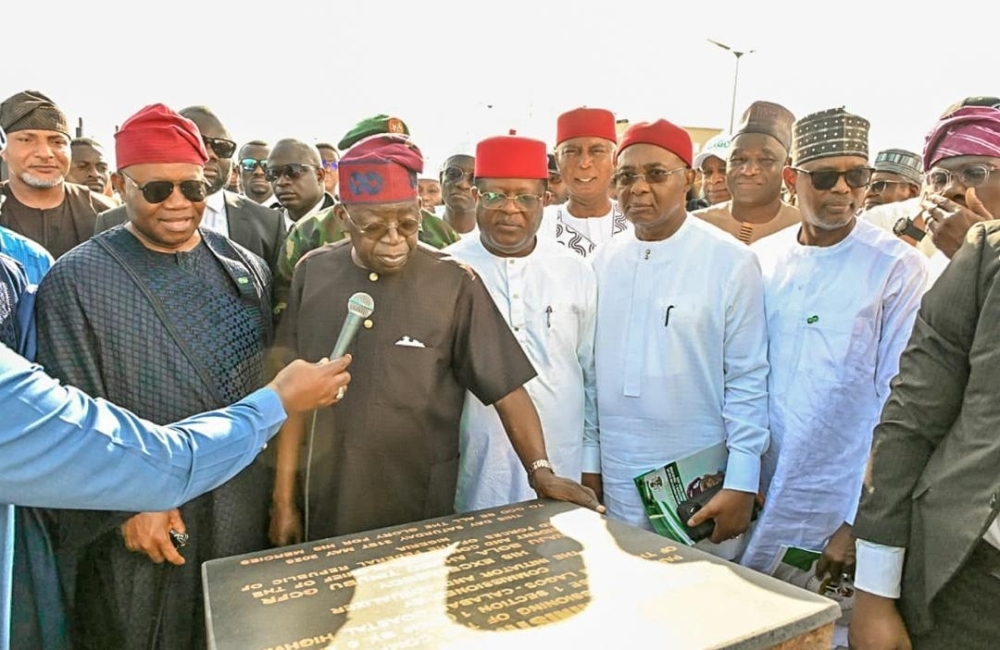
DRIVING NIGERIA’S FUTURE: CELEBRATING TWO YEARS OF TRANSFORMATIVE LEADERSHIP AND THE LAGOS-CALABAR COASTAL HIGHWAY MILESTONE
DRIVING NIGERIA’S FUTURE: CELEBRATING TWO YEARS OF TRANSFORMATIVE LEADERSHIP AND THE LAGOS-CALABAR COASTAL HIGHWAY MILESTONE
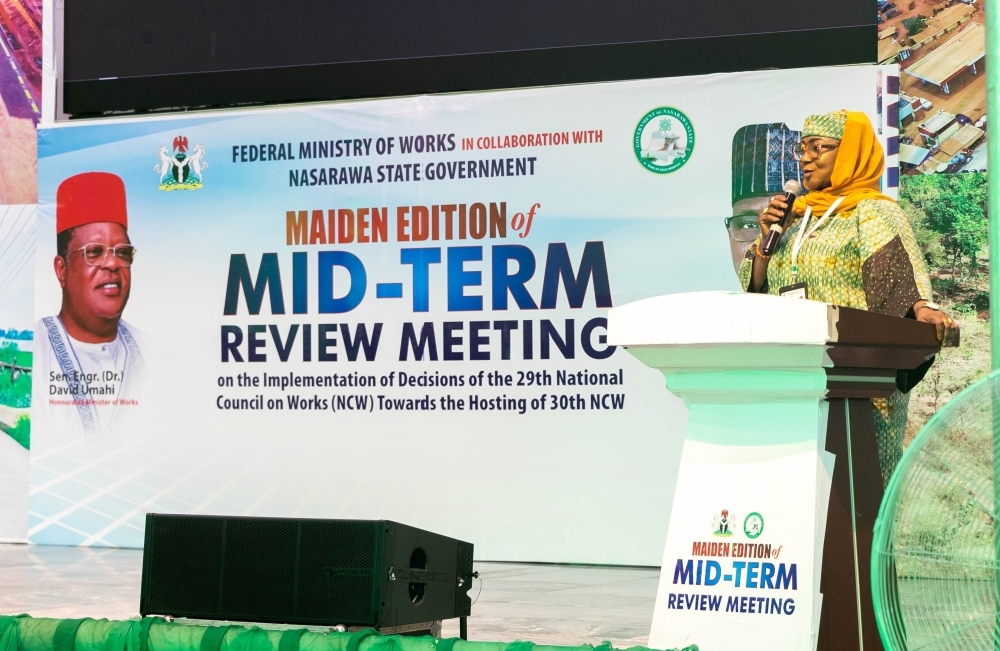
MID -TERM REVIEW MEETING ON THE IMPLIMENTATION OF THE DECISIONS REACHED AT THE 29TH NATIONAL COUNCIL ON WORKS (NCW) DAY 1
MID -TERM REVIEW MEETING ON THE IMPLIMENTATION OF THE DECISIONS REACHED AT THE 29TH NATIONAL COUNCIL ON WORKS (NCW) DAY 1