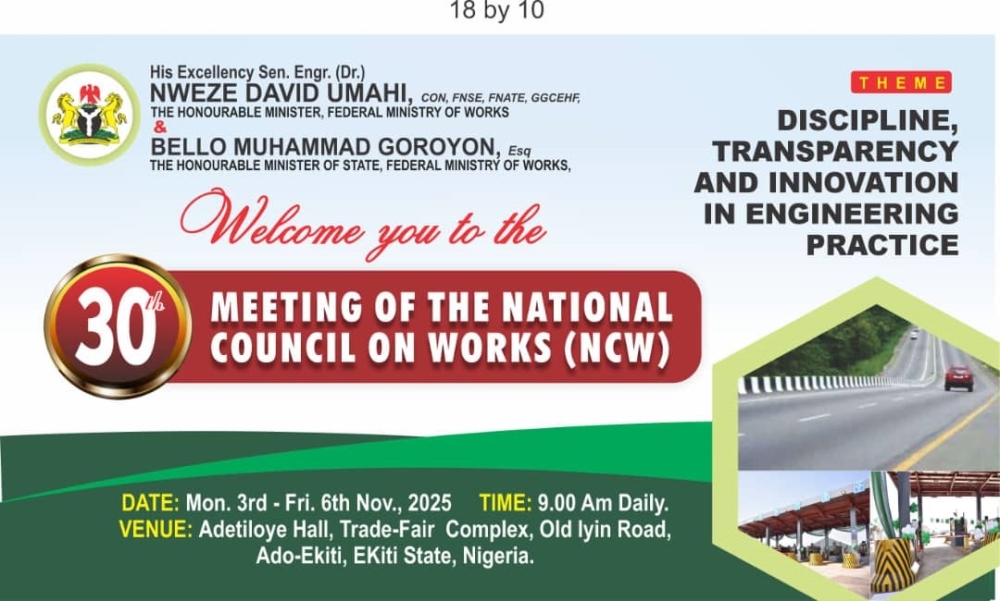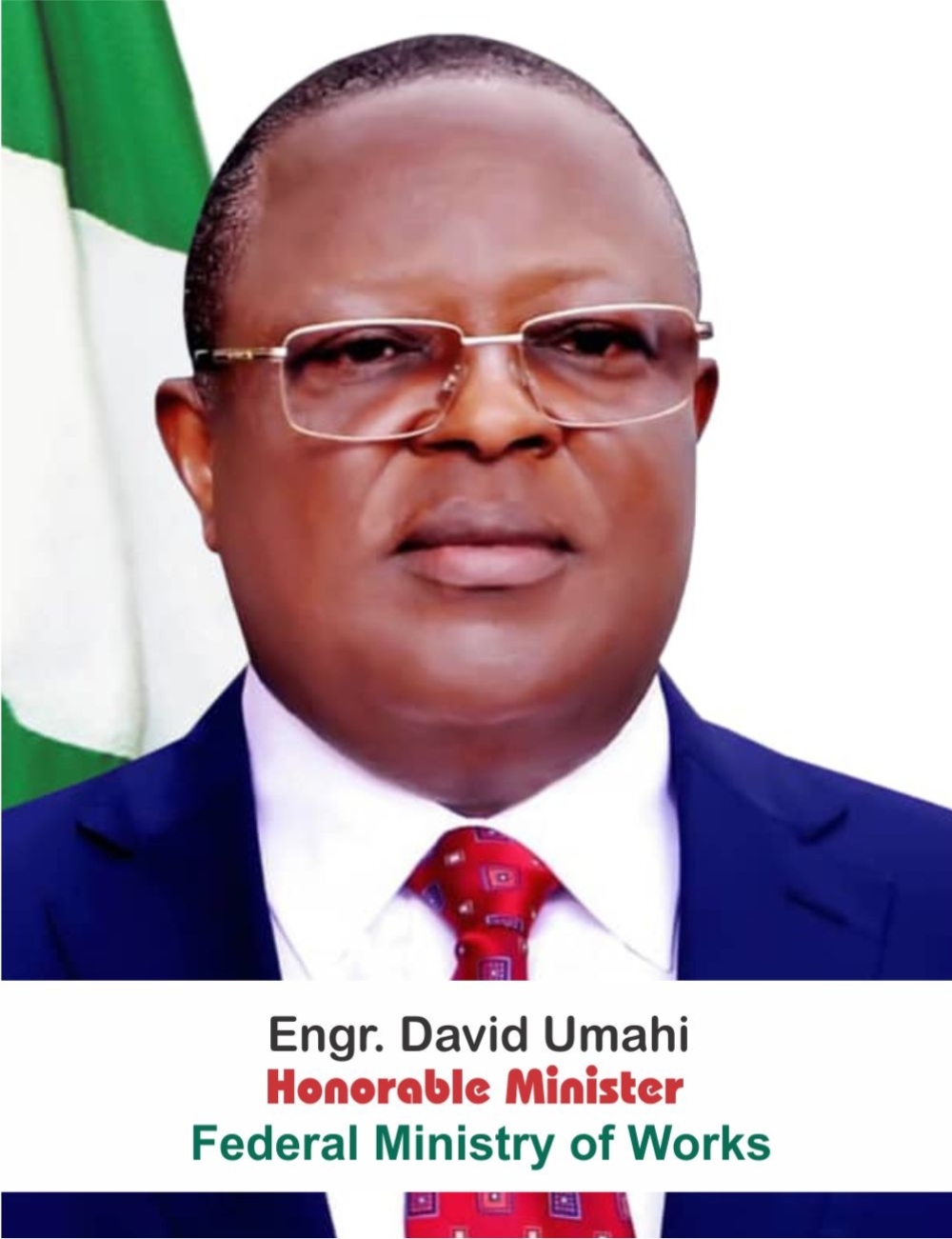
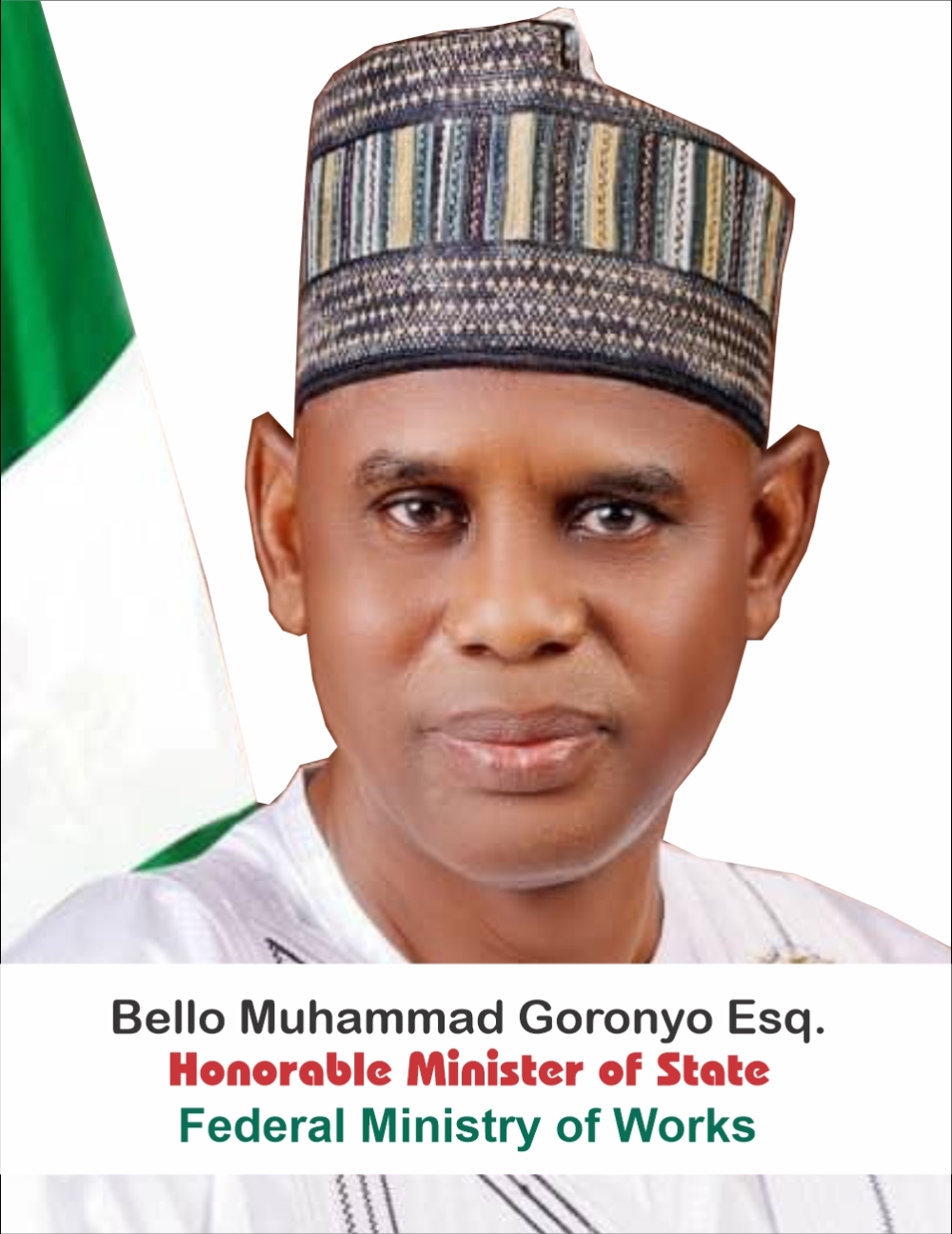
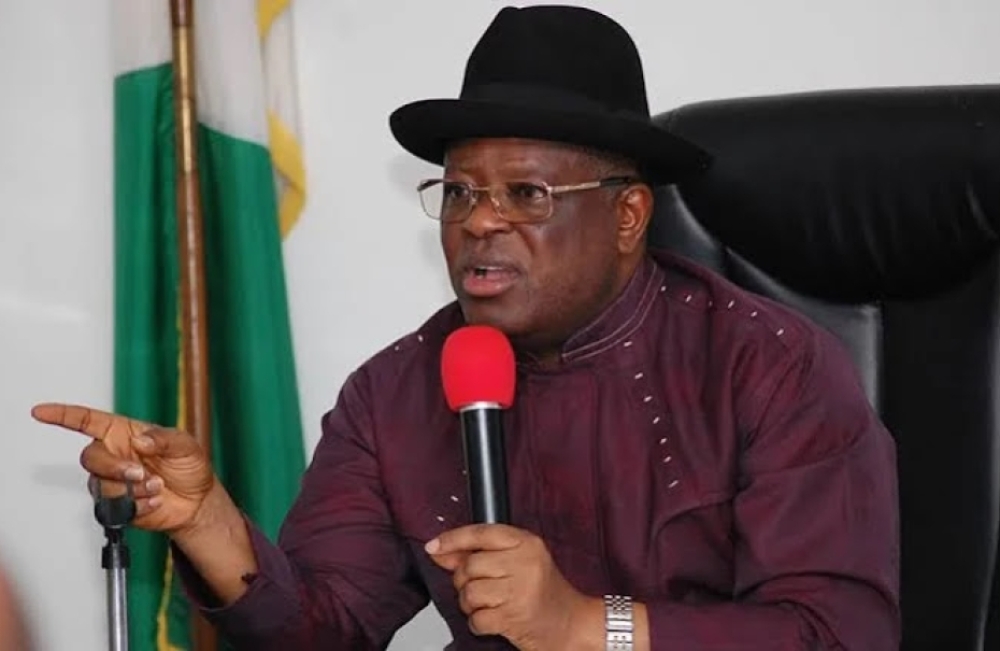
UMAHI ORDERS IMMEDIATE EMERGENCY INTERVENTION ON BENIN-ASABA ROAD, AND SOME OTHER CRITICAL FEDERAL ROADS
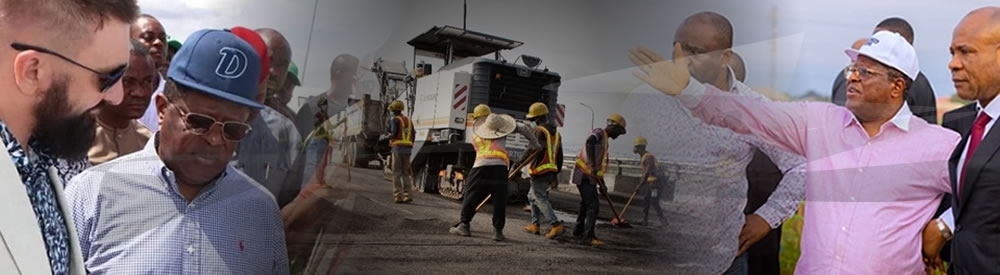
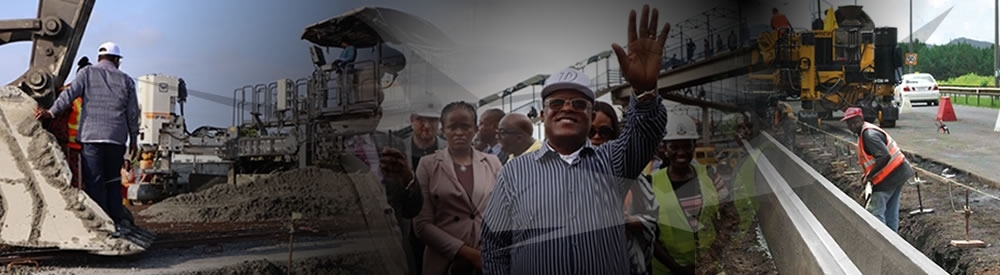
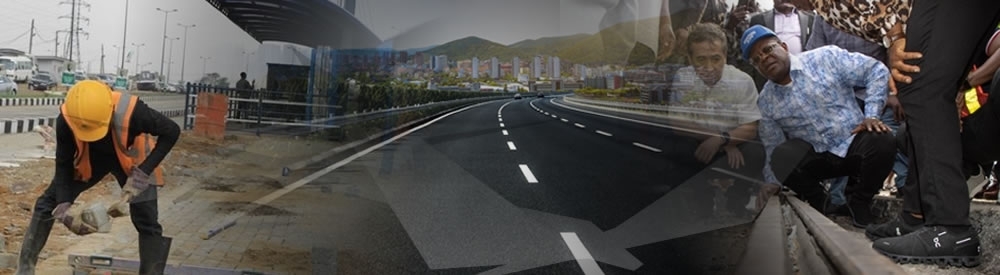
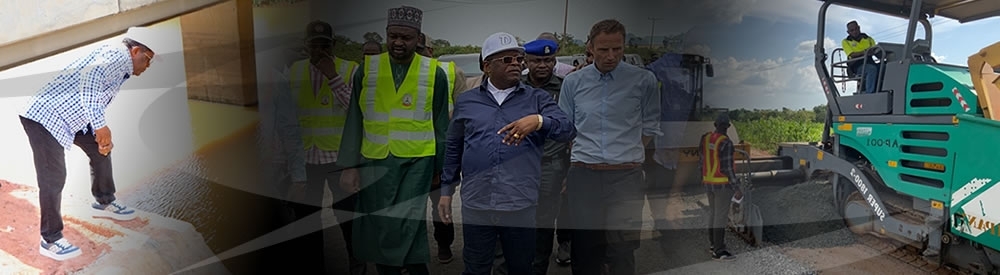
The Honourable Minister of Works, Senator Engr. David Nweze Umahi, CON, has directed the immediate deployment of major contractors to all three sections of the Benin-Asaba Federal Road to restore the failed sections and bring an end to the suffering of motorists and other road users.
This is because, the situation on the concessioned Benin-Asaba Road has reached a point where the overall public interest must take precedence over the existing concession agreement.
Recall that the Honourable Minister of Works was on the Benin-Asaba Road about seven days ago, where he assembled a number of contractors and directed them to prepare for immediate palliative intervention on the affected sections of the road at no cost to the concessionaire. In line with the Concession agreement which requires that before the Federal Government could intervene, the permission of the concessionaire must be required, and that permission was not granted to federal government.
The Minister subsequently proposed three options to the concessionaire, any one of which would have enabled the Federal Government to move in and address the worsening condition of the road. Unfortunately, none of the options was accepted by the concessionaire. Immediately after the Minister left Asaba, the already limited equipment deployed to the road by the concessionaire was further reduced to just one, worsening the situation and increasing the suffering of motorists and other road users.
While the Minister takes responsibility for the concerns and suffering of Nigerians using the road, it is important to state that the concessionaire has also not taken the suffering of Edo people and travelling public sufficiently into consideration by declining all the options put forward by the Federal Government. The concessionaire continues to rely on the terms of the concession agreement entered into by the previous administration, an agreement which weighs heavily against the Federal Government’s ability to intervene quickly in the interest of the public in a situation like this.
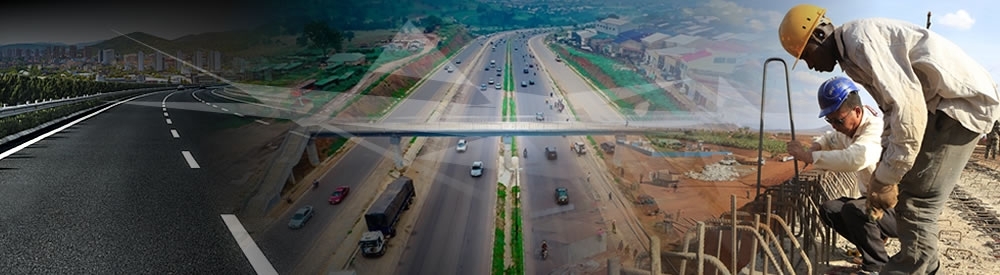
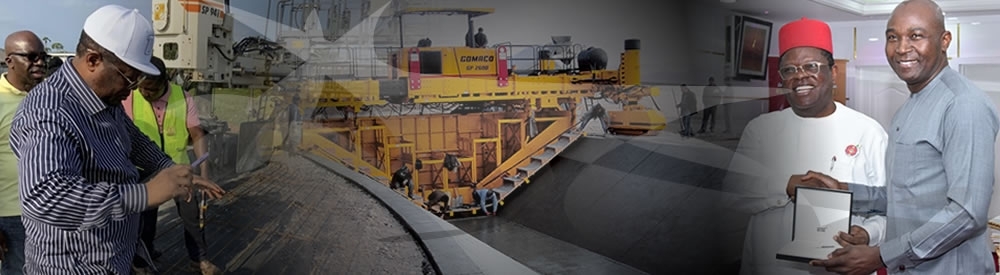
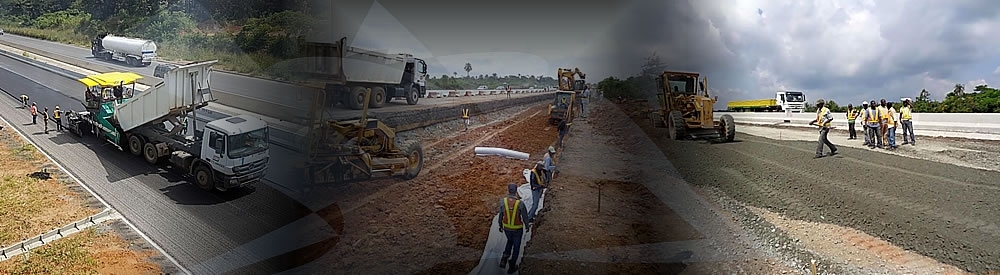
In view of this situation, the Honourable Minister of Works has directed the immediate deployment of major contractors within the corridor to all three sections of the Benin-Asaba Road to restore the failed sections and bring relief to the people, with the cost of the emergency intervention being borne by the Federal Government. The Honourable Minister has also directed immediate redesign of the entire route to be rebuilt with reinforced concrete pavement. The public should therefore take note that immediate action is underway to restore every failed section of the Benin-Asaba Road and subsequently rehabilitate the entire sections of the road using reinforced concrete pavement.
2. On the Benin-Sapele Road:
The Governors of Edo and Delta States, the Niger Delta Development Commission (NDDC), and the Federal Government are currently engaged in interventions on different sections of the road to restore the entire route. While some sections are receiving palliative attention, permanent works are also ongoing on other sections.
3. On Ifaki(Ekiti) - Kabba (Kogi) Road:
The Federal Government is engaging both the contractor; Gamji Nigeria Company Limited, and Dangote PLC on immediate emergency and permanent intervention on the most failed sections of the road, while efforts are being made to financially mobilise the company for more extensive permanent work to commence on the axis.
4. On the Sokoto-Zamfara-Katsina Road: This is an inherited project involving the dualisation of approximately 350 kilometres, which translates to about 700 kilometers. The project has since been redesigned and is currently ongoing and most sections are being reconstructed using reinforced concrete pavement. From the Sokoto axis towards Zamfara, over 50 kilometres of one carriageway have been fully completed with reinforced concrete pavement. From Zamfara to Katsina, some sections have been completed and palliative works have been ordered over the sections that have not been reconstructed. However, the pace of work slowed down due to the redesign and rephasing of the project. The contractors currently engaged on the road include CBC, SETRACO, Triacta and Mothercat. They are being remobilised to return to site and complete the outstanding works.
5. On the Abuja-Kaduna-Zaria-Kano Road: The Federal Government took over the Road project and has currently completed the 118-kilometer mostly on reinforced concrete pavement on lot 1. The Lot 2, which covers 164 kilometres, is over 60 percent completed on reinforced concrete pavement. The Federal Government has also introduced solar-powered light on the entire route of Abuja-Kaduna-Zaria - Kano to improve visibility during night travel and enhance the overall security situation on the route. The entire project is scheduled for completion by December 2026.
6. On Bauchi-Jigawa Road: Triacta Nigeria Limited has been mobilised to carry out the necessary interventions on some failed sections and work is currently ongoing in those failed sections.
7. On the Sagamu-Ore Road: 48 Kilometers of the 96-kilometre road have already been completed using reinforced concrete pavement. There is also a 24-kilometre section around Ore which was abandoned by the previous contractor. The Federal Government has directed its immediate restoration to ensure seamless travel. Solar lights are being installed in the entire 96kilometer of the road.
8. On Flooded Sections on Sagamu-Ore-Benin Road: The flooded sections on the same corridor between Sagamu-Ore-Benin Road, as well as other flooded sections in Ondo State, are being designed for emergency procurement and intervention.
9. On the East-West Road:
Some failed and critical sections, including defective sections of bridges along the East-West Road, are being marked out for emergency procurement and intervention.
10. On the Abuja-Lokoja Road:
Several contracts are ongoing along the route, while the three critical sections currently without contracts are being procured for emergency intervention.
11. On the Lokoja-Benin-Warri Road: The President has directed a complete redesign and procurement of the 400-kilometre dualised route covering the uncompleted sections, using reinforced concrete pavement, while palliative works will continue with the contractors currently on the road.
12. On Carter Bridge:
While the Federal Government continues to undertake weekly maintenance of the underwater elements of the bridge. The site has also been handed over to the contractor, CCECC, for the construction of a permanent new bridge, and work has commenced.
13. On the Third Mainland Bridge:
With regard to the defective underwater structural elements, the Federal Government is at the final stage of determining the appropriate intervention for the repair of the affected elements.
14. On the flooded section of the Lagos-Ibadan Road: Work has commenced on the affected section. There are also several flooded sections on federal roads across the six geopolitical zones, largely occasioned by excessive flooding and the effects of climate change. The Federal Government is identifying and marking these sections for immediate attention.
15. On the First and Second Niger Bridges:
Intervention work is ongoing on the approach roads to the Second Niger Bridge damaged by flood and the work is progressing very well. The First Niger Bridge has been closed to traffic to enable immediate repair works. Contractor has mobilized to site and comprehensive rehabilitation of the bridge has started. From Summit Junction to the First Niger Bridge, massive rehabilitation work is also ongoing using reinforced concrete pavement.
16. The Honourable Minister wishes to commend the President of the Federal Republic of Nigeria, His Excellency Bola Ahmed Tinubu, GCFR, for the massive work being undertaken on the nation’s roads since the administration assumed office in 2023.
17. It is important to state that when the present administration came into office, there was hardly any part of the country where one could travel for an hour without encountering significant challenges on the road network. The condition of the country’s roads and bridges was a major national infrastructure challenge.
18. Rather than shy away from the problem, the administration of President Bola Ahmed Tinubu made the nation’s road network a priority. Virtually every part of the country became a priority, and the Federal Government, through the Federal Ministry of Works, Regional Commissions, Parastatals and other MDA’s has continued to respond extensively to these challenges.
19. The Federal Government is currently working on over 80 percent of the inherited federal roads, an unprecedented level of intervention in the country’s road infrastructure.
20. We ask the public to understand the enormous challenges inherited on our roads and bridges and to take note not only of the problems being solved, but also of the permanent solutions being introduced.
21. A major part of this new approach is the use of reinforced concrete pavement, designed to significantly extend the lifespan of major roads. These roads are expected to last between 50 and 100 years. This means that roads being constructed under President Bola Ahmed Tinubu’s administration are being designed with future generations in mind, rather than simply providing temporary solutions to today’s problems. And this is a complete departure from the past, when roads often deteriorated only a few years after completion, resulting in a continuous cycle of reconstruction and expenditure.
22. We appreciate the concerns of Nigerians over the condition of some roads presently and the difficulties faced by motorists and commuters who cannot move easily from one point to another. Those concerns are legitimate, and the Federal Government is listening. But Nigerians should also recognise the enormous scale of the problems inherited and the amount of work currently being undertaken across the country.
23. It is simply impossible to resolve every road challenge accumulated over many years of neglect by the past administrations within three years. What is important is that the government is working, the government is responding, and the government is putting permanent solutions in place.
25. We appreciate members of the public who send situation reports on failed roads and other infrastructure challenges. These reports help the Ministry identify areas requiring urgent attention. However, we also appeal to members of the public to report when such problems have been addressed, just as they report when they occur.
24. We are aware of situations where photographs and reports of road challenges continue to circulate on social media even after the Federal Government has intervened and resolved the particular problem.
25. However, the Ministry will continue to respond as rapidly as possible to genuine reports and concerns from Nigerians.
26. It is also important to note that we have compiled a comprehensive record of all inherited, ongoing and intervention projects across the country which is available to the public. This is to ensure that Nigerians have access to information on the infrastructure projects being undertaken nationwide and can fully participate in and appreciate the infrastructure revolution of President Bola Ahmed Tinubu’s administration.

UMAHI ORDERS IMMEDIATE EMERGENCY INTERVENTION ON BENIN-ASABA ROAD, AND SOME OTHER CRITICAL FEDERAL ROADS The Honourable Minister of Works, Senator Engr. David Nweze Umahi, CON, has directed the immediate deployment of major contractors to all three sections of the Benin-Asaba Federal Road to restore the failed sections and bring an end to the suffering of motorists and other road users. This is because, the situation on the concessioned Benin-Asaba Road has reached a point where the overall public interest must take precedence over the existing concession agreement. Recall that the Honourable Minister of Works was on the Benin-Asaba Road about seven days ago, where he assembled a number of contractors and directed them to prepare for immediate palliative intervention on the affected sections of the road at no cost to the concessionaire. In line with the Concession agreement which requires that before the Federal Government could intervene, the permission of the concessionaire must be required, and that permission was not granted to federal government. The Minister subsequently proposed three options to the concessionaire, any one of which would have enabled the Federal Government to move in and address the worsening condition of the road. Unfortunately, none of the options was accepted by the concessionaire. Immediately after the Minister left Asaba, the already limited equipment deployed to the road by the concessionaire was further reduced to just one, worsening the situation and increasing the suffering of motorists and other road users. While the Minister takes responsibility for the concerns and suffering of Nigerians using the road, it is important to state that the concessionaire has also not taken the suffering of Edo people and travelling public sufficiently into consideration by declining all the options put forward by the Federal Government. The concessionaire continues to rely on the terms of the concession agreement entered into by the previous administration, an agreement which weighs heavily against the Federal Government’s ability to intervene quickly in the interest of the public in a situation like this. In view of this situation, the Honourable Minister of Works has directed the immediate deployment of major contractors within the corridor to all three sections of the Benin-Asaba Road to restore the failed sections and bring relief to the people, with the cost of the emergency intervention being borne by the Federal Government. The Honourable Minister has also directed immediate redesign of the entire route to be rebuilt with reinforced concrete pavement. The public should therefore take note that immediate action is underway to restore every failed section of the Benin-Asaba Road and subsequently rehabilitate the entire sections of the road using reinforced concrete pavement. 2. On the Benin-Sapele Road: 3. On Ifaki(Ekiti) - Kabba (Kogi) Road: 4. On the Sokoto-Zamfara-Katsina Road: This is an inherited project involving the dualisation of approximately 350 kilometres, which translates to about 700 kilometers. The project has since been redesigned and is currently ongoing and most sections are being reconstructed using reinforced concrete pavement. From the Sokoto axis towards Zamfara, over 50 kilometres of one carriageway have been fully completed with reinforced concrete pavement. From Zamfara to Katsina, some sections have been completed and palliative works have been ordered over the sections that have not been reconstructed. However, the pace of work slowed down due to the redesign and rephasing of the project. The contractors currently engaged on the road include CBC, SETRACO, Triacta and Mothercat. They are being remobilised to return to site and complete the outstanding works. 5. On the Abuja-Kaduna-Zaria-Kano Road: The Federal Government took over the Road project and has currently completed the 118-kilometer mostly on reinforced concrete pavement on lot 1. The Lot 2, which covers 164 kilometres, is over 60 percent completed on reinforced concrete pavement. The Federal Government has also introduced solar-powered light on the entire route of Abuja-Kaduna-Zaria - Kano to improve visibility during night travel and enhance the overall security situation on the route. The entire project is scheduled for completion by December 2026. 6. On Bauchi-Jigawa Road: Triacta Nigeria Limited has been mobilised to carry out the necessary interventions on some failed sections and work is currently ongoing in those failed sections. 7. On the Sagamu-Ore Road: 48 Kilometers of the 96-kilometre road have already been completed using reinforced concrete pavement. There is also a 24-kilometre section around Ore which was abandoned by the previous contractor. The Federal Government has directed its immediate restoration to ensure seamless travel. Solar lights are being installed in the entire 96kilometer of the road. 8. On Flooded Sections on Sagamu-Ore-Benin Road: The flooded sections on the same corridor between Sagamu-Ore-Benin Road, as well as other flooded sections in Ondo State, are being designed for emergency procurement and intervention. 9. On the East-West Road: 10. On the Abuja-Lokoja Road: 11. On the Lokoja-Benin-Warri Road: The President has directed a complete redesign and procurement of the 400-kilometre dualised route covering the uncompleted sections, using reinforced concrete pavement, while palliative works will continue with the contractors currently on the road. 12. On Carter Bridge: 13. On the Third Mainland Bridge: 14. On the flooded section of the Lagos-Ibadan Road: Work has commenced on the affected section. There are also several flooded sections on federal roads across the six geopolitical zones, largely occasioned by excessive flooding and the effects of climate change. The Federal Government is identifying and marking these sections for immediate attention. 15. On the First and Second Niger Bridges: 16. The Honourable Minister wishes to commend the President of the Federal Republic of Nigeria, His Excellency Bola Ahmed Tinubu, GCFR, for the massive work being undertaken on the nation’s roads since the administration assumed office in 2023. 17. It is important to state that when the present administration came into office, there was hardly any part of the country where one could travel for an hour without encountering significant challenges on the road network. The condition of the country’s roads and bridges was a major national infrastructure challenge. 18. Rather than shy away from the problem, the administration of President Bola Ahmed Tinubu made the nation’s road network a priority. Virtually every part of the country became a priority, and the Federal Government, through the Federal Ministry of Works, Regional Commissions, Parastatals and other MDA’s has continued to respond extensively to these challenges. 19. The Federal Government is currently working on over 80 percent of the inherited federal roads, an unprecedented level of intervention in the country’s road infrastructure. 20. We ask the public to understand the enormous challenges inherited on our roads and bridges and to take note not only of the problems being solved, but also of the permanent solutions being introduced. 21. A major part of this new approach is the use of reinforced concrete pavement, designed to significantly extend the lifespan of major roads. These roads are expected to last between 50 and 100 years. This means that roads being constructed under President Bola Ahmed Tinubu’s administration are being designed with future generations in mind, rather than simply providing temporary solutions to today’s problems. And this is a complete departure from the past, when roads often deteriorated only a few years after completion, resulting in a continuous cycle of reconstruction and expenditure. 22. We appreciate the concerns of Nigerians over the condition of some roads presently and the difficulties faced by motorists and commuters who cannot move easily from one point to another. Those concerns are legitimate, and the Federal Government is listening. But Nigerians should also recognise the enormous scale of the problems inherited and the amount of work currently being undertaken across the country. 23. It is simply impossible to resolve every road challenge accumulated over many years of neglect by the past administrations within three years. What is important is that the government is working, the government is responding, and the government is putting permanent solutions in place. 25. We appreciate members of the public who send situation reports on failed roads and other infrastructure challenges. These reports help the Ministry identify areas requiring urgent attention. However, we also appeal to members of the public to report when such problems have been addressed, just as they report when they occur. 24. We are aware of situations where photographs and reports of road challenges continue to circulate on social media even after the Federal Government has intervened and resolved the particular problem.
The Governors of Edo and Delta States, the Niger Delta Development Commission (NDDC), and the Federal Government are currently engaged in interventions on different sections of the road to restore the entire route. While some sections are receiving palliative attention, permanent works are also ongoing on other sections.
The Federal Government is engaging both the contractor; Gamji Nigeria Company Limited, and Dangote PLC on immediate emergency and permanent intervention on the most failed sections of the road, while efforts are being made to financially mobilise the company for more extensive permanent work to commence on the axis.
Some failed and critical sections, including defective sections of bridges along the East-West Road, are being marked out for emergency procurement and intervention.
Several contracts are ongoing along the route, while the three critical sections currently without contracts are being procured for emergency intervention.
While the Federal Government continues to undertake weekly maintenance of the underwater elements of the bridge. The site has also been handed over to the contractor, CCECC, for the construction of a permanent new bridge, and work has commenced.
With regard to the defective underwater structural elements, the Federal Government is at the final stage of determining the appropriate intervention for the repair of the affected elements.
Intervention work is ongoing on the approach roads to the Second Niger Bridge damaged by flood and the work is progressing very well. The First Niger Bridge has been closed to traffic to enable immediate repair works. Contractor has mobilized to site and comprehensive rehabilitation of the bridge has started. From Summit Junction to the First Niger Bridge, massive rehabilitation work is also ongoing using reinforced concrete pavement.
25. However, the Ministry will continue to respond as rapidly as possible to genuine reports and concerns from Nigerians.
26. It is also important to note that we have compiled a comprehensive record of all inherited, ongoing and intervention projects across the country which is available to the public. This is to ensure that Nigerians have access to information on the infrastructure projects being undertaken nationwide and can fully participate in and appreciate the infrastructure revolution of President Bola Ahmed Tinubu’s administration.
Over 35,000 Kilometres of Federal Roads Need Alternative Funding - Goronyo The Minister of State for Works, Muhammad Bello Goronyo, Esq has noted that over 35,000 kilometres of the Federal Government road network across Nigeria could not be funded through Annual Budgets alone, hence the need to source for alternative funding outside the government’s coffers. Goronyo stated this on Monday, 17th February, 2025, while addressing the Management and Staff of the Federal Roads Maintenance Agency (FERMA), Kogi State Field Office at Lokoja during a maiden visit alongside the MD/CEO, Engr Chukwumeka Agbasi. He reaffirmed that President Bola Ahmed Tinubu’s administration is determined to fix all the roads to ensure a drastic reduction in the level of unemployment, rate of crimes, and insecurity. According to him, " Let me commend President Tinubu, GCFR for his determination. I have never seen a President so committed to sustaining physical assets nationwide. The administration gives priority to various road projects scattered across the country. This shows that he is a patriotic Nigerian. He is undertaking these projects so that our economy can be improved, and the rate of unemployment, poverty, and crimes will be reduced. We are seeing the Super Highways from Ilelah to Sokoto to Badagry and another from Lagos to Calabar." Goronyo, who commended the staff of FERMA for their resilience and hard work over the years, noted that despite insecurity, and inadequate funding, Nigerians have been commending them for their excellent work. He urged them to bear with the Ministry of Works over their entitlements, disclosing that their requests for adjustment and increment in consequential salaries have been forwarded to the Salaries, Income, and Wages Commission for consideration and approval. Speaking further on funding for the maintenance of roads, Goronyo stressed that "about 35,000 kilometres of roads cannot be funded and maintained overnight. We have to look for alternative sources of funding so that we can continue to maintain our physical assets, which are the roads. We have to create new ways of funding and new alternatives. He assured that the Government is focused on ensuring that projects are completed in a timely and efficient manner with robust oversight and contractors’ compliance. He also added "I am calling on all of you to support us to ensure that President Bola Ahmed Tinubu succeeds in his mandate to deliver on the 8-point Renewed Hope Agenda. We must put Nigeria first before our interests. Let us fix our roads, we must think positively." Earlier, the Managing Director and Chief Executive Officer (MD/CEO) of FERMA, Engineer Chukwumeka Agbasi commended the Ministry of Works for its determination to ensure that the 8-point agenda of President Tinubu are realised, especially road projects across the country. He informed the Staff that before the end of the year, there would be an increment in their salaries and appealed to them to continue to support and partner with the Ministry to achieve their targeted goals. In his remarks, Engineer Muktar Abdurahim, the Officer in charge of the Kogi Field Office, informed the Minister that the office has thirty-seven (37) staff with 25 permanent and twelve (12) casual workers. He disclosed that Kogi State has sixteen (16) Federal Government roads with a total of 1,263 kilometres, emphasising that the 2024 nationwide flood incident did not affect any of the roads in the state. Engr. Abdulrahim revealed that out of six (6) roads under construction in the state, five (5) have been successfully executed, while one (1) is at 60% completion. He informed the Minister that they are facing challenges such as insecurity, and hyperinflation on the cost of construction materials, amongst others. Furthermore, the Director, North Central Zone I, Engr Omotayo Awodun commended the Federal Government’s commitment to fixing all the Federal roads across Nigeria, especially those in his zone, he also applauded the leadership style of the Honourable Minister of Works for his innovation, where new techniques and stricter supervision are being enforced, like what we are witnessing, today. ...

INFOQUEST NIG LTD WAS NEVER AWARDED ANY CONTRACT ON ABUJA- KADUNA ROAD AS FALSELY AND MALICIOUSLY REPORTED IN A PUBLICATION OF DAILY TRUST NEWSPAPERS OF 21/01/2025. -DAILY TRUST TO RENDER UNRESERVED APOLOGY TO FEDERAL MINISTRY OF WORKS FOR UNJUSTIFIABLE FALSEHOOD The Honourable Minister of Works, His Excellency, Sen. Nweze David Umahi CON has rebutted in strong terms the unwarranted, false, misleading, and damaging report published in Daily Trust Newspapers of 21st January 2025, which falsely represented the Federal Ministry of Works as having awarded a section of Abuja-Kaduna-Kano road dualization to Infoquest Nigeria Ltd. In a press conference held on 21st January 2025 at the Conference Hall of the Honourable Minister of Works and attended by the Honourable Minister of State for Works, Rt. Hon. Barr. Mohammed Bello Goronyo, the Permanent Secretary, Federal Ministry of Works, Engr. Folunso O. Adebiyi and key directors of the Ministry, the Honourable Minister, described as mischievous, insensitively misleading and injurious the statement credited to him in the said publication, where he was wrongly quoted to have said that Infoquest Nigeria Ltd secured a "No objection" of N252.89 billion from the Bureau of Public Procurement ( BPP) for the rehabilitation of a section Abuja- Kaduna- Zaria-Kano road and where they described the Ministry as having awarded the said contract to an obscure company. He made it clear that the Ministry had no business relationship with Infoquest Nigeria Ltd. He further made it known that the company that has a contractual relationship with the Ministry on the said project is Infiouest International Limited and that the company is corporately active and is absolutely in compliance with all legal requirements and regulations set by the Companies and Allied Matters Act. He berated the mischief created by the publication as a deliberate orchestration by a cartel to malign the Ministry, undermine the efforts of the Renewed Hope administration in revolutionizing road infrastructure development and demarket the company that has proven capacity in road construction. He demanded from Daily Trust Newspapers a public apology to the Federal Ministry of Works to be published in at least 5 national dailies for unjustifiably publishing falsehood against the Ministry of Works. The Honourable Minister also alluded to the mischiefs and deliberate misrepresentation of facts contained in the sponsored publications made in several national dailies by Julius Berger Plc recently on the reason why they reneged in their contractual obligations in respect of the section of Abuja-Kaduna-Zaria-Kano road they were handling before it was determined. He wondered why the coordinated onslaught of falsehood, blackmail, gangup by adversaries to the policy of government just because of the Ministry's insistence on a new order of value for money, quality assurance and best practices in project pricing and execution. He urged the public and the press to join in this desirable fight against national sabotage by some contractors. In his remarks, the Honourable Minister of State for Works said he was delighted by the proactiveness and resoluteness shown by the Ministry in decapitating the intentions of those who made the false publication against the Ministry which according to him was intended to distract the Ministry and undermine its confidence before Nigerians. He called on the media operators not to allow themselves to be used by the fifth columnists to publish unfounded reports to undermine the Renewed Hope agenda but should always crosscheck their information with the appropriate authority so as to let out only the truth to the public. In his vote of thanks, the Permanent Secretary described the press briefing as thoughtful and timely. He harped on the importance of development journalism and urged the media to always uphold the truth in their professional duties of information dissemination rather than allow themselves to be used as a tool in the hands of enemies of our national development. ...

EIGHT-POINT AGENDA OF MR. PRESIDENT LINKED TO GOOD ROAD INFRASTRUCTURE - Umahi The Honourable Minister of Work, His Excellency, Sen. (Engr.) David Nweze Umahi, CON, FNSE, FNTI has reiterated that the availability of good road network is instrumental to achieving food security, ending poverty, improving security, enhancing economic growth and job creation. He affirmed this, while opening a two-day retreat organised for Highways Engineers and management staff of the Ministry with the theme, “Ensuring Delivery of Mr. President’s Agenda on Road Infrastructural Development” on 17th January, 2025 in Abuja. According to Engr. Umahi, the massive infrastructural development embarked upon by the present Administration across the entire six (6) geo-political zones of the country is premised on stimulating the economy and improving the lives of the citizenry. He re-affirmed the present administration's commitment towards the reconstruction and rehabilitation of failing major highways across the zones, which will provide robust road infrastructure, as well as alleviate the sufferings of the citizens. He also added that the retreat, which is aimed at enhancing optimum service delivery, efficiency, and unity in the delivery of road projects, nationwide, is expected to help participants ensure that the government gets value for money expended on all projects. While urging participants, especially the Ministry’s supervisory staff, to make the best use of the retreat to sharpen and improve their technical capabilities, he expressed optimism that they would acquire enough resources to help in delivering Mr. President's 8-point agenda. The Minister, who earlier maintained that bad roads are tantamount to keeping people in prison, as it hinders their movement, also called on Highway Engineers to change their _modus operandi _and work professionally, imbibing internationally recommended engineering standards and practices, to achieve the objectives of the Renewed Hope Agenda of Mr. President. He directed that henceforth, contractors must mobilise to the site before requesting for mobilisation fee. Acknowledging the need for continuous capacity building for Engineers, as an enabler for improvement in service delivery, he promised that such exercises would be institutionalised. He, as well, directed all Federal Controllers of Works (FCW) to dismantle all speed calming devices/measures (speed breakers or bumps) on Federal highways in their respective states, insisting that there is nothing wrong in mounting such bumps but there should be approval and standard design and specifications guiding such endeavours. In his Goodwill Message, the Permanent Secretary, Federal Ministry of Works, Engr. Olufunsho Adebiyi, FNSE thanked and welcomed the Honourable Ministers for approving, as well as gracing the occasion. He called for rapid transformation in service delivery in the road sector. The Permanent Secretary, however, formally presented to the Honourable Ministers, a team of transformed Engineers, who are willing to support the government achieve its Renewed Hope Agenda. The Honourable Minister of State for Works, Muhammadu Bello Goronyo, Esq., eulogised the personality of the Minister, whom he revered and referred to as a go-getter, intelligent, hardworking and highly professional. He expressed gratitude to all stakeholder for their collaborative efforts in ensuring the success of the present administration, particularly in the provision of critical road infrastructure. The Chairman of the House Committee on Works, Hon, Akin Alabi enjoins the Ministry to put in more effort, so that our roads work for the citizens, while the Chairman, Senate Committee on Works, Sen. Mpigi Barinada, called on the need to engage the members of the National Assembly (NASS) to ascertain that correct appropriation is made to accommodate all Nigerian roads. He concluded by saying that the good works of the Ministry are an indication of support for Mr. President’s Agenda. The retreat was facilitated by a panel of experts delivering insightful presentations on critical topics. The panelists included the Permanent Secretary of the Ministry, the Director, Highways, Construction and Rehabilitation, Engr. Clement Ogbuagu, representative of the Chairman, Economic and Financial Crimes Commission (EFCC), Mr. Francis Useni, the Chairman of the FCT Civil Service Commission, Engr. Emeka Eze and retired directors from the Ministry such as Engineers Bala Danshehu, Bola Aganaba, J. A. Yusuf, A. A. Adebiyi and Olufemi Oyekanmi. Their Sessions covered Compliance with Procurement Laws, Prudent Use of Resources, Project Planning and Alignment with President Tinubu’s Eight-Point agenda. Discussions were centred on the composition of the Site Management Team; Project Planning; Resolving Bill 1; Direct Labour Policy; Inter Relationship between Engineers; Adherence to the Rules of Law and lastly, Funding of Projects. It was agreed that the Ministry should return to its original structure; waiver for recruitment of young Engineers is to be pursued to bridge the gap of shortage of staff; there is no free money in Bill 1 anymore; the issue of direct labour was stepped down, as extant laws do not support it, more so, to avoid conflict of interest with the Federal Emergency Road Management Agency (FERMA). It was rather agreed that FERMA should be strengthened to effectively carry out its mandates. The Ministry was advised to lobby for the establishment of a Federal Highways Authority; Participants were admonished to eskew backbiting and learn to bond with each other, as well as to forgive one another. As takeaways from the Retreat, participants were asked to reduce the use of emergency contracts; publish all contracts on the Ministry’s websites, including the names of the contractors, and value for money expended on every project; ensure that effective from 2025, categorisation of contractors will start and no longer portfolio or envelop contractors. To avoid unnecessary embarrassment, Officers need to apply extant rules in discharging their duties. The year 2025, being a year for enhanced performance for Mr. President, priority projects will be tracked by the second quarter of 2026, which should be ready for commissioning. Participants also were urged to ensure that Nigeria roads are motorable, especially that of Abuja - Kaduna, a vital artery linking the South to the North of the country. Civil Servants were, as well as urged to guide and support politicians in performing their jobs. ...
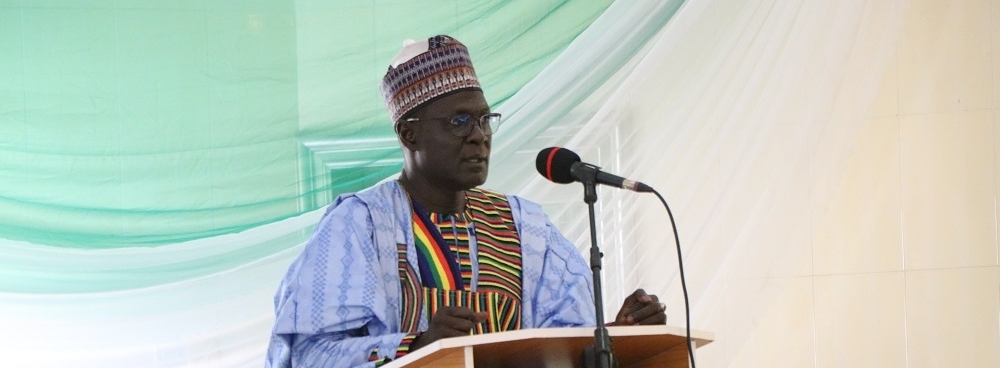
Federal Ministry Works & Housing Sets Up Ministerial And Departmental Task Team To Enforce Covid-19 Protocols
The Permanent Secretary, Federal Ministry Works and Housing, Babangida Hussaini has given a strong warning to those violating the Covid 19 Prevention protocols in the Ministry to desist from such or stay away from the Ministry.
The Permanent Secretary gave the warning earlier today while inaugurating a Ministerial and Departmental Task Team on Covid-19.
Mr. Babangida said that the Task Team was to ensure compliance with prescribed preventive measures and curtailing the spread of Covid-19 Virus, adding that every aspect of Covid-19 control mechanism and crowd control must be adopted and enforced.
He also urged the newly inaugurated Task Team to generate massive awareness campaign on the consequences of the breach of prescribed Covid-19 preventive Protocols and put in place adequate sanctions against violators.
The Permanent Secretary noted with concern the rise in the number of Covid-19 cases in the last few weeks and charged the team to save the government from unnecessary expenses associated with uncontrolled spread of the pandemic, adding that lives of Nigerians are considered very important by the government.
He ordered that henceforth, the team should monitor staff’ and visitors’ compliance to the protocols and punish offenders to deter others.
He therefore, directed that patrol along the corridor in the Ministry should be ramped up and that a reporting template should be put up as well as activating all sanitary facilities within the Ministry.
The Committee which was a ten- man team was chaired by the Ministry’s Director Human Resource Management, Mr. Umar Abdullahi Utono
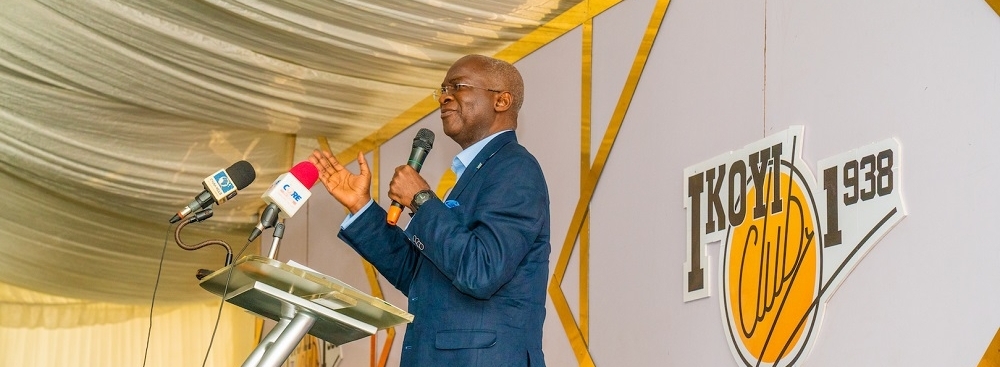
Ikoyi Club At 81: The Youth And Leadership In Nation Building, Lecture Delivered By Babatunde Raji Fashola, SAN At The Anniversary Lecture To Commemorate The 81st Anniversary Of Ikoyi Club 1938
Ladies and gentlemen, let me thank the Vice Chairman of Ikoyi Club, who incidentally is Chairman of the anniversary sub-committee, Tafa Zibiri-Aliu, and by extension, the management and entire body of members of the Ikoyi Club 1938 for inviting me to deliver this anniversary lecture.
Because it is an anniversary, felicitations are in order and I offer congratulations to all of you members of this club and to myself, being a member in my own right. As we say in Eko: “Mo yo fun e, mo yo fun ara mi”.
It is not easy to deal with my assigned topic which is Ikoyi Club at 81: The Youth and Leadership in Nation Building. In that sense, my host has not done me any favours by setting me this difficult task.
Firstly, 81 years of Ikoyi Club is eight decades of history entwined with the early development of Nigeria that features valleys and hills of segregation, war, independence, births, deaths, family tribulations and triumphs, consultations and confrontation with government, court cases and much more.
To undertake only a review of those eighty-one years will keep us here for a long time. Time that we certainly do not have today.
What is important is that against the odds, in spite of the passage of time, Ikoyi Club 1938 has not only survived, it has endured and prospered.
One of the reasons for this, and there are many, is the fact that it is a family club, where children can come with their parents and get exposed very early to the finest traditions of the club, mature to become youth (young adults), become members in their own right and ultimately rise to various positions of responsibility and leadership in their various sections and main management committee in a series of torch passing moments and generational regeneration for which Ikoyi club has been the beneficiary.
Secondly, the youth and the role they play in emerging leadership have been and remain a subject of long and continuing study that we cannot exhaust today.
Therefore, to make my task easier than my host may have planned, I will be speaking about youth and leadership within a context and I will come to the context shortly.
In the early days of Sir Alex Ferguson’s legendary quarter of a century reign as Manchester United’s most successful manager, he decided to disband the old and aging players he inherited.
He fielded a team of mostly teenagers and a few players in their early twenties in the season of 1992. The British press was unsparing in their condemnations and criticisms.
The most memorable headline was one which read: “You cannot win anything with kids.”
Sir Alex Ferguson was famously later to reply by saying “You cannot win anything without them,” because those kids, who later and forever will be known as the Class of 1992 became so successful and have remained the gold standard for that club and many others.
It was on their backs that two decades of success and global brand building of the Manchester United colours was achieved and propagated to every continent and to millions if not billions of homes.
This is the context about which I want to speak about the youth and leadership because in truth and in fact, it is the youth who have borne the responsibility of leadership as history has shown us.
Whether it is the young men, mostly teenagers, who bravely charged at the German forces on the beach of Normandy in June of 1944, to free Europe and the rest of the world from a very mendacious leader; or the young Herbert Macaulay, Obafemi Awolowo, Nnamdi Azikiwe and their ilk, who in the prime of youthfulness, dared to ask, challenge and struggle for independence against British Imperial rule; or the Golden Eaglets who won our first gold in global cadet football in 1985 to be followed by the Olympic medallists of 1996; or those who battled adversity in the desert in the ‘Miracle’ of Damman to set an example of an unflagging and undying Nigerian spirit.
It is the youth who have projected the might, resourcefulness and the possibilities of their nations across the world.
History is replete with records of bravery, daring, decisiveness and leadership that the young people have provided everywhere.
In business, entrepreneurship and innovation, it is the youth and young people who have led the way and demonstrated leadership.
Brands like Microsoft, Facebook and Twitter are products of youthful endeavour, daring and innovation that have re-ordered our world. In Nigeria, brands like GT Bank, Thisday Newspaper, Zenith Bank, Dangote Group, Oando and many more are the products of the youthful endeavour and determination of the Fola Adeolas, Nduka Obaigbenas, Jim Ovia, Aliko Dangote, Wale Tinubu and many more of their type.
They may have needed government permits, licenses and other approvals, but they did not refuse to act because government was not acting.
If you under estimate what the generation of Chief Awolowo, Nnamdi Azikiwe, Abubakar Tafawa Balewa, on one hand and the generation of the Dangotes, Obaigbenas and Adeolas have done (and their list is much longer than I can recount in this speech) perhaps a few points will help to remind us.
Let us all remind ourselves that in the period before independence, there was racial segregation in Nigeria and Nigerians could not use this club as members.
Imagine if that generation of young men and women did not act by agitating for independence, would the walls of segregation have voluntarily given way? Would Nigerians have become members of this club, would they have invited me to speak here today?
Imagine the days when it took a whole day to cash a cheque, and two days to get a bank draft or recall the middlemen who prospered on the back of ordinary citizens when we had to import cement; and remember the days when only government controlled the print and electronic media.
If you do, and you think banking is easier today, cement is no longer a dealer’s racket and the news and information are easier to access, we must salute the daring and the endeavour of that generation of Nigerians.
We must also acknowledge another generation who have started walking this path, who are now in their twenties, thirties and forties and who are building a new series of brands in medicine, industrialization, entertainment, agriculture and other areas too numerous to mention.
They are already acting to take leadership. They are propelled by the fire of youthfulness and the capacity to dare.
Presently, shortly, and in the imminent future, we are, we will and we expect to feel the impact of their efforts as they will change the way we live and experience life.
And this is the centre point of my address. The Duty of the youth and their Responsibility for leadership.
Every generation of young people must understand their duty, rise up to it, and discharge it not only for themselves, but also for the next generation.
It is that sense of duty and the responsibility to act, as distinct from rights and the sense of entitlement, that is the defining character of the youthfulness in nation building and it is about some of those duties, that I wish to speak.
Sadly, I say so, we have been more concerned about rights and less about duties and we have abandoned many of the traditional building blocks that helped to prepare children into dutiful young persons and adults.
Indeed, until recently, our constitution only first provided for rights without prescribing for the duties we owe as citizens to our country.
Between 1922 and 1999 we have had 9 (Nine) Constitutions.
But remarkably while all of them make provisions for Rights of Citizens, it was in the 1989 Constitution that provisions were made for duties of citizens.
The 1989 Constitution provided for 10 (Ten) duties but these have now been harmonized into 6 (Six) duties in the 1999 Constitution that we now operate.
Perhaps because of this omission, (which I think is grave), we have looked at our country and nation with a sense of expectation of what we can get from her rather than what we can do for her.
It is therefore not unusual to feel a sense of disappointment which is expressed in statements like “what is Nigeria doing for me,” as against a sense of obligation that propels us to be driven by an urge and sense of duty to want to do our best for our country.
We have a saturation of Human Rights Defenders and organisations without Civic Duty advocates.
Rights do not exist in a vacuum.
This is perhaps why we expect messiah-like leaders, when indeed the youth and all of us are the leaders we are looking for.
This is a mindset that has set us back and it is a mindset that we must urgently get rid of like a bad habit.
It is a mindset that sees what is foreign and imported as better than what is Nigerian. It is a mindset that seeks answers in prayers, miracles and spiritualism. It is a mindset that credits and ascribes every little success that our hands achieve to the realm of miracles, religion and the unbelievable.
It is a mindset that avoids responsibility.
This is the mindset that “thanks God” when we build a house instead of the architects and builders; when our children do well in school we thank God instead of the teachers, when our sportsmen excel we thank God instead of the coaches.
It is a mindset that leads us to deny our reality and say we are “strong” even when we are visibly ill. If you doubt me, please listen to conversations in our country and in other countries, on our media platforms and those of other countries and see how many times we talk about God.
This is a mindset that abdicates responsibility and it is a slippery slope from which we must turn around and embrace our responsibilities especially our youth.
Some of the duties we owe our country and ourselves are set out in Section 24 of the Constitution of 1999, as amended, as follows:
It shall be the duty of every citizen to:
(A) abide by this Constitution, respect its ideals and its institutions, the National Flag, the National Anthem, the National Pledge, and legitimate authorities;
(B) help to enhance the power, prestige and good name of Nigeria, defend Nigeria and render such national service as may be required;
(C) respect the dignity of other citizens and the rights and legitimate interests of others and live in unity and harmony and in the spirit of common brotherhood;
(D) make a positive and useful contribution to the advancement, progress, and well-being of the community where he resides;
(E) render assistance to appropriate and lawful agencies in the maintenance of law and order;
(F) declare his income honestly to appropriate and lawful agencies and pay his tax promptly.”
I cannot but wonder if this is the mindset that has made the taking of “selfies” with almost every available camera a most consuming and disturbing pastime when that same phone can be deployed for other productive and developmental uses.
It is a mindset that places self above others and it is unhelpful towards the task of nation-building.
It is probably the mindset that suggests to many to flee Nigeria when things are difficult. For everyone that chooses to leave please remember that there are people also applying to be citizens of Nigeria.
Indians, Cypriots, Greeks, Lebanese, Chinese and other nationalities have chosen Nigeria as the place to invest and raise families and this cycle that started around the 1950s has not stopped.
Every year there are applications made to the Nigerian Government for Nigerian citizenship.
The hard work, the ceaseless responsibility of nation-building which started in Nigeria since 1914 will fall on no other than her citizens especially its youthful population.
The soldiers who would defend her territory must be her strongest and by implication her most youthful.
The men and women who will build her infrastructure, move heavy equipment, that will turn ore to steel, break rocks, transport them, mix cement, lay the bricks cannot be her weakest but her strongest and therefore her most youthful citizens.
The teachers who will teach the next generation cannot be her oldest but her most enterprising and youthful ones.
The policemen and women, that will protect her citizens from criminal acts must be her strongest not her weakest, and must therefore be her youth.
The sportsmen who have and will continue to protect her global image and sporting prowess cannot be her weakest but her strongest and fittest, and therefore must be her youth.
Those who will be joined in matrimony to continue the act of procreation; to produce the next generation of Nigeria’s human capital will be those largely of childbearing age and therefore her youth.
Those who will farm the fields, work the tractors, the factories that process food will not be the aging, aged and infirm, but the youthful energetic and virile members of our citizenry.
The list is long, but these examples show the burden of responsibility for nation building that rests fairly on the shoulders of the young and youthful members of any community. It is their destiny to fulfil or betray.
I urge all of us in this club, in our offices, our local Governments, in our states and in our country to acknowledge and salute the efforts of those who have come before us.
No matter how much is now left to be done, let us acknowledge that those who came before us have started the journey.
If we do so, we will appreciate the value of their contribution to the work which we now have to do, because nation building is a never ending responsibility.
The actors change but the duties and the nation endures.
On this auspicious occasion of Ikoyi Club’s 81st anniversary, and on the eve of Nigeria’s 59th Independence Anniversary, I say once again Happy Anniversary.
God will bless Ikoyi Club and Nigeria, but it is the members of Ikoyi and Nigerian citizens, especially the youthful ones that will build Ikoyi Club and Nigeria.
Thank you for listening.
Babatunde Raji Fashola, SAN
Honourable Minister of Works and Housing
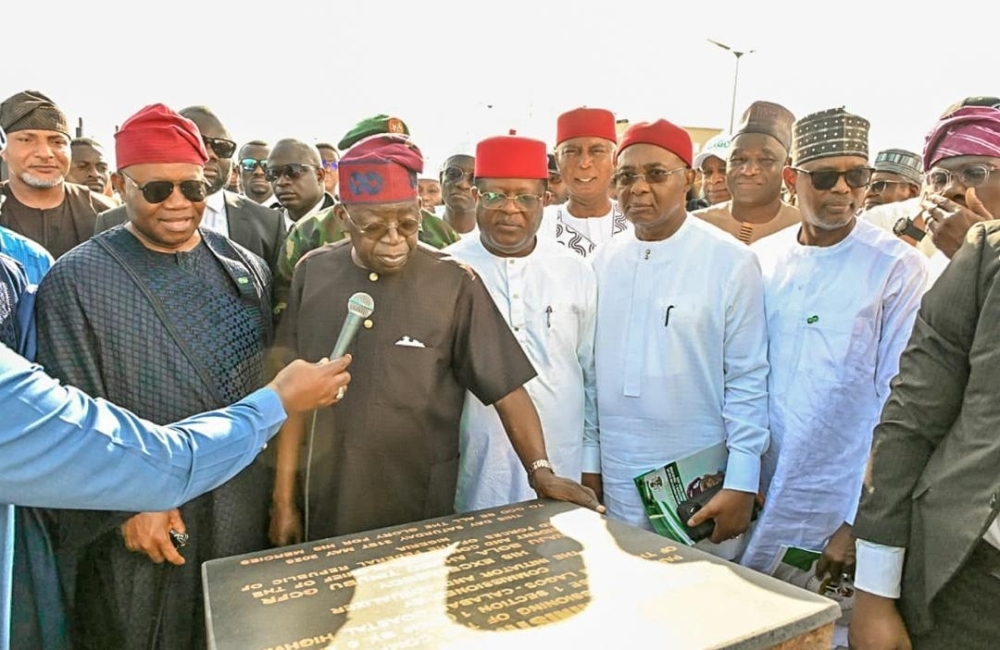
DRIVING NIGERIA’S FUTURE: CELEBRATING TWO YEARS OF TRANSFORMATIVE LEADERSHIP AND THE LAGOS-CALABAR COASTAL HIGHWAY MILESTONE
DRIVING NIGERIA’S FUTURE: CELEBRATING TWO YEARS OF TRANSFORMATIVE LEADERSHIP AND THE LAGOS-CALABAR COASTAL HIGHWAY MILESTONE
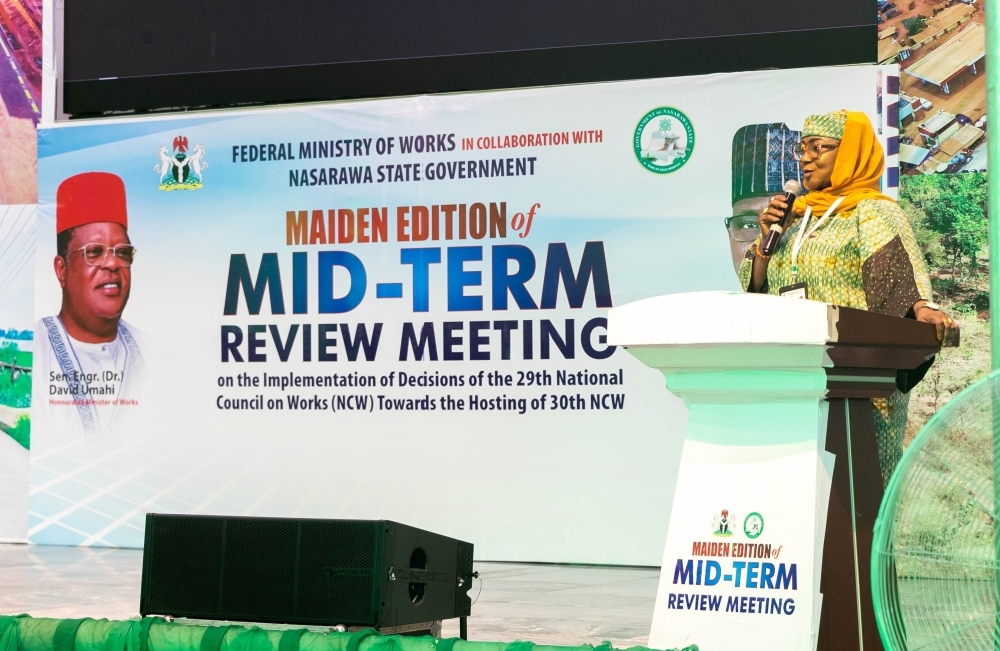
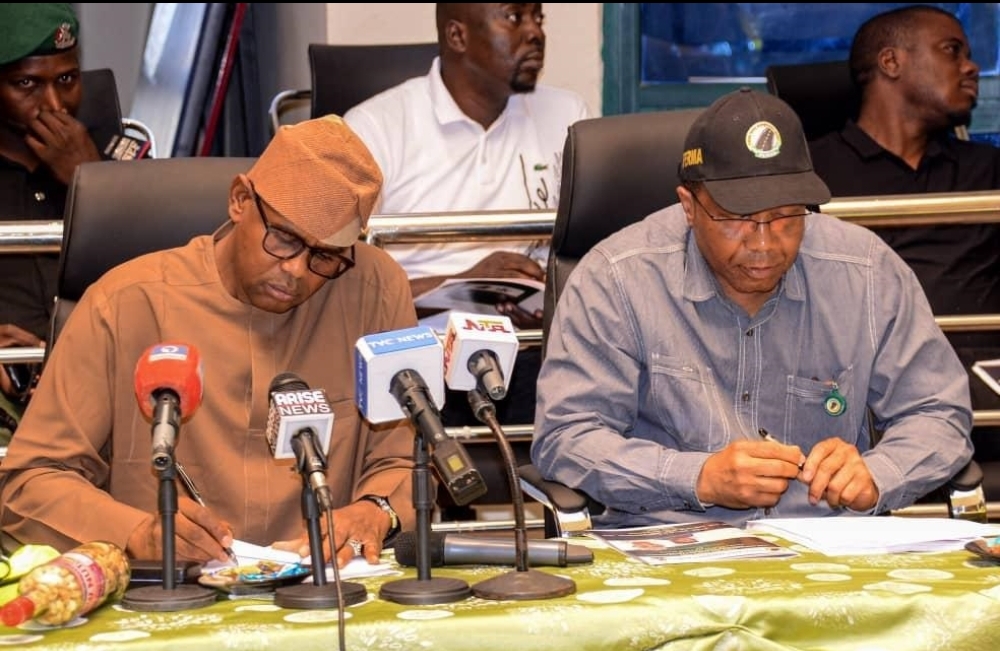
MID -TERM REVIEW MEETING ON THE IMPLIMENTATION OF THE DECISIONS REACHED AT THE 29TH NATIONAL COUNCIL ON WORKS (NCW) DAY 1
MID -TERM REVIEW MEETING ON THE IMPLIMENTATION OF THE DECISIONS REACHED AT THE 29TH NATIONAL COUNCIL ON WORKS (NCW) DAY 1