“Let Us All Work Hard For A Peaceful, Safe Nigeria”, Fashola Urges Nigerians
· As Minister is decorated with Emblem of the 2022 Armed Forces Remembrance Day
· Says it is the only way to keep alive the memories of those that paid the supreme sacrifice for peace in Nigeria, globally
· Explains promotion of peace as “not necessarily absence of conflict, but quick resolution of such conflicts”
· Pays tribute to the fallen heroes, their widows and children who continue to serve to promote peaceful co-existence
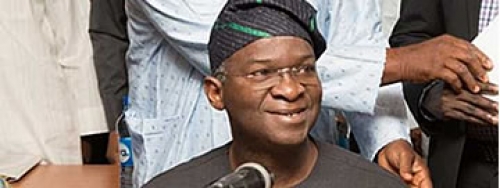
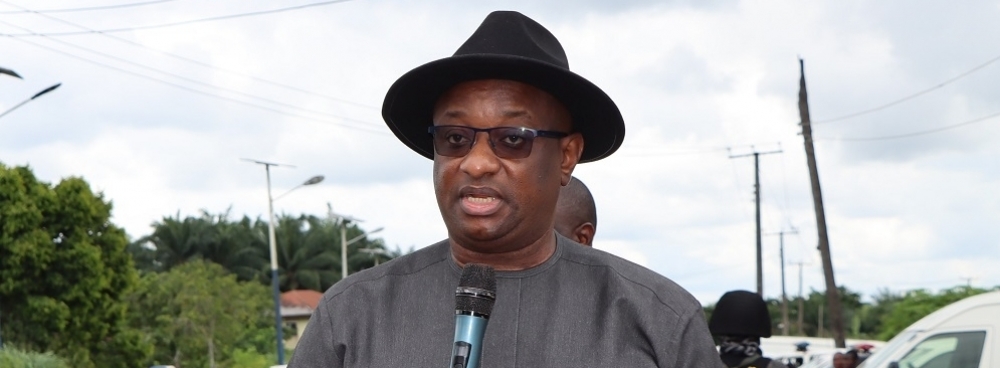
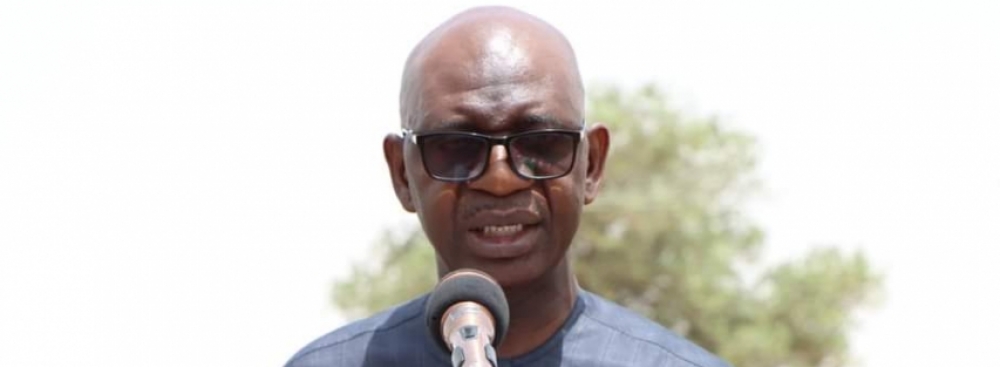
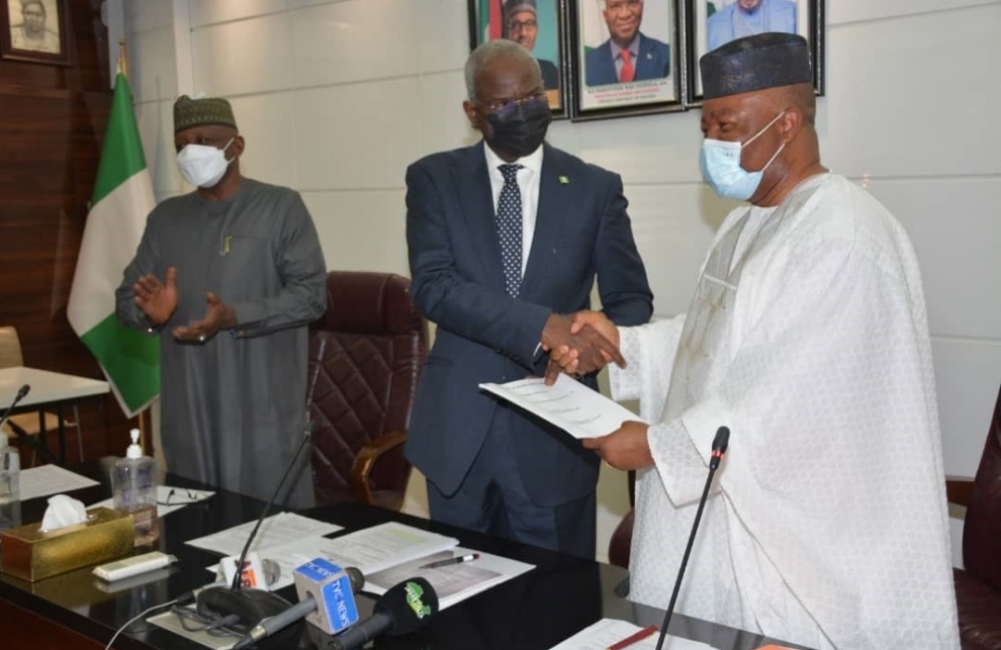
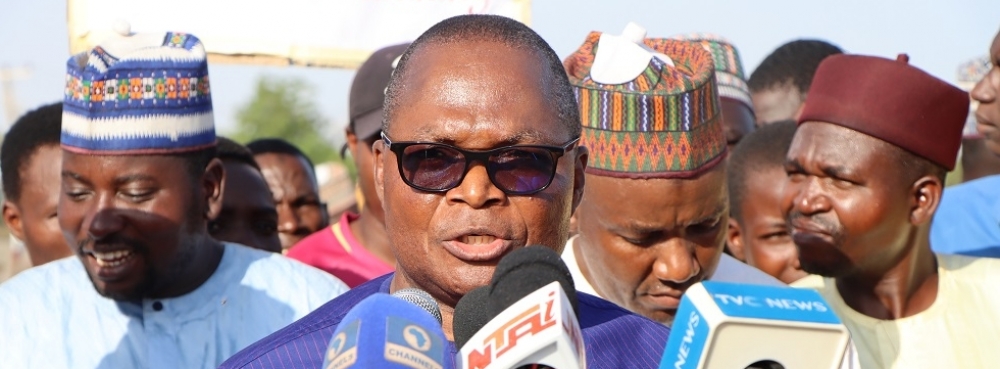
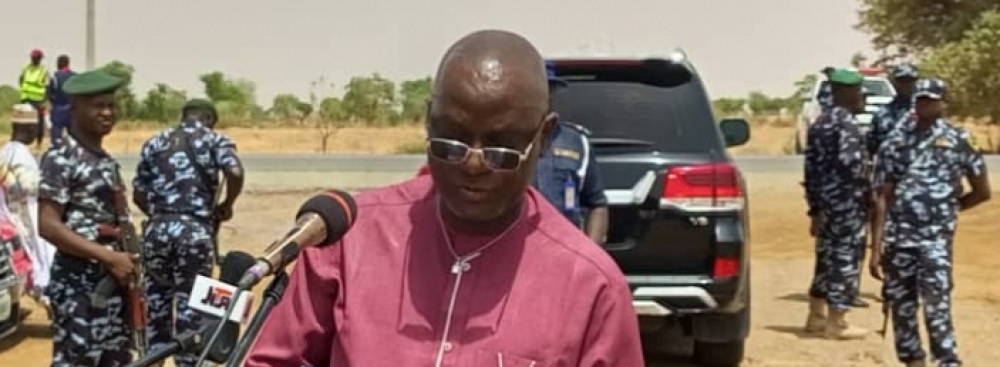
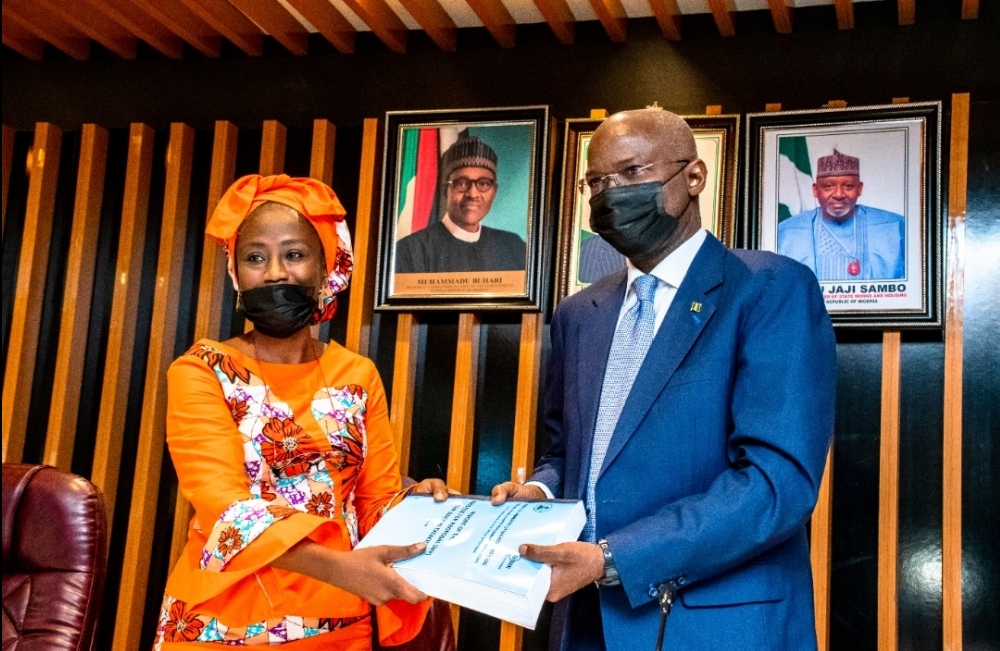
The Minister of Works and Housing, Mr. Babatunde Fashola, SAN, Monday called on Nigerians to join hands with government to promote peace and security in the country saying that it is the only way to keep alive the memories of those compatriots who paid the supreme sacrifice to preserve the peace and unity of the country.
Fashola, who spoke at the Headquarters of the Ministry where he was decorated with the 2022-Armed Forces Remembrance Day Emblem, said working together for the promotion of peace and security would ensure that the sacrifices made by the fallen heroes were not in vain.
Reiterating the call for the promotion of peace and security among the people, the Minister, who, however, explained that the promotion of peace did not mean the absence of conflicts and disagreement, declared, “It is the resolution of those conflicts in a manner that does not lead to conflict that is important”.
“As human beings with our diversity, we could have so many conflicts and disagreement, but those conflicts must not lead to violence or lead to clashes. Those conflicts must be resolved before the day is over and this is the job that is everybody’s responsibility, not only those in government but to all Nigerians”, he said.
Fashola pointed out that if all Nigerians choose to live together the issue of conflict resolution would be an easy task adding, “And the less conflict we have, the less people who will have to lay down their lives to bring such conflicts to an end, and the less widows and widowers and orphaned children we will have; and the more that happens daily the better our country will be”.
Urging all Nigerians, both at home and in the diaspora, to support the course of the Armed Forces Remembrance Day, the Minister commended President Muhammadu Buhari for leading from the front at all times the cause of the upkeep of those left behind by the nation’s fallen heroes adding, “Nothing can be too much to support the cause that keeps the veterans and their dependants going”.
Welcoming the delegation of the Nigerian Legion led by its Chairman, Major General Jibril (rtd.), Fashola, acknowledged that the occasion was not just about the military but also about the affairs of both those who laid down their lives and those who “bear the burden of the sacrifice of our officers and their family members, in this case, widows, who in spite of their grief, continue to support and propagate the values of service in the military”.
The Minister, who described the “Season of Remembrance” as very important, declared, It is a very important season to remind all of us that were it not for the service of some people and their sacrifice in an ultimate way, perhaps our story would have been different. The least we can do to keep the memories of those people alive, to make sure that their sacrifices are not in vain is to continue to work hard to uphold the purpose for which they laid down their lives”.
Earlier, in his opening remarks, Major General Jibril said the purpose of their visit was to solicit for assistance from well-meaning Nigerians for the country’s veterans of the various conflicts across the world and in Nigeria as well as their dependants.
Major General Jibil, who said President Buhari launched the Emblem on October 21, 2021, added that the President directed that they should go round to well-meaning Nigerians across the country to support the course by launching the Emblem.
Accompanying the Chairman of the Legion to the occasion were the General Secretary and other top members of the Legion while on the Ministry’s side were the Permanent Secretary, Mr. Babangida Hussaini, Directors, Special Advisers and other top Ministry officials.
WHAT CAN THE PRESIDENT DO FOR ME? BEING THE TEXT OF A KEYNOTE DELIVERED BY H.E BABATUNDE RAJI FASHOLA, SAN AT THE YORUBA TENNIS CLUB ANNUAL LECTURE
Distinguished Ladies and Gentlemen:
At the onset of the protest against the Special Anti-Robbery Squad (SARS) when five demands were made in respect of the police and SARS, President Muhammadu Buhari weighed in on the side of the protesters when he said:
“On Monday 12th October, I acknowledged the genuine concerns and agitations of members of the public regarding the excessive use of force by some members of SARS…As a democratic government, we listened to, and carefully evaluated the five-point demands of the protesters. And, having accepted them, we immediately scrapped SARS, and put measures in place to address the other demands of our youth.”
To some of the protesters this was not enough action. In my interaction with some of them, young and not so young they wanted the President to sack some policemen, in some cases even the Inspector General of Police.
During this interaction I referred them to the provisions of the 1999 Constitution as amended, that I pointed out to them that:
* The President of Nigeria cannot sack a policeman because a policeman is not the employee of the President but rather the employee of the Police Service Commission;
* The President can only sack Ministers, and other appointees that he personally appoints to assist him and not any civil servant deployed to work for him such as a cook, driver, or administrative staff who are ordinary employees of the Civil Service Commission.
Not a few persons were surprised to hear this.
Indeed, I have discovered that a sizeable number of our people express surprise when I explain the structure of Government to them.
For example, when I explain to people that as Governor or Minister I do not sign cheques, vouchers or documents that directly involve the transfer of money.
On the contrary, at certain levels of payment under the financial regulation, my powers as Governor or Minister are limited to approving recommendations for payment made to me through the Permanent Secretary; after he and I have satisfied ourselves that the Government has received value for the payment or will do so.
Although the Federal Ministry of Works and Housing has several directorates such as Construction and Rehabilitation, Planning and Development, Bridges and Design, Materials Geotechnics and Quality Control, Finance and Accounts, Legal and Procurement, many openly express surprise when I tell them that only Engineers, Architects, Valuers, Builders, Town Planners and those involved in the built industry are staff of the Ministry of Works and Housing.
Those in Legal Department are lawyers seconded from the Ministry of Justice to whom they report, Finance and Accounts are staff of the Accountant General/Ministry of Finance, to whom they report, and procurement personnel are staff of the Bureau of Public Procurement to whom they report; while those in administration are staff of the Head of Service/Public Service Office to whom they report.
And this is true of all ministries, in a system of checks and balances.
Similarly of course, in the engineering sections of other ministries, the Ministry of Works also seconds engineers to support those ministries and they report to their parent ministry.
What is true of the Federal civil service system in this regard is largely true of the state civil service systems.
This in part is why the public service is a bureaucracy, which has been defined as:
“…a complex organization that has multi-layered systems and processes.” (Source - Investopedia)
I am surprised that this surprises people and this is a part of the reason for choosing to discuss it at this public forum.
So very often, I hear general statements that the President of Nigeria is very powerful, sometimes they say the office is too powerful in some cases they even ascribe more powers to him than the United States President.
Therefore I have decided, in responding to the invitation of Chief Babajide Damazio, the Chairman of the Yoruba Tennis Club, to interrogate the matter publicly by titling my speech “What can the President do for me?”
The flip side is also that some of our public discourse is coloured with general statements that are not factual such as some statements to the effect that the Vice President is in their words “just a spare tyre” suggesting that he has no powers or functions except those assigned to him by the President.
These statements betray a lack of knowledge about the Constitution and I intend to discuss them here within the reasonable limits of time.
If one looks through the length and breadth of the constitution as I have, you will find that the office of the President is referred to 48 (FORTY-EIGHT) times.
A closer look at the details for those who have read the constitution, will suggest possibly an error in mixing up or conflating “powers” with “function” and the difference is significant.
“Whereas ‘power’ is the legal right or authorisation to act or not to act, it is the ability conferred on a person by law to alter, by an act of will, the rights, duties liabilities and other relations, either of that person or another. On the other hand, the term “function” is the duty of the office.
In the 48 mentions of the Office of the President in the Constitution:
* 23 instances refer to powers exercisable by the President;
* 9 instances refer to powers exercisable by the President subject to the National Assembly;
* 4 instances refer to powers exercisable by the President subject to other institutions;
* 9 instances refer to the President’s functions and duties; and
* 3 instances refer to restrictions on the powers of the President.
Yes, the “all powerful,” “too powerful” President that we generalise about his powers, has restrictions on his powers.
I have provided a table of all the references in the Constitution below:
Part A: Powers exercisable by the President
| Section | ||
| 1 | The executive powers of the Federation is vested in the President | Section 5(1)(a) |
| 2 | The executive powers include the power to execute and maintain the Constitution | Section 5(1)(b) |
| 3 | Power to execute and maintain all laws made by the National Assembly | Section 5(1)(b) |
| 4 | Power to make treaties [Power conferred on the Federation] | Section 12 |
| 5 | Power to deprive registered or naturalized citizens of their citizenship | Section 30 |
| 6 | Authorization of qualified private persons to establish a television or wireless broadcast station | Section 39 |
| 7 | Power to assent (or withhold assent) to bills passed by both the Senate and the House of Representatives | Section 58 |
| 8 | Power to decide whether or not it is practicable to hold elections | Section 64 |
| 9 | Power to issue proclamation for the holding of the first session of the National Assembly | Section 64 |
| 10 | Right to attend joint meetings of the National Assembly or of either the Senate or the House of Representatives to deliver an address on national affairs or to make statement on government policies | Section 67 |
| 11 | Power to order withdrawal of moneys from the Consolidated Revenue Fund of the Federation for the purpose of meeting expenditure necessary to carry on the services of the Government | Section 82 |
| 12 | Establishment of offices of Ministers of the Government of the Federation | Section 147 |
| 13 | Assignment of responsibilities to the Vice President and Ministers | Section 148(1) |
| 14 | Power to appoint or remove Chairman and members of Federal Executive Bodies established by section 153 of the Constitution | Section 154 |
| 15 | Approval of rules of procedure made by the Federal Executive Bodies established by section 153 of the Constitution | Section 160 |
| 16 | Power to approve delegation by the Federal Civil Service Commission of its power to any of its members or to any officer in the civil service of the Federation | Section 170 |
| 17 | Power to appoint and remove the following officers: Secretary to the Government of the Federation, Head of Service, Ambassadors, High Commissioners and Permanent Secretary, etc | Section 171 |
| 18 | Power to give approval to a State body where it is intended by the body to confer power or impose duties to any officer or authority of the Federation | Section 204 |
| 19 | Power to give lawful directions to the Inspector General of Police with respect to the maintenance and securing of public safety and public order | Section 215(3) |
| 20 | Power to direct the armed forces to suppress insurrection and acting in aid of civil authorities to restore order | Section 217(2)(c) |
| 21 | The President is the Commander-in-Chief of the armed forces of the Federation and as such is empowered to: * determine the operational use of the armed forces of the Federation; * appoint the Chiefs of Staff of Defence, Army, Navy, and Air Force; and * appoint heads of any other branches of the armed forces of the Federation. |
Section 218 |
| 22 | The Constitution vests the Executive power for the administration of the Federal Capital Territory in the President | Section 299 |
| 23 | Power to appoint a Minister for the Federal Capital Territory | Section 302 |
| 24 | As the Appropriate Authority, the President is authorized to make modifications in the text of any existing law as he considers necessary to bring the law into conformity with the provisions of the Constitution | Section 315(2) |
Part B: Power subject to the National Assembly
| 1 | Power to declare a state of war between the Federation and another country [subject to the sanction of the National Assembly] | Section 5(4) |
| 2 | Deployment of members of the armed forces of the Federation on combat duty outside Nigeria. [subject to approval of the Senate] | Section 5(5) |
| 3 | Making regulations to prescribe matters which are required to give effect to constitutional provisions on citizenship [subject to laying before the National Assembly] | Section 32 |
| 4 | Appointment and removal of the Auditor-General for the Federation | Section 86 |
| 5 | Appointment of Ministers | Section 147 |
| 6 | Power to appoint Special Advisers to assist the President in the performance of his functions. [Their number is to be determined by the National Assembly] | Section 151 |
| 7 | Power to appoint the Chief Justice of the Federation, Justices of the Supreme Court of Nigeria, President of the Court of Appeal, Justices of the Court of Appeal, Chief Judge and Justices of the Federal High Court and Justices of other Federal Courts. [Subject to confirmation by the Senate] | Sections 231, 238, 250, 254B, etc |
| 8 | Power to remove the Justices and Judges appointed by him [Acting on address supported by 2/3 majority of the Senate or NJC] | Section 292 |
| 9 | Power to issue a proclamation of a state of emergency in the Federation or any part thereof in the circumstances listed in section 305(3) and (4) of the Constitution | Section 305(1) |
Part C: Power subject to other institution
| 1 | Deployment of members of the armed forces of the Federation on a limited combat duty outside Nigeria. [in consultation with the National Defence Council] | Section 5(5) |
| 2 | Power to grant a pardon to any person convicted of any offence created by an Act of National Assembly (Prerogative of mercy) [This power is to be exercised by the President after consultation with the Council of State] |
Section 175 |
| 3 | Power to accept or reject report of population census conducted by the National Population Commission. [This power is subject to the advice of the Council of State] |
Section 213 |
| 4 | Appointment of the Inspector General of Police [This power is to be exercised on the advice of Nigeria Police Council] |
Section 215(1)(a) |
Part D: Functions and Duties
| 1 | Considering recommendations from a body set up to review ownership and control of business enterprises operating in Nigeria | Section 16(3) |
| 2 | Approving the registration of persons who apply to be registered as citizens of Nigeria | Section 26 |
| 3 | Granting of certificate of naturalization to persons who are qualified | Section 27 |
| 4 | The President has the responsibility to cause budget to be prepared and laid before the National Assembly | Section 81 |
| 5 | Duty to hold regular meetings with the Vice President and the Ministers of the Government of the Federation | Section 148(2) |
| 6 | Tabling of proposals for revenue allocation from the Federation Account to the National Assembly | Section 162(2) |
| 7 | Duty to transmit copies of official gazette containing emergency proclamation to the President of the Senate and the Speaker of the House of Representatives | Section 305(2) |
| 8 | The President is the chairman of the following constitutional bodies: The Council of State * National Defence Council * National Security Council * Nigeria Police Council |
|
| 9 | Duty to lay accepted report of population census conducted by the National Population Commission before the National Assembly. [This power is subject to the advice of the Council of State] |
Section 213 |
Part E: Restriction
| 1 | Prohibition from holding any other executive office or paid employment | Section 138 |
| 2 | Prohibition from maintaining or operating a bank account in a country outside Nigeria | Fifth Schedule to the Constitution |
| 3 | Prohibition from being employed by foreign company or foreign enterprises after leaving office | Fifth Schedule to the Constitution |
Is the Vice President really without responsibilities, duties and functions unless the President assigns them to him?
Certainly not. Those who assert that position tell a big lie. A lie born either out of ignorance at the best or mischief at the worst.
The framers of the Nigerian Constitution and our legislators seem to have deliberately attempted to entrust matters relating to its security with the President by making him chairman of the National Councils such as the Security Council, Defence Council and the Police Council, while entrusting the Vice President with matters relating to the economy by making him the Chairman of the National Council on Privatization and the National Economic Council.
Although they did not say the President cannot deal with economic matters, it is my view that he cannot chair the Economic Council or National council on privatization without violating/breaching the constitution with its attendant constitutional risks and consequences.
So much for the “all-powerful” President.
As for the Vice President, his other constitutional functions include:
|
SECTION A Constitutional Function and Duty of the Vice President |
Constitutional Provision | |
| 1 | Exercise of Executive Powers of the Federation as delegated by the President | Section 5(1)(a) |
| 2 | Power to perform the functions of the President as Acting President during temporary absence of the President | Section 145(1) |
| 3 | Power to hold the office of the President if the office of the President becomes vacant by Section 146 | Section 146(1) |
| 4 | Performance of ‘responsibility for any business of the Government of the Federation’ as may be assigned by the President | Section 148(1) |
| SECTION B Constitutional Appointment/Position |
Constitutional Provision | |
| 1 | Deputy Chairman of the Council of State | Third Schedule, Part I, Paragraph B (5) |
| 2 | Chairman of the National Economic Council | Third Schedule, Part I, Paragraph H (18) |
| 3 | Deputy Chairman of the National Defence Council | Third Schedule, Part I, Paragraph G (16) |
| 4 | Deputy Chairman of the National Security Council | Third Schedule, Part I, Paragraph K (25) |
| SECTION C Statutory Function/Position |
Statutory Provision | |
| 1 | Chairman of the Governing Council of the National Emergency Management Agency | Section of National Emergency Management Agency Act |
| 2 | Chairman of the Governing Board of the Border Communities Development Agency | Section 2 Border Communities Development Agency (Establishment, etc.) Act |
| 3 | Chairman of the National Boundary Commission | Section 4 National Boundary Commission (Establishment) Act |
| 4 | The Vice President may represent the President of the Federal Republic of Nigeria as the Chairman of the Governing Council) | Section 8 Nigeria Sovereign Investment Authority (Establishment etc.) Act 2011 |
| 5 | Chairman of the National Planning Commission | Section 3 National Planning Commission Act |
| 6 | Vice Chairman of the Council of the National Space Research Development Agency | Section 2 National Space Research and Development Agency Act |
| 7 | Chairman of the Supervisory Board of the Debt Management Bureau | Section 2 Debt Management Bureau (Establishment) Act |
| 8 | Chairman of the National Council on Privatisation | Section 9(2) Public Enterprises (Privatisation and Commercialisation) Act |
Which brings me to the heart of the matter, as to why a significant number of Nigerians place their hopes and expectation for a better life on their President rather than their Governors and Local Government Chairmen.
Or put differently, why do we seem to only like our Presidents after they have left office and not while in office or after they have died, like “the best President we never had.”
Again, after a very deep interrogation, my answer to this question is traceable to the constitution. And this is not a concession to the advocates of restructuring, but rather a clear lack of relationship by many of us with the constitution.
In other words, we are not fully or sufficiently familiar with our constitution and the roles it ascribes to the different levels of government, at local, state and federal, and the officers attaching to them such as Local Government Chairman, State Governor and the President.
And the related question, to the question what can the president do for me, is to ask ourselves: how the office of the President make my life better?
Before I offer an answer, let me share with you the feedback of a survey that I commissioned to gauge the sense of what the Nigerians who were polled desired most.
The common thread in the responses were: security, education, healthcare, transportation, water supply, employment, housing and electricity. Of course, there are others, which time and space will not permit me to interrogate.
In understanding what the President can do, we must bear in mind the nature of our political arrangement where the President as head of the country, also leads the executive arm of the Federal Government and projects our sovereign status, but shares power and responsibility with 36 states headed by Governors, and 774 Local Government headed by Local Government chairmen.
If we go through our constitution, (and I urge everybody to get a copy and read it if only casually) we will find two (2) lists of responsibilities in the schedule to the constitution.
They are:
* The Exclusive list
* The Concurrent list
The first list contains matters over which only the National Assembly, as the custodian of legislative power of the Federal Government can make laws and over which the President as the head of the executive arm can take action. This list contains 68 (SIXTY-EIGHT) items and includes matters like the banking, currency, police, the military, customs, immigration, citizenship etc.
The second list, which is called the concurrent list, means exactly what it says. A concurrence of authority where the Federal and State governments share power and therefore the state houses of assembly as well as the National Assembly can make laws over these matters; while the Governors, as well as the President, can act in these areas.
This list contains 12 (TWELVE) items and includes matters like Education (secondary and university including polytechnics) Health (secondary and tertiary), Electricity (generation, transmission and distribution).
This list does not include primary education or primary health or sanitation or markets which are expressly left for the Local Governments in the 4th schedule of the constitution.
All matters not listed in these two lists or in the fourth schedule to the constitution such as magistrate courts, consumption tax, rent control, local levies and non-specified taxes, are regarded as RESIDUAL, and the sole preserve of the state governments.
Manifestly and contrary to the view that everything revolves around the President or the Federal Government, what is obvious from the Nigerian constitution and political arrangement, what we really have is an arrangement of shared powers, and I might add, shared responsibility. The question then must be, whether all those who bear responsibility actually discharge them; and I will come back to this in some comparative examination of some of the problems identified earlier that people seek government action for.
But before I do so, I need to quickly shed light on even the nature of the Federal Government.
The Executive arm, such as the Federal Executive Council, has the President and Vice-President elected by the people of Nigeria, and at least 36 ministers appointed from each state as prescribed by the constitution that every state must have a Minister. It also then prescribes that the ministerial nominee must be cleared and approved by the Senate.
And who is the Senate? 109 people, elected by you and I, whether you voted or not, 3 from each state to represent us in the Federal Government because there is no building big enough to accommodate us so we send representatives.
The FCT also has one Senator. The House of Representatives, the other arm of the National Assembly has 360 members from all the 36 states who act to exercise legislative powers over the exclusive list, to determine what the Federal Executive can act upon.
When you see how the structure is laid out, what is obvious to me and hopefully to you, is that it is the people of Nigeria, rather than one man, (the President), who truly have powers and responsibility over our affairs.
Let us now then look at a few examples, because there are many, to examine how these powers have been exercised.
Let me start with electricity. As I said it is a concurrent power by the federal and state. The Federal Government since 2013 has chosen to privatize its own responsibility by selling the generating and distribution assets, while managing the transmission side with varying degrees of success.
The question to ask is what is happening at state level across Nigeria with electricity generation, transmission and distribution.
This question cannot be posed to the President. He is not in charge of any state. He did not elect or appoint a Governor. You and I did.
So I am not suggesting that all electricity problems are the responsibility of the state Governors, but if you have an electricity problem in your states please ask your Governor what he plans to do about it, and your House of Assembly lawmaker which law he will support if you vote for him to give you electricity.
The same applies to primary education and primary health. The Federal Government does not and should not own a primary school or primary healthcare centre. But these are the most defining centres for quality education and preventive health. The foundations of young life are defined here. Basic literacy and numeracy, ante-natal care and life protecting immunization are delivered here.
Please ask your Local Government chairman not the Governor or the President.
Sanitation, characterized by water supply and proper refuse management and civic education are not the constitutional responsibility of the Federal Government, your Senator, house of representative member or the President.
It is our state representatives who have constitutional mandate to deliver water to our homes, move our refuse and make sure our surroundings are clean and we do not suffer from disease and epidemics.
Because I expect that there will be responses, whether informed or uninformed to what I already said and will say, let me be clear that I have not come to absolve the Ministers, the Senators, House of Rep, Federal Civil servants and the President of responsibility.
We have our responsibilities and can do a lot more, but I first sought to clear the air and state the facts for those right thinking and indeed well-meaning Nigerians who honestly want a better life and do not know who is responsible for the problems they face.
So, let me go to a contentious area, like Security.
Section 14.2 (b) of the Constitution provides that:
“the security and the welfare of the people shall be the primary purpose of government…”
Interestingly, it does not say which government. My view is that security is an all government responsibility not a Federal Government responsibility alone.
Yes, the Federal Government controls the apparatus of coercive law-enforcement prescribed in the constitution like the military and police, but it has not precluded states from setting up certain types of law enforcement for traffic, sanitation etc.
I am also a public advocate for states to control their own law enforcement apparatus in other extensive areas where they have powers to make laws.
However, I hold the view that security, which is a concern of some of the people, is not guaranteed by having a state law enforcement apparatus.
Indeed, it is more than a government affair.
In my view, it is an all nation affair as contemplated in section 24(e) which provides that:
“It shall be the duty of every citizen to…render assistance to appropriate and lawful agencies in the maintenance of law and order…”
It seems to me that the road to resolving our security problems, starts with a resolution to prevent or resolve the existence of conflict, eliminate the opportunities for crime to happen, and this requires effort from the family unit to the schools, religious institutions, to all levels of government.
It requires a reset of our values for hard work, a love for one another as a keeper of each other, brothers and sisters, a commitment to peaceful cohabitation and the mustering of the capacity to ensure that no conflict lasts to the next day, whenever any occurs.
This will reduce the need for law-enforcement and put less pressure on them.
It is more than a job for a President, Governor, Local Government chairman, or legislator at any level. It is a job that requires parents at home, teachers in schools, religious leaders in places of worship, title holders like Obas, Emirs, Chiefs like Obis, Baloguns, Turakis, Asiwajus, Bashoruns, Galadimas, Ezes and many more.
This again does not absolve the need for well-equipped law enforcement or excuse those responsible, as it does not absolve the need to stem and stop drug abuse in our society, and the need to reduce or eliminate abandoned buildings where suspicious people thrive in our society and need for street lighting at night to deter criminal atrocity.
I cannot conclude this intervention without mentioning road infrastructure.
Nigeria as a country has 200,000 plus kilometres of roads. But they belong to different levels of government.
Federal trunk roads, mentioned in item 11 of the executive legislative list is the one the Federal Government is responsible for
These are the roads that connect one state to the other, interstate roads. These account for 35,000km out of the 200,000km representing 17.5 %.
The state government roads are 17.5% of the 200,000 km and these are the roads that connect one Local Government to another; while the Local Governments have responsibility for the balance, representing 65% of roads that connect one ward to another.
I cannot of course ignore the fact that the Federal Government has a big and important role to play in respect of fiscal and monetary policy that impacts exchange rate, interest rate and inflation.
But there are legitimate questions to ask about how many local businesses need foreign exchange to operate as much as they need water, electricity and skilled personnel and lower levies and non-state actors from extorting them.
There is a legitimate question to ask about whether those of us who keep bank accounts are ready to accept lower deposit rates as a measure to induce lower lending rates, because high interest rates affect our people.
And of course, with housing on the rental side, how many of us who own houses are ready to accept monthly payments as rent paid in arrears as against two (2) years rent paid in advance, which is a point of pain and stress for many people.
While the properties for which these rents are charged largely belong to individuals and companies, not to government, there is also the question to ask whether or not our legislators at state levels can make laws to control rent. This is not a matter for the president because the federal legislator has no powers over rent.
On the construction side of housing, we must remember that it is the state Governors who control land, not the Federal Government. While the Federal Government is currently constructing houses in 34 states, and developing site and service schemes on land provided by state governments and using employee’s contribution to fund mortgages to help some people buy houses, there is a legitimate question to ask whether your state government is building houses and ready to create a mortgage funding institution.
Ladies and gentlemen, there is a lot to expect of a President, there is perhaps much more to ask of State and Local Government actors.
After all, the projection of national might and success on the international stage by heads of Governments such as Presidents, whether in terms of cuisine, technology, sports or the economy, is the projection of the aggregate of what happens at their sub-national entities.
Now that you know who to ask about primary education, primary health, water supply, refuse management, electricity, security, interest rate, roads and a lot more, please know that candidates will soon begin to emerge as 2023 beckons. Do not keep quiet.
Ask them what they will do to make your life better.
Thank you for listening.
Babatunde Raji Fashola, SAN
Honourable Minister of Works and Housing
Friday 5th November 2021
We will continue to prioritize welfare of staff - Perm. Sec. (FMW&H)
The Permanent Secretary, Federal Ministry of Works and Housing (FMW&H) Babangida Hussaini has said that his Ministry under the leadership of His Excellency Babatunde Raji Fashola SAN will continue to give priority to staff welfare in order to motivate them to give their best to the service of the nation as the Ministry pursues President Muhammadu Buhari’s mandate of infrastructural development in the nation.
Mr Hussaini made the remarks during handing over of the newly acquired four 36-seater Toyota Coaster Buses to the staff of his Ministry through their union, Amalgamated Union of Public Corporations, Civil Service Technical and Recreational Services Employees (AUPCTRE), today in the premises of the Ministry.
The official handing over event took place at the Ministry Headquarters with some of the Management staff, The Labour Union Executive members and some staff of the Ministry in attendance.
The Permanent Secretary in his remarks said that he was grateful to God for making the purchase possible and to the Honourable Minister of Works and Housing Babatunde Raji Fashola SAN for granting approval for the procurement and commended the Executives of the Union for their maturity during the procurement period.
Mr Hussaini said he was dedicating the purchase to Director of Human Resources Works and Housing Umar Abdullahi Utono who retired today as a parting gift due to his wise counsel and for the necessary follow up to make the purchase a reality.
He promised that more staff buses would still be purchased as the procurement is in batches while the old ones that are grounded would be refurbished as soon as proposal from the reputable motor mechanics are considered for approval.
Director Human Resources of the Ministry, Umar Abdullahi Utono said “I cherish the Permanent Secretary for the official handing over of the buses to staff, and it is one event that will remain in my memory, and he has provided welfare for staff within a short period. The four buses would cover the following major routes: Bwari /Dutse, Suleja, Karshi /Jikwoyi and Gwagwalada. It is a major milestone.”
The Union Chairman of Works and Housing branch of AUPCTRE, Comrade Sunday Sanusi said “When I heard that these vehicles have been purchased it was like a dream to me, I am using this opportunity to say thank you to Permanent Secretary and the management for making it a reality.”
The official handing over of the event was rounded off after the Permanent Secretary performed the test running of the buses.
FG Commended For Award Of Road Projects
The Honourable members representing Biu/Bayo/Kwaya Kvsar/Shani Federal Consitutency of Borno State, Hon. Murtar Aliyu Betara and his counterpart representing Chibok /Dambon /Gwoza Constituency Hon. Ahmed Jaha Babawo also in Borno State have expressed appreciation to the Federal Ministry of Works and Housing on the award of contract for the re-construction of Gombe-Biu road, and urged the Ministry to ensure the contractor expedite action to complete the road.
Honourable Betara who led the delegation of some House of Representatives Members to the Ministry in order to follow up on the state of some critical roads in their states and the strategy of the Ministry in fixing the roads noted that some of the contractors were complaining of funding challenges.
In his response the Permanent Secretary Federal Ministry of Works and Housing, Babaginda Hussaini appreciated the gesture of the law makers in dialoguing with the Ministry in order to fix the critical roads in their constituencies adding that such collaboration with the Ministry by the National Assembly will help the government in its bid to improve road infrastructure. He also said that the gesture was a clear demonstration of love for their constituencies.
Mr. Babaginda informed the law makers that the major challenge in road infrastructure development was funding as the budgetary allocation was grossly inadequate to address the needs in the road sector.
He however informed the law makers that this administration had created new funding windows for road construction and repairs which has greatly helped in bridging funding gaps
The Permanent Secretary said “On behalf of the Honourable Minister Mr. Babatunde Raji Fashola SAN and the Management of the Ministry, I wish to reaffirm the commitment of this administration to complete all critical road projects as practically possible.’
Furthermore, Mr. Hussaini averred that the Ministry was engaging with the contractors since the rains have abated in most parts of the country.
In the same vein, the House of Representatives member representing Zuru /Fakai /Danko Wasaru –Sakaba Federal constituency of Kebbi State also expressed appreciation to the Federal Government for constructing the Gadar – Zaima –Zuru - Gamji road which has aided trading activities in the area.
Stakeholders In The Built Industry Meet In Lagos
Stakeholders in the built industry have converged in Lagos for the 10th Meeting of the National Council on Lands, Housing and Urban Development deliberate on ways to move the industry forward with a view to creating employment, social inclusion and economic development of Nigeria.
The theme of the meeting is " Housing Development As A Catalyst for Job Creation, Social Inclusion and Economic Development.
The meeting of the National Council on Lands Housing and Urban development is organized annually by the Federal Ministry of Works and Housing as part of its statutory mandate.
In his introductory remarks, the Director, Planning, Research & Statistics, Federal Ministry of Works and Housing, Olajide Ode-Martins, said that the National Council on Lands, Housing and Urban Development is the highest policy making organ of the Housing Sector where stakeholders in the sector engage in critical evaluation of and proffer solutions to challenges facing the sector.
Speaking earlier, the Permanent Secretary, Lagos State Lands Bureau Olabode Agoro, identified housing development as a critical key to achieving the Federal government's vision of pursuing social economic renewal, inclusive of job creation and overall national as well as individual development
Agoro, who urged participants to actively evaluate the challenges facing the built industry in relation to Job Creation and national development, pointing out that if housing was thoroughly planned and implemented it could reactivate both the individual and national economy.
Directors and senior officials from relevant agencies in the built industry from both federal, states as well as private sectors are participating in the meeting.
Oversight Visit: Lawmakers Commend Fashola, Ministry Over Progress In Roads Sector
- Call for commissioning of completed projects as means to publicize achievements in road transportation infrastructure.
Members of the Senate Committee on Works on Friday commended the Minister of Works and Housing, Mr. Babatunde Fashola, SAN, and his Team for the progress so far made on the on-going construction, rehabilitation, and expansion of roads across the country.
The Committee members who made the commendation when they paid an Oversight visit to the Ministry, also called for the commissioning of completed projects saying it would enable Nigerians know and appreciate what the Muhammadu Buhari administration has been doing with the nation’s resources since inception.
Addressing the Management of the Ministry, the Chairman, Senate Committee on Works, Senator Adamu Aliero, expressed appreciation on the work of the Ministry in terms of road construction and rehabilitation saying it has become necessary to commission the finished projects for the Nigerian public to see.
The Chairman who said the Committee recently concluded a nationwide tour of the road and bridge projects, declared, “We have to let the public know what the President has done in the road sector. I appeal that you take the initiative to commission the completed parts or sections of the roads”.
Also speaking in the same vein, Senator Ike Ekweremadu, noted that a lot has been achieved in the last six years in the road sector but because the completed roads were not being commissioned, most Nigerians found it difficult to appreciate the achievements.
Senator Ekweremadu noted that some of the contractors have done well in carrying out their assignments on the road projects while others have not and thus recommended that in the face of paucity of funds, those contractors doing good jobs should be paid while those not doing well should be sanctioned. He added that it was better to use available funds to pay those contractors performing well instead of waiting for those who are not doing well.
In his remarks, Senator Ajayi Boroffice, who described the progress so far made on the on-going road construction and rehabilitation nationwide as tremendous, declared, “This administration has done very well by moving people from poverty to prosperity”, pointing out that it has completed almost all the projects inherited from the previous administration.
He told the Minister, “I appreciate what you are doing even though you will receive a lot of criticisms, we know you are doing well”. Also reiterating the importance of commissioning the completed projects, the lawmaker said, “We have to blow our own trumpet to make Nigerians know what we are doing”.
In his remarks, the Minister explained that the concern of the Ministry was principally to ensure completion of the roads to give Nigerians quality travel time in terms of journey time and experience adding that Federal roads are very long roads that connect cities and states as opposed to the intra-city roads.
“I have continuously explained to people that the roads that belong to the federal government are very long roads. They are roads that connect cities and states together, unlike intra-city roads that connect local governments together”.
“So, sometimes somebody will ask me ‘when are you going to commission the roads’. And I ask them, “How, for instance, do you commission Kano-Maiduguri Road; where do you start the commissioning from”, the Minister said.
According to him, “Completion happens in the way we do construction, you close up a Section of the road while constructing and after finishing, you open it up for use. The day you start driving on the roads, it means the roads have been commissioned”.
Noting that commissioning was better suited for municipal roads of five to ten kilometres, Fashola, however promised that the Ministry would consider commissioning some of the completed roads adding that the priority at the moment was to give Nigerians a good road network especially during the coming EMBER MONTHS.
In the robust question and answer session, some of the Lawmakers raised the issue of delays in the completion of some major roads, especially those leading or passing through their constituencies or districts urging the Minister to use his good offices to ensure their completion before the exit of the administration.

Responding, Fashola listed some reasons for apparent delays in project completion to include, paucity of funds, topography of the project location and problems of climate change pointing out that the Rainy Season in Nigeria is always very challenging, especially to road construction.
“The other point I want to make is that the Rainy Season is always very challenging in Nigeria in terms of transport logistics”, the Minister said adding that roads through swampy or muddy terrains always pose more difficulties during construction as the top soils have to be replaced.
On the issue of the major projects funded under the Presidential Infrastructure Development Fund (PIDF) initiative – Abuja-Kaduna-Zaria-Kano Road, Lagos-Ibadan Expressway and the 2nd Niger Bridge-, Fashola said much progress have been made on them adding the Buhari administration was committed to delivering them before 2023.
KEYNOTE SPEECH BY H.E BABATUNDE RAJI FASHOLA, SAN AT LAGOS BUSINESS SCHOOL EVENING WITH THE MINISTERS SERIES HELD ON SEPTEMBER 29, 2021
Distinguished Ladies and Gentlemen:
The compelling part of the LBS’ invitation letter to me dated August 31st 2021 signed by Dr. Franklin N. Ngwu is the part which talks about:
“…the need for more public/private sector dialogue and collaboration for Nigeria’s inclusive and sustainable economic growth and development.”
It is about those 3 (three) things: inclusiveness, sustainable growth and development that I wish to focus my intervention today.
But before I do so, let me push back against the part of the letter that says that:
“Some key constraints such as limited trust, lack of information on the opportunities available, impact of policies and business and operational frameworks of engagement limit their collaboration.”
The first question I wish to ask is “limited trust” on whose part?
My appeal to those who have a one-sided view of the public sector is to stand back and take a hard look at the antecedents of many of those who now occupy leadership positions in the public sector.
What you will see is that many of them, including me, spent a sizable part of their careers in the private sector.
Have we become unworthy of trust because we chose to serve?
And speaking of information or lack thereof about opportunities and policies, I recall that it was to this business school that we came for the launch of the Highway Development and Management Initiative (HDMI) to share information and opportunities regarding the planned concession of 12 highways spanning over 1,000 km of federal road network, and the opportunity for investment growth and job creation.
It is the largest highway concession ever undertaken on the African continent with the potential to create 5,000 direct jobs and 200,000 indirect jobs if successful.
We did not go to a foreign business school to launch the initiative; and there are many we could have gone to, if we so desired. We came to the Lagos Business School, because we wanted a homegrown success.
By way of updates, even though LBS has not come back to ask for one, I can report that out of 75 applicants, 18 have been prequalified, and will soon be requested to submit requests for proposals, environmental and social impact studies are concurrently being undertaken and the national tolling policy has been approved to guide the development of business plans.
Of course, as far as providing information about development and growth goes, many of us regularly brief the public about projects, I go on many project inspection tours to highlight what is going on.
Every quarter, the National Bureau of Statistics (NBS) releases reports about the growth situations in the economy.
What I have observed of course is that the negative results are readily acceptable and pleasing to some people, while they question the data when the same Bureau announces positive quarterly economic performances.
I will now return to the 3 (THREE) issues of:
a) inclusiveness;
b) sustainable growth and
c) development
But first, I must set the context.
Between the period 2012 to 2015 Nigeria‘s economy was reportedly growing at between 5% to 7%. But if we all take time to go back to the reviews and reports in the media at the time, the overwhelming response was that it was “jobless growth or “non-inclusive growth.”
This was the story then and it is not a new story. The other context before we proceed is to remind ourselves that at the peak of that growth, sometime in 2014, the then Minister of Finance issued a statement that Nigeria was heading towards a recession.
These were her words:
“There are some difficult moments out there in the international economy and we have noticed a downward slide in oil prices in recent weeks. Nigeria may not be so lucky to avoid recession this time as it did during the last economic meltdown.”
The question to ask is a recession under who’s watch?
My response is that it did not matter who was managing the economy, the recession was inevitable. We had consumed all the prolific and extraordinary income we earned from high prices of crude oil sales.
We did not invest them in infrastructure, new hospitals, universities, rail, bridges, broadband rollout, airports etc.
So the logical issue would be, what is the plan to get out of the recession?
Before I proceed let me quickly deal in broad strokes with some of the things that happen during a recession.
One of them is that it is the “services sector” that first feels the pinch, and when growth returns the services sector is the last to recover and that is when the feel-good factor returns. I will come back to this.
So in deciding what to do when the recession beckons or happens, the first thing to look at is who is managing the economy and what views do they espouse, because this is likely to shape the choices they will make.
Regrettably, many have again fallen into the error of believing the one-sided story that there is no ideology in Nigerian politics or in the political parties.
Nothing could be further from the truth and any worthy scholar who goes through the various party manifestoes will find not only differences but also similarities and this is one thing I commend for further study and analysis by this business school.
Whilst I will do my best not to be overly partisan, I find it difficult to effectively discharge my task without linking policy to politics.
For example, my party professes a progressive ideology and what this simply means is a “commitment to improving the human condition” and this is one difference between us and the others.
Ask them what they profess?
The other difference is that in 6 (SIX) years we have ensured that the average Nigerian remembers what we committed to: anti-corruption; economic development and security. This is a major reason why we have been held accountable.
You have to go back to 1993, (28 years ago); or further back to 1978 (43years), to find a political era where the public remembers what the parties promised during the campaign.
In MKO Abiola’s SDP, the party manifesto hinged on Energy, Rural Development, Education and Defence. In UPN, Awolowo’s 4 (FOUR) cardinal points (Free Education, Free Health Services, Integrated rural development, Employment) were examples of political promises or ideology so clearly articulated and retained.
This is another difference between us and them, and I challenge many here to ask themselves if they can remember two or three things they were promised in the 16 years before us.
With this background I will now go back to the choices for getting out of recession; because we inherited the doomsday which was foretold.
As I have said earlier, in over five years when oil sold about $100 per barrel, we did not invest in infrastructure.
The 2015 Federal Government budget left by our predecessors for Nigeria’s road network was N18 billion, less than the 2015 budget for roads in Lagos State of N31 billion. (Office of Infrastructure budget)
The said budget had a 15% capital component and 85% of the recurrent component. A budget says a lot about what the Government wants to do. Consume 85% and invest 15%, at the time that oil prices were high.
This is another area of vast policy difference between us and them because from the first budget of 2016 we committed to a minimum of 30% capital investment in the annual budget and an expansive infrastructure investment to boost growth, facilitate development and create jobs.
With oil revenues averaging $43 per barrel in 2016, the works budget for roads was cast at N200 Billion naira, an increase of 1011%.
This pattern has continued to date, where we are spending even more on infrastructure with far less resources.
We must remember that with very high oil prices the total FGN budget in 2015 was N4.4 Trillion while the first budget passed under this administration was N6.06 Trillion.
The Economic Recovery and Growth Plan (ERGP) 2017 - 2020 which was developed as the pathway to recovery from recession was underpinned by infrastructure investment as it committed to:
a) Achieving a stable microeconomic environment;
b) Creating a globally competitive economy and
c) Investing in the Nigerian people.
Apart from over 13,000 km of roads and bridges now under construction or rehabilitation nationwide, hitherto very difficult projects, like Bodo-Bonny Bridge, Lagos-Ibadan Expressway, Abuja-Kano Expressway and Second Niger Bridge now underway and heading towards completion before 2023, a generation of Nigerians can now travel by rail in their own country from Lagos to Ibadan and Abuja to Kano for the first time after a very long hiatus.
This did not happen in 16 years before us.
You may not like how we look or what we say, you may even disbelieve what we say but you cannot disbelieve what we have done with limited income on infrastructure.
This is another difference between us and them.
There is yet another difference and it relates to how we the progressives have chosen to deploy resources.
Between 1999 and 2015 all the infrastructure we are talking about today were crying out for attention.
In spite of prolific oil resources in between that period, I ask anyone to show one bridge, major highway, airport or a rail project that our country built.
I will remind you that in 2005 we choose to pay $12.09 billion to negotiate a Paris debt forgiveness when there was infrastructure crying out for attention.
However, by 2015 the debt stock we inherited was $10.3 Billion in spite of prolific oil resources.
That was a policy choice. No debt, no infrastructure while population grows.
On the contrary, with limited resources and commitment to expansionary fiscal investment and infrastructure to improve the living conditions of Nigeria, our budgets have been deficit budgets funded by debts to invest in infrastructure.
It is our belief that instead of increasing the tax burden of Nigerians, if we borrow to build infrastructure, small businesses who need broadband, rail, roads, bridges and other infrastructure will improve their efficiency and create opportunities.
This can only lead to the inclusiveness, sustainable Growth and development that my invitation letter speaks about.
The Economic Recovery and Growth Plan that we developed to address the recession that our predecessors predicted has worked.
By the second quarter of 2017 we were out of the recession that started in Quarter 2 of 2016 and we recorded 12 consecutive quarters of growth until COVID-19 struck.
By staying true to our core beliefs and by developing the Economic Sustainability Plan to deal with the COVID-19 impact, we came out of a second recession which was global and we now have a 5.1 GDP growth in Quarter 2 with services sector growing at 2.8%.
Remember I told you that the services sector is the last sector to recover after recession and this result is therefore clear evidence that the economy is on the mend and we must sustain it and expand it. In this regard I urge cautious optimism.
If you still think we are the same, let me share with you two different quotes from two sides of the divide to disabuse your minds.
The first is by the Vice-Presidential candidate of the main opposition party during the last elections in 2019.
This is what he said on August 8th 2021 about how to grow the economy.
“You cannot use infrastructure to drive economic growth…taking people out of poverty is not magic.”
But contrast President Buhari’s views expressed in Owerri on 9th September 2021 when he said:
“If we fix infrastructure, people will get on with their businesses.”
I am persuaded that President Buhari gets it.
His contemporary in the USA (a country held out as the example to follow) also gets it when he said:
“The American Jobs Plan will generate historic job growth, historic economic growth, help businesses to compete internationally, create more revenue as well. They are among the highest-value investments we can make in the nation — investing in our infrastructure.”
What limits or enhances the capacity of business is the infrastructure in the environment they operate.
The better the infrastructure the more efficient business becomes and the more productive and prosperous they will be.
If they can move goods and services in quicker time, through ports, rail and road, if they can transact financial services through reliable broadband, move fuel through new pipelines like the Ajaokuta-Kaduna pipeline project, if they can traverse about 40 kilometres on the Bodo-Bonny Bridge on land rather on canoes through the creeks, businesses will prosper and the economy will grow.
This in part is what the enablement of this private sector by the public sector means; in addition to fiscal and monetary policy.
This is a clear road to sustainable growth; and it is growth that will need more people to manage it thereby achieving inclusiveness.
Thank you for listening.
Babatunde Raji Fashola, SAN
Honourable Minister of Works and Housing
Road Blockade: FG Appeals to Truck Drivers for Understanding on Bida -Lambata Ongoing Work
The Federal Government has appealed for understanding of truck drivers on the ongoing construction work on Bida-Lambata road, saying that government is committed to deliver a quality work that will stand the test of time for the benefit of the users.
The Permanent Secretary, Federal Ministry of Works and Housing, Babangida Hussaini made this appeal over the weekend.
Hussaini was reacting to the blockade of a section of the Bida -Lambata and Suleja - Minna roads by some articulated trucks drivers in Niger State, protesting that government should expedite action to complete the ongoing construction to ease their difficulties in using the roads.
" I am appealing to the truck drivers for understanding of the efforts of the Federal government in fixing this road. This Bida-Lambata road is among the many other ongoing projects across the nation which the government prioritised to deliver," he said.
Hussaini also noted that the rehabilitation work has not reached the sections that collapsed but the Contractor has been directed to do palliative work on all such sections while the contruction progress as scheduled.
He however lamented that the contractor has been denied access to the road due to blockade by the tanker drivers.
The Permanent Secretary stated that the administration of President Muhammadu Buhari gives premium to providing road infrastructure across the country as a way of improving the social and economic well-being of the people.
He assured the truck drivers that the Federal Government through the Federal Controller of Works in Niger State is working round the clock with the contractors on site to ensure not only timely completion but to deliver a qualitative road that would stand the test of time.
BEING THE TEXT OF H.E BABATUNDE RAJI FASHOLA, SAN AT THE 27TH MEETING OF THE NATIONAL COUNCIL ON WORKS AND HOUSING HELD AT THE COMMAND GUEST HOUSE, BAUCHI, BAUCHI STATE ON THURSDAY, 23RD SEPTEMBER, 2021
It is a very exciting homecoming for me to return to Bauchi State, named after the ancient and historic Emirate of Bauchi, the home of the Yankari Game Reserve, a great gift of nature to Nigeria.
But Bauchi is not just home to Yankari, it is home to some very great and inimitable patriots who have served our country.
Perhaps Bauchi’s most famous son is Abubakar Tafewa Balewa, but Bauchi also gave Nigeria the Katagums, the Giades, the Toros, the Ahmeds, the Yugudas and so many other illustrious sons and daughters who have dedicated their lives to the service of our nation.
Of course we could not have this event here today without the support and commitment of another Bauchi son, who has followed the path of his illustrious predecessors in public service.
I speak of none other than our chief host HE Sen. Bala Abdulkadir Mohammed, former Minister of the Federal Capital and now Governor of Bauchi State.
Your Excellency, I bring to you and the people of Bauchi the goodwill of the Federal Government and the best wishes of President Muhammadu Buhari and thank you for accepting to host this National Council.
Distinguished Ladies and Gentlemen, the theme chosen for this year‘s council is “Infrastructure delivery, The Maintenance Economy and National Prosperity” and I hope it would help all of us focus on, not just the importance of the investment in infrastructure, but more importantly on the maintenance of infrastructure, the economy around maintenance and sustainable and long lasting jobs that are created through maintenance.
Since the implementation of the Marshall plan in 1948, after the Second World War, it has become clear to any serious minded economist or politician that infrastructure provision is critical to development, growth, wealth creation, employment and prosperity.
I have said and I will repeat it here, that infrastructure investment is the most legitimate way to distribute wealth in any economy.
This is why it is not surprising that during campaigns for elections and after elections, you will find discussions not only centering around roads, bridges, rails, schools, hospitals, water supply and power supply to be provided, you will also find that in the inauguration speech of every President, Prime Minister, Governor and other elected public officers, time is dedicated to addressing the provision of infrastructure.
I am sure our host will recall that he made similar commitments in his inauguration speech on May 29, 2019:
“…at the core of this mandate is the crucial drive to give Bauchi State citizens a better prospect and greater opportunity for a prosperous life. Reducing poverty and empowering our citizens in the areas of Agriculture, Education, urban and rural infrastructure among others.”
The reason for this is not far-fetched. The nations that are richer than us have more infrastructure than us and in order to bridge this gap we have to invest; because no nation or community can grow bigger than the stock of infrastructure.
Infrastructure also helps to make people efficient, it creates competition and leads to productivity. Currently the Federal Government is executing 895 contracts in 795 projects spanning over 13,000 km of roads and bridges nationwide.
Across all of these, engineers, geologists, surveyors, lawyers, bankers, suppliers, artisans and laborers are involved in an ecosystem of enterprise from which they earn a daily, weekly or other periodic income.
But that is only part of the story, the employment. The other parts include improved asset value, because everywhere a new road or bridge is built, the land value appreciates by up to 30% creating enormous capital gain.
On the completed sections of the roads, journeys that used to take days now take only a few hours, journeys that took hours are now reduced to minutes; and if it is true that time is money, clearly reduced journey times currently being delivered across Nigerian roads is money either through savings on journeys and fuel cost, or utilization of time saved for other productive activities, not to mention the Health benefits attributable to shorter travel time and reduced stress.
So when President Buhari committed on June 12, 2019 to taking 100 million people out of poverty in 10 years, his vision was not a Federal Government vision but a national one, which has started with the work being undertaken in all states and FCT and to which the Federal Government is contributing through infrastructure.
In the pursuit of this National vision, I urge all of us to embrace the more wholistic view and definition of poverty as not only the number of jobs, or amount of cash, but also well-being, efficiency and the lack of access.
For example if a one-hour journey takes six hours even in the best car, or land value is stagnant because it lacks an access road, the reversal of these situations by improved journey time or provision of access roads are steps towards prosperity.
Similarly, all those employed in the process of building the roads, surveyors, contractors, engineers, bankers, artisans, suppliers and lawyers have certainly been impacted on the income side.
Regrettably we cannot build forever and so when the infrastructure project is completed, most of those employed in the building must leave the site to look for new opportunities.
This is the heart of the matter and this is the message that the theme of this council seeks to focus on. What should we do in addition to building infrastructure, in order to keep the jobs on.
The answer, Ladies and Gentlemen is simple. We must maintain the infrastructure we built.
This is important for many reasons, the first of which is that we preserve the life of the infrastructure and get the best value for the money we spent on it.
The second reason is that a maintenance economy is a critical contributor and driver of GDP in many economies around the world.
You will notice that I have spoken about a “maintenance economy” not a “maintenance culture.” This is because maintenance is not a cultural thing, it is an existential matter of survival, bread and butter and income.
Available data shows that in the “built industry” only about 30% of the manpower is employable by design and construction which lasts until the project is completed; while the remaining 70% are employed in the process of “operation” and “maintenance” of the infrastructure.
These are the reasons why the development of a maintenance economy must commend itself to all of us here and why we must all return home not only to think about it, but to do something about it.
The question is what needs to be done? My answer is that we must develop policies to stimulate the economy of maintenance.
All that we need to do is take a look at the state of existing infrastructure, and we are likely to see bridges with damaged expansion joints and bearings, buildings with broken windows and leaking pipes, doors that do not lock properly, toilets that do not work well and so much more.
If we reflect on what we see, we will realize that these are jobs for plumbers, carpenters, printers, foundry workers and many more skilled and unskilled people in our country and it is our responsibility to connect these people to the opportunities that infrastructure in disrepair represents for sustainable employment.
The Federal Government has already initiated such a policy in 2019, and we are now at implementation stage.
This has seen the Head of the Federal Civil Service approve the creation of the Department for Federal Public Asset Maintenance.
The next step is for each Ministry Department and Agency (MDA) of government to set up their own units for maintenance, undertake a condition assessment of their infrastructure, develop a maintenance plan, and implement the procurement for annual periodic and scheduled maintenance.
You might want to ask what this will do? My answer is that it will immediately begin to create jobs.
From the first stage of condition assessment, people are employed to inspect, assess, measure, document, photograph and do many things in the process of ascertaining what the infrastructure needs.
In 9 (nine) facilities that we assessed the conditions of fittings such as fans, air conditioners, light fittings, toilets and wash hand basin, we found that out of 41,800 installations 12,459 representing 29.8% were not functioning. These are people’s jobs to repair, supply, replace and install as the case may be.
The development of the maintenance plan and the procurement plan leading to invitation to tender and award of maintenance contracts for rehabilitation and facility management is a sure pathway to job creation.
Currently we are undertaking maintenance works on 41 (Forty-One) bridges that has employed 1,157 people directly and created 3,309 indirect jobs and we have facility management contracts for 25 federal secretariats across Nigeria after we completed renovation works. Each facility manager employs at least 40 people.
This is only a tip of the iceberg because the supply side that supports maintenance involves the purchase and supply of paint, bleach, rakes, brooms and other tools which create employment for small and medium size enterprises which is another activity of economic empowerment.
When we started the office of Facility Management in Lagos State, I recall one day when we awarded contracts for the facility management of 600 schools. This was employment not only for 600 small contractors but also for the people that were employed to do the job.
Ladies and Gentlemen, when we see functional and efficient public assets in other parts of the world there is no secret to it. It is evidence of a maintenance economy led by government.
Our federal maintenance initiative has assessed schools, courts, hospitals, correctional facilities and police buildings and is getting ready to commence work on them. I commend the same to you in your states if you want to create sustainable jobs.
Thank you for listening.
Babatunde Raji Fashola SAN
Honourable Minister of Works and Housing
REMARKS BY THE CHAIRMAN OF THE SESSION AND PERMANENT SECRETARY, FEDERAL MINISTRY OF WORKS AND HOUSING, ALHAJI BABANGIDA HUSSAINI
In his remarks, the Permanent Secretary and Chairman of the session, Babangida Hussaini welcomed Permanent Secretaries to the 27th Meeting of the National Council on Works. He thanked the Host, His Excellency Sen. Bala Abdulkadir Mohammed, the Executive Governor of Bauchi State, his executive team members and good people of Bauchi State for providing the enabling environment for the successful hosting of the event.
He also thanked the technical session for the meticulous work done on the memoranda presented for the consideration of the 27th meeting of the National Council meeting on Works.
He explained that the theme of this year’s National Council on Works “Infrastructure Delivery, the Maintenance Economy, and National Prosperity” is carefully chosen as a new concept to explore ways of providing massive infrastructure with the support of alternative sources of funding to complement Government efforts and reduce overdependence on Government for infrastructure delivery.
He added further that the focus of the Theme is on policy formulation and implementation, Institutional Strengthening, alternative sources of funding, enhancing professionalism in road infrastructure development, maintenance as an emerging economy in infrastructure economy, tolling and weigh bridges as a catalyst in road infrastructure development and sustainability, Local Content and Alternative technology in road infrastructure development and skill development and job creation for national prosperity.
He charged members to ensure that the outcome of the meeting, meets the standard and expectations of the Council so that the nation can harness the benefits of accelerated infrastructure development.
INTRODUCTORY REMARKS BY THE DIRECTOR, PLANNING, RESEARCH AND STATISTICS FEDERAL MINISTRY OF WORKS AND HOUSING, MR JIDE ODE – MARTINS AT TECHNICAL SESSION OF THE 27TH MEETING OF THE NATIONAL COUNCIL ON WORKS HELD IN BAUCHI, BAUCHI STATE FROM MONDAY 20TH – FRIDAY 24TH SEPTEMBER, 2021
Protocol,
1. On behalf of the Organizing Committee permit me to warmly welcome you to the 27th Meeting of National Council on Works holding from today 21st - 24th September, 2021 here in Bauchi, Bauchi State.
2. As you are aware, the theme for this year National Council Meeting is ‘’Infrastructure delivery, the Maintenance Economy and National Prosperity’’. The theme is timely, considering our collective resolve to address the challenges in road development in the country within available resources.
3. It is appropriate to highlight that the Council Meeting is heralded by a 2-Day Technical Meeting of the Directors and the Meeting of the Permanent Secretaries. The responsibility of the Technical Meeting of the Directors as you are aware, is to create a solid and resourceful foundation by diligently reviewing the memoranda submitted by stakeholders and fine-tuning the recommendation made by the Meeting of the Permanent Secretaries for presentation to the Council.
4. Esteemed delegates and officials, the timing of this meeting therefore, is very significant as it affords us the opportunity to think through and make necessary provisions in our various institutions towards adequate infrastructure delivery and ensure maintenance culture to improve national prosperity.
5. On a concluding note, I wish to express our profound gratitude to the Honourable Minister Babatunde Raji Fashola SAN and the Permanent Secretary, Babangida Hussaini for providing the enabling environment for the success of this Meeting. I also appreciate the support of all Directors and entire staff of the Ministry whose efforts made today a reality.
6. On this note, I once again welcome you all and wish you fruitful deliberations.
7. Thank you.
FG Has Not Abandoned Birnin - Yauri- Rijau- Zuru -Daki Takwas Road
The Federal Ministry of Works and Housing (FMW& H) has assured the road users of her commitment to fix Birnin -Yauri- Rijau- Zuru -Daki -Takwas Road in Kebbi State and make it safe for the public as, H & M Nigeria Limited, a Civil Engineering Company, Kau International (Nig) Ltd and Great Northern International Construction Company were engaged by the Ministry to deliver the project as proposed.
Speaking, on the receipt of a report from road users that the Federal Government has abandoned the road, the Director, Highway Construction and Rehabilitation (FMW& H), Engr. Folorunsho Esan noted that, although the contractors had achieved various levels of progress but had suspended activities due to challenges poised by banditry, however with the reduction in activities of bandits in the area, all the contractors have decided to resume work on site.
While commending the understanding of the motorists over the temporary stoppage of construction works and its attendant inconveniences, the Federal Government assures the members of the public and the road users that, all necessary supports will be put in place to ensure that the road is delivered on scheduled.
Jebba-Mokwa-Tegina Road Not Cut Off - FG
The attention of the Federal Ministry of Works and Housing has been drawn to an online story over the weekend, stating that a bridge along Jeba -Mokwa road had collapsed resulting in total closure of the road
" This is totally false as the recently constructed Talabu bridge along the road that was claimed to have collapsed is intact contrary to the online report"
Faulting the story, the motorists flying the Jeba-Mokwa road who were interviewed confirmed that the road has not been cut off anywhere, as their movement has not been affected in any way as claimed in the story
In view of this, the Permanent Secretary, Federal Ministry of Works and Housing, Babangida Hussaini, hereby assures motorists that the road is safe and passable, urging them to disregard the story and not to panic
Mr. Babangida further reassured the public that the administration of President Muhammadu Buhari is working tirelessly to provide good roads for Nigerians, as such called on the citizens to give the government necessary support and encouragement
He explained that the Ministry has Controllers of Works in every state that will quickly inform the Ministry of any emergency of such nature on our roads for immediate intervention.
Mr. Babangida therefore appealed to Nigerians to verify stories received on social media before sharing such.
Perm Sec Works Appeals Against Destruction of Public Utilities
The Permanent Secretary, Federal Ministry of Works and Housing, Babangida Hussaini has appealed to the public to desist from destroying public utilities, imploring them to help the government in it's effort to preserve them for the good of the nation.
Hussaini gave the warning over the weekend during a routine inspection of the ongoing Abuja - Kano road project and coincidentally saw some women burning tyres under the bridge of a railway crossing along Zaria-Kano section of the expressway.
He queried " where are you destroying our bridges, our roads and public utilities, this is putting the government and public life in danger "
The Perm Sec was on inspection of the ongoing reconstruction work of the road when he suddenly saw some women burning tyres under the bridge of the railway crossing along Zaria-Kano section of the road and suddenly braked to address them.
Hussaini told them that their action was putting the citizens life in danger and a waste of resources of the government, thereby drawing back the efforts of President Muhammadu Buhari at providing quality road infrastructure for the good of Nigerians.
While expressing his visible anger, he also sounded a strong warning to them to desist from such activities henceforth. He implored them to see government's properties as their personal property so that they protect and preserve them jealously.
In their reactions, one of the women caught in the act said that, they only saw some other people burning tyres under the bridge and that they only joined without knowing the implication.
She expressed regrets over their actions, telling the Perm Sec and his entourage that "we have to obey our leaders"
Governor Bagudu Commends President Buhari For Completing Legacy Road Projects In The State
The Excutive Governor of Kebbi State, Sen Abubakar Atiku Bagudu has commended President Mohammadu Buhari GCFR, for completing one of the legacy roads his administration inherited; the Sokoto-Tambuwa-Gwandu-Aliero-Jega-Yawuri-Kotongora road.
The Governor said this over the weekend when the Honourable Minister of State for Works and Housing, Engr. Abubakar Aliyu, FNSE paid him a courtesy visit.
He said: “The road is one of the most important roads, not only does it link other states with the Federal Capital Territory, but it is the main gateway to Lagos.”
Continuing, he said: “I remember in 2015 when we came in before the completion of the road, whenever we were having security council meeting, it was a nightmare for the Emir of Yauri to come, but today, he even looks forward to coming for the meetings.”
He commended the efforts of the Ministry that made it possible for Mr. President to complete the road saying that it was one of the numerous uncompleted roads that were inherited by the Buhari’s administration.
Speaking on the importance of the road, the Commissioner of Works and Transportation, Alhaji Chika Ladan commended Mr. President also saying that it has saved the road users more travelling time.
“Traveling from Yauri to Birnin Kebbi used to take about five hours traveling time, but today, it takes less than two hours on the same road,” he said.
The Minister, who was in the state to verify the claims of refund on the Federal Government roads undertaken by the State Government, said that out of the total distance of road we have in the country, about 34,000 kilometres of the distance is under the jurisdiction of Federal Government.
“Out of the 34,000 kilometres, we are currently working on over 13,000 kilometres simultaneously with over 800 contracts currently going on all over the country, covering all the Six Geo-Political Zones” he added.
The long distance Sokoto-Tambuwa-Gwandu-Aliero-Jega-Yawuri-Kontogora road is divided into two sections. The Kebbi section of the road is about 171km with an origin at Jega township roundabout with a standard 7.3m carriageway. While the Sokoto section is about 133km with additional 8.0km Bye pass and it originated from Sokoto Airport roundabout through South West direction passing through Bodinga-Shagari-Tanbuwal, Aliero and terminates in Jega town at the Birnin Kebbi-Koko roundabout.
The overall percentage completion of works to date is 100% in Sokoto section and 99.94% in Kebbi State section respectively. Lane Marking in the Kebbi section is in progress.
REMARKS BY THE HONOURABLE MINISTER OF WORKS AND HOUSING, MR BABATUNDE FASHOLA, SAN, AT THE PROJECT COMPLETION AND HAND OVER FLAG OFF ON THURSDAY 25TH NOVEMBER, 2021 AT KOKO/BESSE LGA, KEBBI STATE
On behalf of the Federal Government of Nigeria and President Muhammadu Buhari, I bring good tidings to the peoples and Governments of Sokoto, Kebbi and Niger States, who will be impacted by the Sokoto-Tambuwal-Jega-Kontagora-Makera Road that our President will hand over today.
My principal message to you all is that this is the first of many more project Completion and Handovers our country will experience in the next few weeks and months as we enter what l call a season of completion and impact.
In this phase of completion Mr. President has approved that Ministers from the various States where projects have been completed should represent him to perform the handover formalities.
The other handing over formalities that will follow these formalities which we flag off today in Kebbi will be in:
a) Jigawa for Section II covering 142.2 x 2 (dual) Kilometers between Shuwarin and Azare, connecting Jigawa and Bauchi States.
b) Bauchi for Section III covering 106.3 x 2 Kilometers between Azare and Potiskum , connecting Bauchi and Yobe States.
c) Benue for Vandeikya-Obudu Cattleranch Road covering 24 Kilometers connecting Benue and Cross River States.
d) Ebonyi for Nnewe- Uduma- Uburu Road covering 26.27 Kilometers with 14 Kilometers spur to Ishiagu connecting Enugu and Ebonyi States.
These projects represent major investment in road Transport infrastructure, which is a commitment of the Buhari administration as a driver for economic growth and prosperity.
They are visible and incontrovertible Assets in proof of what Nigeria’s resources are invested in, from a combination of our earned resources, and borrowings.
This occasion affords another opportunity to acknowledge the impact of the Sukuk funding in the completion of Azare – Potiskum, Shuwarin – Potiskum and Sokoto-Tambuwal- Kontagora Roads.
The Sukuk is currently contributing to progress of work on 44 roads across Nigeria and as we complete them, events like this will hold.
I want to express gratitude of our Government to the investors in the Sukuk and thank the Ministry of Finance, and the members of the National Assembly, especially the Chairmen of the Senate and House Committees on Works in the 8th and 9th Assembly for their support.
Our gratitude to the Debt Management Office is deep and continuing for their role in previous SUKUKS which have been most innovative and impactful nationwide, and for the Sukuk we are expecting.
To our staff and contractors who have worked very hard to bring these projects to conclusion I also say thank you, as I cannot fail to acknowledge the cooperation of the host communities where these projects pass through or are hosted.
I hold them out as examples of what peace can achieve, and the investments that collaboration and some sacrifice can deliver if we embrace partnership with Government.
Ladies and Gentlemen, none of these would have been possible without the support of Ministers in the Federal Executive Council during debates over the projects.
To all Ministers in the first term and this current term, I express gratitude on behalf of the Ministry of Works and Housing for your support.
To the President and Vice President who preside for long hours over the Council meetings, your leadership is now bearing fruits and the evidence of change is now manifesting.
Bauchi, Jigawa, Benue, Cross Rivers, Sokoto, Kebbi, Niger, Enugu and Ebonyi bear witness and there is more to come.
Thank You.
BABATUNDE RAJI FASHOLA, SAN
MINISTER OF WORKS AND HOUSING
Damages On Federal Roads Now To Be Prosecuted By Attorneys-General Of Host States
· Fashola requests Ogun State Attorney-General to take over prosecution of case of damage to flyover bridges on Lagos-Ibadan Expressway
In a bid to stem the tide of wilful damage to Federal Roads and other infrastructure across the country as it strives to renew the nation’s infrastructure, the Federal Government has directed State Attorneys-General to henceforth prosecute all such cases and ensure that offenders face legal sanctions.
The directive, which emanated from the Office of the Attorney-General and Minister of Justice of the Federation, Mr. Abubakar Malami, specifically directed the Attorneys-General of the 36 States of the Federal to immediately takeover both pending and new cases of damages to Federal roads, bridges and other public utilities within their jurisdictions.
On the strength of this directive, the Minister of Works and Housing, Mr. Babatunde Fashola, SAN, has written to the Attorney-General of Ogun State requesting him to take over a criminal case of damage to three flyover bridges along the Lagos-Ibadan Expressway against one Folarin Temitope.
According to the letter dated October 14, 2021, the fact of the case, RE-CHARGE NO: MIS/221/2021: COMMISSIONER OF POLICE VS FOLAREIN TIMITOPE ‘M’ 30 YEARS, is that on March 12, 2021, one Folarin Temitope, while driving a low-bed Renault trailer with registration number MUS 758 XU, conveying an excavator, damaged three flyover bridges at Ogunmakin, Isara and Sapade respectively along the Lagos-Ibadan Expressway.
Investigations later by the Ogunmakin Unit of the Federal Road Safety Corps (FRSC) revealed that the excavator inflicted the damage on the bridges because its height was above the clearance level allowed by the bridges and this led to the booking of the driver for road obstruction and dangerous driving while the Isara Police Division impounded the vehicle and charged the driver to the Isara Magistrate Court in Ogun State.
Noting that the Court ordered the release of the vehicle owners when the case came up for hearing at the Court on August 3, 2021, Fashola requested the Ogun State Attorney General and Commissioner for Justice to take over the prosecution of the suit saying the seriousness of the case required that the Commissioner for Justice should “exercise his constitutional power to take over the suit” as directed by the Federal Government.
Requesting the Commissioner to liaise with the FRSC and the Police Prosecutor for further information about the case, the Minister declared, “having regard to the seriousness of the offense and the implication of the damage occasioned by the negligence of the driver on the affected bridges, the Federal Government is interested in ensuring that the matter is prosecuted diligently and professionally by the Ministry of Justice with Counsel in the Ministry of Works and Housing holding watching brief”.
Third Mainland Bridge Is Safe, Intact
The Federal Controller of Works in Lagos, Engineer Olukayode Popoola, has debunked insinuations making the rounds in the social media that the Third Mainland Bridge in Lagos has “opened up” and “shaking” and, therefore, unsafe to traffic saying the claim was both false and unfounded.
Giving an on-the-spot report on the Bridge, the Controller, who said he just drove along the Bridge without noticing any opening or experiencing any shaking as contained in the social media report, advised members of the public, especially commuters, to ignore the insinuations as the Bridge, which is receiving regular attention along with others across the country, is safe for use.
ADDRESS DELIVERED BY THE HONOURABLE MINISTER OF WORKS AND HOUSING, BABATUNDE RAJI FASHOLA SAN AT THE 27TH MEETING OF THE NATIONAL COUNCIL ON WOKS
PROTOCOL
It is my pleasure to welcome you all to the fourth day of this memorable event of the 27th meeting of the National Council on Works (NCW) being held in Bauchi State.
2. Let me first express my profound gratitude to His Excellency, Senator Bala A. Muhammed CON, the Executive Governor and the entire people of Bauchi State for accepting to host the 27th meeting of the National Council on Works (NCW). This has demonstrated the mutual relationship and peaceful coexistence between the Federal and Bauchi State Government. The Bauchi State, "the Pearl of Tourism" is no doubt the treasure of the Nation considering its many beautiful tourist attraction canters across the State.
3. The theme of this year's Council meeting "Infrastructure Delivery, Maintenance Economy and National Prosperity" was carefully selected to alleviate the problems associated with lack of maintenance of infrastructure being provided by the Federal, State and Local Governments which results to huge money and retard the economy growth.
4. Nigeria like other developing Countries is seriously confronted with inadequate resources for establishment of infrastructure which are essential for National Economic Development. Since the Independence, a large chunk of the country's resources has been channelled to infrastructure constructions including roads infrastructure. However, maintenance culture which encompasses provision for adequate care of hard-earned infrastructure is needed to ensure sustainability of these roads’ infrastructure for national prosperity. Experts have posited that if any nation can imbibe the maintenance culture in every sector of the economy, it will reduce cost and ensure national economic growth. Therefore, provision of adequate road infrastructure with a maintenance backup will no doubt help the government in saving more money to achieve National Economic Prosperity.
5. The highly acquired capital infrastructure is not given adequate maintenance to enable it have a longer lifespan needed to support development efforts and thereby deteriorate to the point of starting afresh. Therefore, acquired infrastructure such as constructed road network, bridges, road signage should be properly managed and adequately maintained to ensure durability and enable them live up to their life span of 20 years of road construction.
6. In prioritizing Maintenance culture in the road network with the goal of improving its 195,500 km road network of which about 60,000 km are paved while 135,000 road networks are un-tarred, the Federal Government and the States need to collaborate together along with investments from International
Finance Institutions and Public Private Partnership intervention in order to achieve the desired goal in Infrastructure Delivery, Maintenance Economy and National Prosperity.
7. Therefore, the 27th Council is expected to provide policy frame work that will sustain concerted and consistent culture of maintenance on the infrastructure on ground and also build in maintenance policy in the future road projects to move the country to the next level.
8. Kindly bear in mind that your recommendations will bear far reaching importance in Nation building and it is my prayer that our Highways will become safer and more comfortable for all and the nation's economy will be revamped and sustained.
9. I urge you to contribute meaningfully to the deliberations here today which will not only enhance improvement in the road infrastructure but will also stimulate world standard maintenance culture in the Nigerian road system.
10. Once again, I wish to express my profound gratitude to the Executive Governor and the entire people of Bauchi State for providing necessary provisions to ensure the hitch free of this year's Council meeting.
11. Thank you all and God bless
Fashola Flags Off Ember Month Rehabilitation Works, Advocates Synergy Among All Stakeholders
· Says purpose is to find solutions to the problems created by months of rainfall and adverse weather on Federal Roads.
· Appeals to Motorists to comply with traffic regulations, especially 100 KM Speed Limit
· NARTO, NUPENG, NURTW, FERMA, FRSC, FG’s Contractors fully represented
The Minister of Works and Housing, Mr. Babatunde Fashola, SAN, has presided over the seasonal EMBER Months Rehabilitation Briefing in Abuja advocating a synergy among all the stakeholders in the nation’s road transportation sector to achieve a safe and pleasurable travel experience during the coming festivities.
Addressing stakeholders made up of representatives of the National Association of Road Transport Owners (NARTO), Federal Road Safety Commission (FRSC), Petroleum Truck Drivers Chapter of the NUPENG, and National Union of Road Transport Workers (NURTW) , the Federal Roads Maintenance Agency (FERMA) as well as government contractors, Fashola said the only way to achieve the said objective was to work in collaboration during the period.
The Minister, who noted that adverse weather has always posed a challenge to nations globally, pointed out that the only solution was to plan for such periods and ensure that whatever damages or failures caused by such adverse weather were addressed immediately after the period to restore status of the roads.
Referring to the presentations earlier made by some of the Agencies of government, Fashola noted that it was a result of many weeks of planning, likening it to the recent Ministerial Retreat where all the Ministers’ Sectoral activities were evaluated.
The Minister said aside the transport unions and other road users, the meeting was also important for contractors pointing out that although the period was the time contractor would like to continue their main projects it was equally important to create a period during which the contractors would work on the failures to enable travellers have a pleasurable time during the period.
Fashola said the Ministry chose to hold the meeting because, “It is a festive period, it is a period of heightened movement of goods and services, a period when families reunite, it is a period when our brothers and sisters from other parts of the world come home, it is also a time when some people get married”.
“This is the reality of our live experience. All of the people involved in transportation, whether Aviation, whether shipping, it is a very busy period, the port is busier during the period, airports are busier during the period and so are the roads”, the Minister said.
Pointing out that construction still takes place during the period, he added, “contractors at this period are usually more interested in continuing their main work rather than going to repair failures, in order to complete their main contract. So what we try to do is to get them to realize that what interests the road users at this time is not the new road but the part they cannot pass”.
Fashola said the Ministry has also commenced a plan ahead of the EMBER period because, according to him, “During December to January things seem to normalize. Between January and June vehicles rarely get stuck” adding that on roads like Lagos-Otta, Calabar-Itu, vehicles rarely get stuck during the period”.
“It is from July through August and September when the rains start that vehicles get stuck”, the Minister said adding that while the rains may favour the fisherman and the farmer, the transporter, whether Aviation, Shipping on Road, the rain poses challenges to all transport logisticians.
“Whether it is shipping, whether it is Aviation, whether it is the road, bad weather poses challenges to all transport logisticians. Flight are cancelled, ships can’t sail, water flood roads and rail stations. We see them all over the world whether as typhoons or hurricanes”, he said. He noted, however that such periods of discomfort which last for a short while, should not be a reason to stop the movement of people.
Pointing out that the meeting helps the stakeholders to gather and find solution to the challenges and facilitate the movement of people, Fashola explained that strike as threatened by one of the stakeholders was not a solution adding that it would serve the people better if every stakeholder joins in finding solution to the challenges.
The Minister stressed the need for evolving strategies to solve the problem posed by adverse weather on the nation’s roads saying going on strike would impose more hardship on the people, who, according to him, are struggling to make ends meet.
Recalling the presentation made earlier by the Director Highways, Construction and Rehabilitation who put the amount needed to effect repairs on the identified road failures across the country at N75 billion, the Minister, who said the year’s budget could not cover such an amount added that the only alternative was to seek alternative sources of funding including borrowing.
He charged those who criticise the government’s borrowing to proffer a solution or the alternative to borrowing so that the needed amount could be raised to carry out the needed repairs. According to him, such critics are only familiar with home economic but do not know public financing.
“In your home you can stop some things, in public financing you cannot stop anything. You cannot stop building the roads, you cannot stop the provision of security, you can’t stop packing refuse. It has to be done,” he said.
Describing the nation’s transport strategy as the “Eight Wonder of the World”, Fashola said a situation where all heavy cargoes such as petroleum products and other heavy equipment are transported by road could not be described any other way pointing out that it is only in Nigeria that it was happening.
“There is no country where they do what we are doing transporting all heavy cargoes by road”, the Minister said expressing the hope that as the rail network increases more of such heavy cargoes would be moved by rail transportation. “That is when we will have real value of the roads”, he said.
Appealing to the road users, especially the cargo handlers and other transporters such as the petroleum tanker and truck drivers as well as others commercial drivers to comply with traffic regulations, Fashola said adding, “One of the road regulations I would like you to comply with is the Maximum Speed Limit on our highways. It is 100 kilometres not 101 kilometres”.
“Help us tell your members. All the data that we have about road accident show us that speed violation is the largest contributor. It is excessive speeding that is the largest contributor. Our responsibility is to build the roads but the responsibility of enforcement of regulations is FRSC’s work”, the Minister told the transport unions.
He disclosed that the Ministry has started calibrating the nation’s weighbridges adding that the government would henceforth start enforcing regulations starting from Lagos and urged the FRSC to begin this season to intensify enforcement of regulations, especially ensuring that any driver behind the wheels has a valid drivers’ license.
In his presentation earlier, the Director Highways, Construction and Rehabilitation, Engr. Folorunsho Esan had said 194 damaged roads sections “in the six geo-political zones and major links to the 36 States of the Federation that required urgent palliative works to avoid further deterioration were identified” were identified during the surveys directed by the Minister adding that N75.8 billion would be required to fix them. However, due to paucity of funds, the Department identified 14 critical road corridors with heavy vehicular traffic that need repairs to ensure smooth travels across the country during the yuletide season.
In his presentation, the representative from FERMA said the agency identified damages within 17 road corridors across the country, including Lagos-Shagamu-Benin-Asaba-Onitsha, Lokoja- Kabba- Omuo-Ifaki-Ado Ekiti, Umuahia-Ikot-Ekpene-Uyo, Enugu-Port Harcourt, Akwanga-Jos, Kano-Azare-Potiskum and Zaria-Funtua-Gusau-Sokoto, among others.
Also in their presentations, representatives of major contractors, such as CGC, RCC, JBN, ARAB Contractors, Mothercat, CCECC and Sermatech, among others, acknowledged the directives of the Minister to provide palliatives to road sections within their projects damaged by the rains and promised compliance.
Earlier in his opening remark, the Permanent Secretary, Engr. Babangida Hussaini, said the purpose of the yearly meeting was to take stock of challenges posed by the passing Rainy Season and provide solutions in order to ensure shorter travel time and pleasurable journey across the country during the festivities.
Also present at the briefing were Directors, Federal Controllers of Works from some of the States and Special Advisers from the Ministry as well as contractors and other and other stakeholders.
EMBER Period: Fashola Advises Motorists On Traffic Rules
Minister of Works and Housing, Mr. Babatunde Fashola, SAN, has called on motorists to be cautious and obey traffic rules during this EMBER period.
Fashola, who was spoke at an interactive session with stakeholders in the transport industry organized by his Ministry, stressed the importance of obeying rules and regulations guiding the use of Nigerian roads, especially during the coming festive period.
Lamenting the loss of lives resulting from accidents on Nigeria roads, the Minister charged the Federal Road Safety Corp (FRSC) to ensure that road users do not exceed the speed limit of 100 kilometres per hour recommended by the law.
He further urged the leaders of the National Association of Road Transport Owners (NARTO), Nigerian Union of Road Transport Workers (NURTW) and National Union of Petroleum and Gas (NUPENG) to sensitize their members on the voluntary compliance with road safety regulations, pointing out that excessive speeding and disobedience to traffic rules were among the major cause of accidents.
“I want to appeal mostly on compliance with road regulations. What I want to appeal for is the maximum speed limit on highway. It is 100kilometres, not 101 kilometres; help us to tell your members not to exceed 100 kilometres. It is important, that is the first step to save life,” he said.
Speaking earlier, the Director, Highways Rehabilitation and Construction, Engineer, Funso Esan, noted that 194 failures have been identified on14 critical roads recording heavy traffic for urgent repairs during the yuletide period in order to ease traffic and ensure more pleasurable travel experience for motorists.
He explained that the Ministry would award emergency repair contracts to any contractor who could work at short notice to fix the roads. “We need you very urgently to carry out palliatives on our roads”, Esan told the contactors.
In attendance were the representatives of National Union Road Transport Workers, (NURTW), National Association of Road Transport Owners (NARTO), Federal Road Safety Corp (FRSC) and Nigeria Union of Petroleum and Gas (NUPENG).
VC Commends FG for Road Intervention in University
The Vice Chancellor of Bayero University Kano, Professor Sagir Adamu Abbas has commended the Federal Government for the road intervention projects in tertiary institutions nationwide.
Professor Abbas who led the management team of the University on a visit to the Federal Ministry of Works and Housing expressed appreciation for intervention in road projects and street lights in his institution.
He described the intervention in Bayero University as critical to the institution which had provided a conducive atmosphere for learning in the University thereby boosting the morale of the students and staff in the institution.
In his response, the Permanent Secretary Federal Ministry of Works and Housing, Babangida Hussaini who received the delegation on behalf of the Honourable Minister of Works and Housing, Mr. Babatunde Raji Fashola, SAN, appreciated the team for the accolades showered on the Ministry and noted that the commitment of President Muhammadu Buhari to providing infrastructure in every sector of the country provided the needed motivation to the Ministry of Works and Housing to discharge its mandate judiciously.
The Permanent Secretary also stated that the Honourable Minister of Works and Housing has a strong passion to ensure the fulfillment of President Muhammadu Buahari’s commitment to providing infrastructure in all sectors across the states of the federation.
It will be recalled that the Federal Ministry of Works and Housing had so far completed and delivered 29 out of 47 road projects executed in various tertiary institutions nationwide.
Other members of the delegation from the university are Deputy Vice Chancellor; Professor Mahmoud Umar Sani, Acting Registrar; Jemila Salim, and Director Liaison Office Abuja; Ibrahim Usman Yakasai.
2023 Elections: Fashola Distances Self from The Antics of Unsolicited Support Groups
The Media Office of the Hon. Minister of Works and Housing, Mr. Babatunde Fashola, SAN, has urged well-meaning people to disregard the invitation of some Groups, operating under The Nigeria Project 2023, purportedly to the inauguration of a Support Group for the Minister and the Governor of Borno State over the 2023 elections.
The social media was awash at the weekend with a poster from the Group allegedly presenting the Honorable Minister and the Governor of Borno State, Prof. Babagana Zulum as Presidential and Vice-Presidential candidates respectively of an unnamed political party.
Ordinarily, the poster and the various social media reports almost instantly orchestrated on its account would have been ignored as the handwork of mischief makers. However, it became necessary to issue this disclaimer for two key reasons.
The first of such was to answer with a strong negative to the numerous inquiries from right thinking and well-meaning Nigerians on whether the Honorable Minister had been contacted or if the Groups had his consent in issuing the invitation.
Without equivocation, no individual or Group has contacted the Honorable Minister for or on behalf of The Nigeria Project 2023. As Honorable Minister, Mr Fashola is currently focused on leading his dedicated Team in the Ministry of Works and Housing to deliver on the mandate of President Muhammadu Buhari for an expanded and upgraded road transport infrastructure; and affordable Housing nationwide in order to achieve economic growth and prosperity for the citizenry.
Secondly, is the fact that entities unknown to a political party cannot present candidates on behalf of such a political party. As a ranking and loyal member of the ruling All Progressives Congress (APC), the individual and groups cited as promoters of The Nigeria Project 2023 are unknown to the APC and the Honorable Minister.
Against the backdrop of the foregoing, the Honorable Minister of Works and Housing, Mr Babatunde Fashola SAN urges members of the public to be wary of the antics of unsolicited individuals and Support Groups whose real intentions remain questionable. Every support possible should be given to the efforts of the current administration under the leadership of President Muhammadu Buhari to deliver a better nation for all.
Dualization Of Keffi-Makurdi Road: FG Working With Nasarawa, Benue States To Resolve Compensation Issues- Fashola
The Minister of Works and Housing, Mr. Babatunde Fashola SAN, has called on the people affected by the ongoing road construction project in Nasarawa and Benue States to embrace dialogue and peaceful engagements towards resolving issues related to compensation rather than seeking recourse to agitations.
The Minister, who made the call during his inspection tour of the ongoing Dualization of the 221 kilometres Keffi - Akwanga-Lafia - Makurdi Road, Tuesday, September 21st, 2021, declared, “Agitations don't solve problems, it is engagements and collaborations".
Fashola, who was responding to a question from a journalist on the efforts of the Federal Government to compensate those affected by the project along the road said that the Federal government was closely working with the Benue and Nasarawa States to resolve the issues.
He pointed out that the Federal Government was making a deliberate and careful effort to ensure that the real beneficiaries get the compensation and not middlemen.
Explaining further, Fashola said that the 221 kilometres Dualization being undertaken includes a 10-lane expansion over five kilometers where Abuja joins Nasarawa state around Mararaba area.
He disclosed that work is yet to begin on the areas that still have issues of resettlement, relocation and compensation until such issues are resolved.
The Minister explained that funding for the project was secured through a China EXIM loan, adding that the decision to borrow the fund for the project was taken before the administration of President Muhammadu Buhari.
"The decision to borrow this money was taken before our administration. So we just completed the process that has been started, a process that we own because this is money borrowed for investment to improve people's lives", he said.
The Minister who was later joined by the Governor of Nasarawa State, Engr. Abdullahi Sule, also inspected the National Housing Programme (NHP) and Federal Secretariat Complex in the state capital, Lafia.
On the economic benefits of the projects, Fashola said, the projects will drive the economy and create jobs for the people, as so many people have been employed directly or indirectly through the infrastructure developments.
"If you see the economy beginning to head towards growth it's clear that the President's strategy on Infrastructure as a driver of growth is working ", he said.
Earlier during a courtesy visit to Governor Abdullahi Sule, the Minister appealed to the Governor to establish a park for the trailers in order to protect the roads from being damaged, pointing out that the parking of trailers and the pouring of lubricants; diesel and oil on the roads by the drivers negatively affect the life span of the roads .
In his response, the Governor expressed gratitude to President Muhammadu Buhari and the Minister for their commitment to the development of infrastructure in Nasarawa State.
Governor Sule also told the Minister that the State was already establishing trailer parks across the state to protect the roads from being damaged through indiscriminate parking on the shoulders and to avoid the incidence of such areas becoming criminal hideouts.
He urged the Federal Government to consider working on more roads in the state.
On the Minister's entourage during the inspection tour were some Directors the State's Controllers of both Works and Housing of the Ministry and Special Advisers.
Babangida Hussaini Calls For Commitment Of The Body Of Permanent Secretaries At The Ongoing Council On Works
The Permanent Secretary, Federal Ministry of Works and Housing, Mr. Babangida Hussaini has called on the body of Permanent Secretaries in the Works sector to be committed to and engage in thorough deliberations to come out with recommendations that meet standard requirements for the Council Meeting that will be chaired by the Honourable Minister of Works and Housing, Mr. Babatunde Raji Fashola, SAN on Thursday, September 23, 2021.
Hussaini made the call during the meeting of the Permanent Secretaries at the 27th Meeting of the National Council on Works taking places in Bauchi, Bauchi State.
He said that, “The essence of this meeting therefore is for the body of Permanent Secretaries of Works to further consider and refine the recommendations of the Technical Meeting of the Directors which had already realigned some memoranda.”
He added that Technical Meeting of the Directors had also merged some memoranda with similar purposes and contents, pointing out that some memoranda were stepped down for further consideration by relevant professional bodies in the works sector.
Earlier, in his welcome address, the Honourable Commissioner, Bauchi State Ministry of Works and Transport, Alhaji Abdulkadir Ibrahim said that the administration of his Excellency, Senator Bala Abdulkadir Mohammed had done significant work in the areas of provision of portable water, construction and rehabilitation of roads, blocks of classrooms in both primary and secondary schools, health facilities and provision of farming implements.
He stated that it was for the interest and respect for the Council that made the Governor of the Sate to graciously approve the hosting of the 27th Meeting of the Council of Works in Bauchi, Bauchi State.
Ibrahim commended participants that have been deliberating on the various memoranda by the Federal and State Ministries of Works, stakeholders and other organizations that have been playing significant roles in the development of infrastructure in Nigeria. “I therefore enjoin the Permanent Secretaries to examine the various recommendations meticulously with a view to make appropriate recommendations to Council for deliberation,” he charged.
National Council On Works Kicks Off In Bauchi
The 27th National Council on Works has kicked off in Bauchi, Bauchi State capital today, Monday, September 20th, 2021
The four- day Council Meeting has the theme:” Infrastructure Delivery; the Maintenance Economy and National Prosperity.”
In his opening remarks at the technical session, the Director, Planning, Research and Statistics of Federal Ministry of Works and Housing, Jide Ode-Martins, described the theme for this year’s Council as timely, considering the collective resolve to address the challenges in road development in the country within available resources.
He explained that the first 2 days of the meeting will be the technical meeting of the Directors, followed by the meeting of the Permanent Secretaries that will fine-tune the recommendations of the Directors' meeting and other stakeholders.
The outcome of the Permanent Secretaries' meeting, he added, will be presented to the Council meeting of States' Commissioners and heads of relevant agencies under the Chairmanship of the Honourable Minister of Works and Housing for final deliberation.
Accordingly, Ode-Martins stated that the responsibility of the technical meeting of the Directors and other stakeholders was to create a solid and resourceful foundation by reviewing diligently the memoranda submitted by stakeholders.
He called on all the participants to make necessary contributions towards a successful Council Meeting.
“Esteemed delegates and officials, the timing of this meeting is very significant as it affords us the opportunity to think through and make necessary provisions in our various institutions towards adequate infrastructure delivery and cultivate maintenance culture to improve national prosperity,” he said.
Earlier, in his welcome address the Permanent Secretary Bauchi State Ministry of Works and Transport, Engr Stephen Abubakar, said that the theme of the meeting was suitable to the present situation in the country where there was the need to rethink infrastructure delivery and its maintenance for socio-economic development of the nation.
He further said that the meeting would provide the required platform for participants in the works sector to articulate policies that would provide the enabling environment and guide the path that would lead the country in bridging infrastructure gaps through innovative delivery and effective maintenance culture.
In attendance at the opening ceremony were critical stakeholders of the Works sector from the 36 states of the federation and the Federal Capital Territory, Abuja and representatives of the private sector.
FG Begins Immediate Repairs On Sections Affected By Flooding In Five States
* Others to receive attention soon.
The Minister of Works and Housing, Mr Babatunde Raji Fashola, SAN Tuesday directed the immediate Emergency Repairs on Sections where failure had occurred due to flooding caused by heavy rainfall in five states across the country.
Fashola who gave the directive at a briefing meeting in Abuja named the roads for immediate intervention to include Ibadan – Ife Road, Gombe – Bauchi Road, Gombe – Darazo; Bauchi – Ningi, Bida – Lambata, and Tsamiya bridge in Jigawa State, also assured of continuous attention to other roads with similar problems.
The Minister said that the Federal government is committed to infrastructure development and will respond promptly to complaints from citizens.
He however, appealed to commuters to be patient with the government as the excessive rains being witnessed has negative effect on road construction and rehabilitation.
He expressed his Ministry’s commitment to do all within its means to ease the hardship of commuters.
Minister Assures Motorists For Prompt Intervention On Gashua - Potiskum Damaged Road
Minister of State for Works and Housing Engr Abubakar Aliyu has assured motorists plying the Gashua-Potiskum axis of prompt intervention by the government to restore to normal the flood damaged parts of the road.
The Minister disclosed this during an on-the - spot assessment of the portions of the road damaged by the flood, assuring motorists that government is already taking urgent steps to remedy the situation.
Engr Aliyu spoke through the Federal Controller of Works in Yobe State, Engr Olusegun B. Akinmade, whom he delegated to visit the site said the Gasua-Potiskum Federal highway was recently damaged by massive flooding as a result of heavy downpour.
" The ministry would deploy the relevant agency to attend to the affected parts of the road in no time" he said, adding that the most affected part of the highway is a stretch between Garin Gada to Tarajim along the Gashua-Potiskum highway.
While commending the understanding of the motorists over the incidence and its attendant inconveniences, Engr Aliyu reaffirmed that the federal government would do all it could to remedy the situation as well as taking measures of averting future occurrences.
He said " President Muhammadu Buhari’s commitment to road infrastructure is unprecedented, as evidenced by his administration’s huge investments in road reconstruction and rehabilitation across the country" .
Accordingly, the Minister said the prompt assessment of the damaged portion of the highway is a demonstration of the leadership commitment of his ministry working round the clock to deliver on its mandate.
Yobe State Commissioner for Works, Engr Umaru Wakili Duddaye, was among the team that inspected the damaged portion.
The Nigerian Meteorological Agency (NiMet) had earlier predicted that about 25 states, including Yobe, would experience flood in 2021
FG Assures Motorists Of Commitment To Road Infrastructure
The Federal Government has assured the Public of its commitment to infrastructure development in the country, adding that all roads affected by flash floods are noted and are receiving required attention.
Speaking in the Ministry after receiving an interim report of on- the -spot assessment of the Abuja -Lokoja flash flood and the bridge in Gwaram Local Government Area of Jigawa State, The Permanent Secretary, Federal Ministry of Works and Housing Babangida Hussaini, stated that the Ministry was looking into all the issues of flooding on the nation’s roads
On the Abuja -Lokoja road , he said the flash flood at the weekend was caused by excessive rain and that as soon as the rain subsided , the flood receded, and the road has been opened to traffic since Saturday.
On the bridge in Gwaram Local Government Area of Jigawa State the Permanent Secretary noted the prompt response of Jigawa State by diverting traffic to an alternative route and commenced repair works on the bridge immediately, he therefore commended the state governments and the stakeholders for their efforts in supporting Mr. President’s commitment to road and infrastructure development.
He assured the Jigawa State Government of the Ministry’s technical support as at when needed. He said the professionals in the Federal Ministry of Works and Housing are always available to provide technical support to states in all the roads and bridges construction activities.
Fashola Inspects Federal Road Projects Executed By Yobe State Government
...Minister promises to submit his findings for consideration by FG
The Minister of Works and Housing, Mr Babatunde Fashola, SAN, on Monday inspected the Nguru - Machina and Gashua - Yusufari, federal road projects that the Yobe State Government executed for which they are requesting reimbursement.
While speaking to journalists during the inspection, the Minister said President Muhammadu Buhari promised that refund would be made to all states that intervened in Federal Roads though such interventions took place before the advent of this administration in 2015.
He explained that some State Governments got their own refund in the first term of this administration while some others got theirs late last year. However, States like Yobe and Kebbi who were yet to get their own sent their requests to the Federal Government which led to the reconstitution of the Presidential Committee to assess the claims by the State Governments and submit their reports for consideration.
Fashola said in response to a question on the possible amount being expected by the State, " You know that there are standard prices for materials and also standard design, we will file our report based on what we find, we have a method for making quantification and we will send it to the government Cost Control Centre and they will then advice government as to appropriate payment ".
Speaking on the impact of the ongoing special repair of the heavily flooded area in Zangwon Kanwa on Nguru - Machina Road by the Federal Government, Fashola described the work as a relief measure for the Community because due to the excavation of some of the construction materials from the area, it was burrowed thereby turning it into a pond which has become the lowest point in the place, a situation that brought a lot of challenges to the people.
He said the current work by the Government is a temporary measure which would be followed by a permanent solution that would be considered by both the State and Federal Government.
The Secretary to Yobe State Government, Baba Mallam Wali expressed gratitude to the Honourable Minister for coming to assess the projects and hoped that he had seen quality work.
Earlier, the Federal Controller of Works in Yobe State, Engineer Olusegun Babalola Akinmade informed the Minister that the repair work in the flooded area in Zangwon Kanwa on Nguru - Machina road will intensify after the raining season. He said the water in the pond will be rechannelled while the capacity will be increased downward by 2 metres just as it is done in residential houses when Septic Tanks are emptied.
The Controller said the situation was so bad before work commenced in the area to the extent that some residents were evacuated.
The Minister was received at the border between Jigawa and Yobe by the Federal Controller of Works in Yobe State, Engineer Olusegun Akinmade and a high-level delegation comprising the Speaker of the Yobe State House of Assembly, Rt. Hon. Ahmed Lawal Mirwa, the Secretary to the State Government, Alhaji Baba Mallam Wali, the Commissioner for Works, Engr. Umar Wakili and some traditional rulers.
He was accompanied on the inspection tour by the Director Highways, Construction and Rehabilitation, Engr. Folorunsho Esan and the Director Highways, North East, Engr. Celestine Shausu among others.
THE HONOURABLE MINISTER OF WORKS AND THE EXECUTIVE GOVERNOR OF NIGER STATE, H.E. MOHAMMED UMARU BAGO AT THE TOWN HALL MEETING AND STAKEHOLDERS ENGAGEMENT ON THE CONSTRUCTION OF THE 127-KILOMETRE, 3-LANE, SINGLE CARRIAGEWAY (NIGER STATE COMPONENT) OF THE 1,068-KILOMETRE SOKOTO - BADAGRY SUPERHIGHWAY IN MINNA, WEDNESDAY, 13TH NOVEMBER, 2024
1
PICTURES FROM DAY 2 OF THE 29TH MEETING OF THE NATIONAL COUNCIL ON WORKS
Image 1