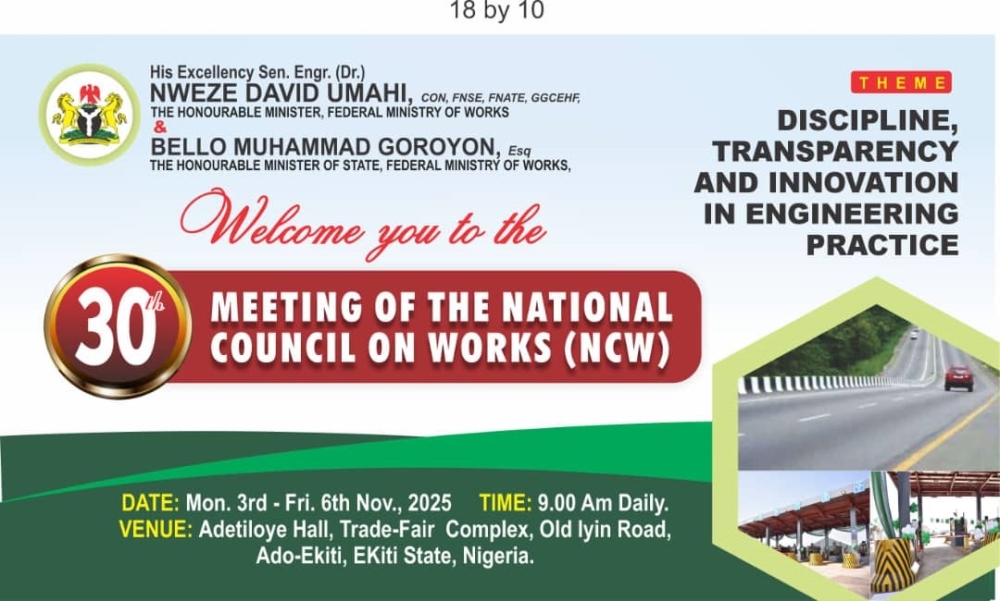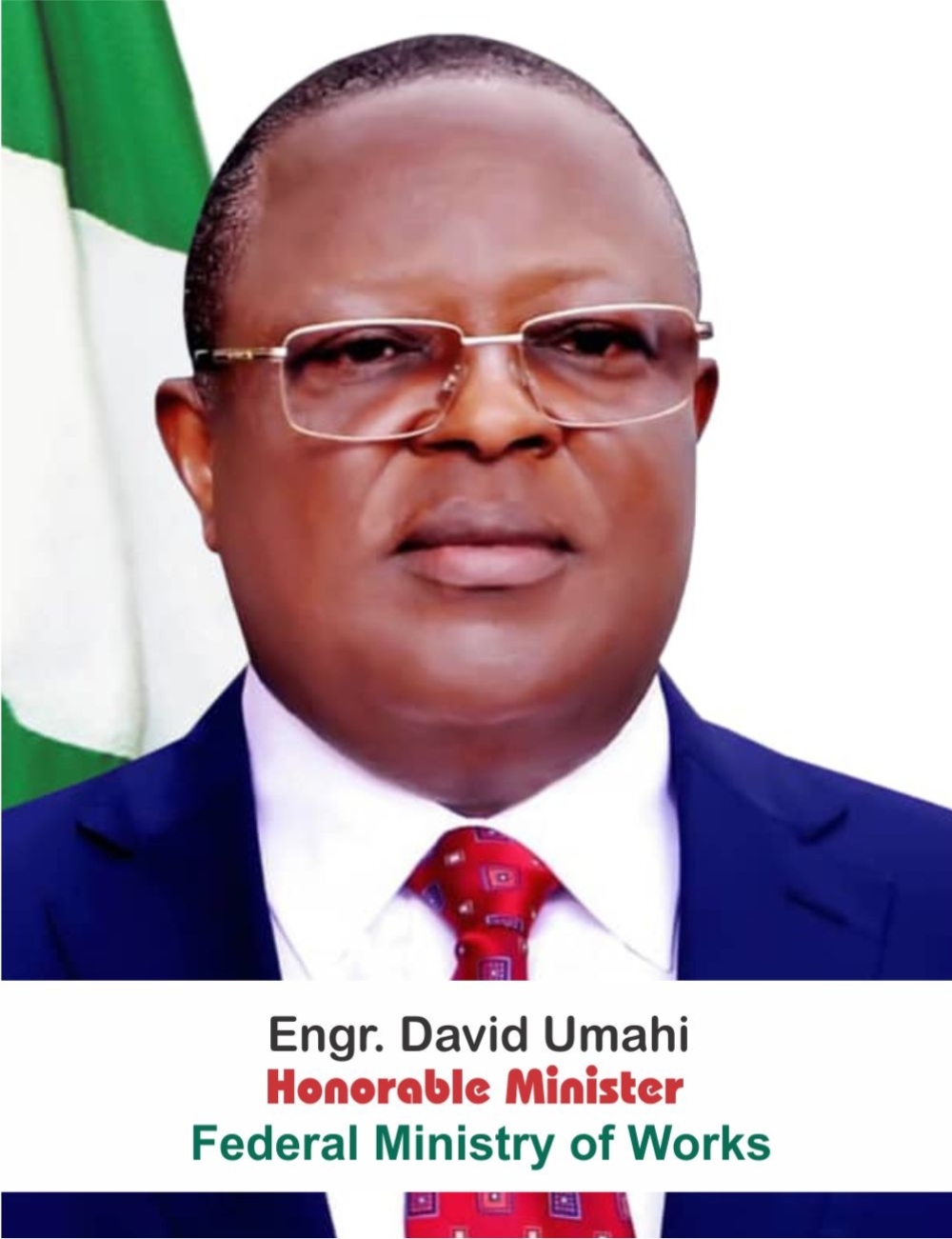
UMAHI HIGHLIGHTS IMPACT OF TINUBU’S LEGACY PROJECTS, SAYS INFRASTRUCTURE INVESTMENTS ARE TRANSFORMING NIGERIA
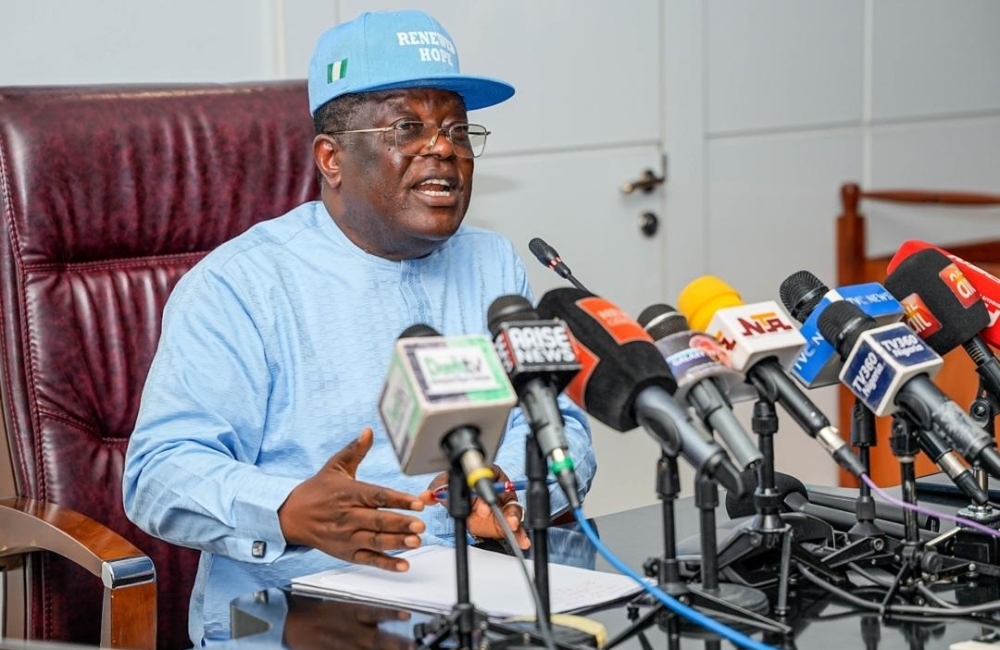
The Honourable Minister of Works, Engr. David Umahi, CON, FNSE, FNATE, has highlighted the progress and transformative impact of the major infrastructure projects being executed by the President Bola Ahmed Tinubu-led Administration, describing them as strategic investments aimed at reshaping Nigeria’s transportation network, strengthening national connectivity and stimulating economic growth.
Umahi said this on Wednesday, 7 October 2026, in Abuja, during a *Press Conference,* where he updated on the Tinubu Administration's *four Legacy Road Projects,* ongoing federal road interventions, completed projects, procurement processes, and the Ministry’s efforts to ensure value for money in the development of infrastructure.
The Minister identified the four legacy projects as the Lagos-Calabar Coastal Highway, Sokoto-Badagry Superhighway, Calabar-Ebonyi-Abuja Highway (the Trans-Saharan Route/North-South connectivity corridor, and the Dualisation of Akwanga-Jos-Bauchi-Gombe-Biu-Maiduguri Road.
According to him, the projects were conceived as strategic national infrastructure to connect all six (6) geopolitical zones, facilitate the movement of people and goods, open up economic opportunities, and strengthen Nigeria’s long-term development.
Giving an update on the Lagos-Calabar Coastal Highway, Umahi disclosed that Section 1, covering 47 kilometres, has been completed, while significant progress has also been recorded on Section 2, covering approximately 55 kilometres.
He explained that pavement works on Section 2 were nearing completion, while major flyovers, overpasses and underpasses were being constructed to address complex traffic, environmental and engineering challenges along the corridor.
The Minister said some parts of the alignment had to be redesigned to accommodate existing and planned rail, road and industrial infrastructure, particularly around the Dangote Refinery and Lekki Deep Seaport axis. He stressed that the objective was to develop an integrated transportation system rather than an isolated road project. On the Ondo State axis, Umahi explained that the alignment was redesigned in some locations because of difficult terrain, deep pits and challenging subsoil conditions. He said the redesign was aimed at ensuring durability, safety and cost-effectiveness, with substantial filling and ground improvement works ongoing in some areas.
The Minister further disclosed that President Tinubu had directed that the continuation of the Lagos-Calabar Coastal Highway be aligned with the existing East-West Road in parts of the Niger Delta area.
He described the decision as a strategic engineering intervention that would address the increasing impact of flooding and climate change on the vital infrastructure. According to him, critical sections of the East-West Road would be raised to accommodate present and anticipated flood levels and ensure the continued functionality of the strategic route.
Umahi also dwelled on the importance of the Construction of the Benin City Bypass and other sections of the littoral corridor in reducing congestion and improving movement across the South-South zone.
On the Sokoto-Badagry Superhighway, the Minister said the project was designed to establish a major economic corridor linking Ilelah in Sokoto State with Badagry in Lagos State. He noted that various sections of the highway were at different stages of construction, with significant progress recorded across the Sokoto, Kebbi, Oyo, Ogun and Badagry axes, while those of Niger and Kwara States are commencing soon.
Umahi said the strategic importance of the project is beyond road construction, noting that the corridor would unlock agricultural, industrial, tourism and other economic opportunities. He added that the Federal Government was exploring opportunities for complementary investments, including agriculture, housing, tourism and other economic activities along the major infrastructure corridors.
Speaking on the third legacy project, the ancient Trans-Saharan Route, Engr. Umahi explained that it was designed to strengthen connectivity between the coastal axis and the northern parts of the country, thereby facilitating the movement of people, goods and services across the South-South, South East and North Central geopolitical zones.
He disclosed that substantial progress had been recorded on the initial sections, while additional sections had been approved to make the corridor more economically viable and attractive to potential financiers.
On the fourth legacy project, the Minister said the Akwanga-Jos-Bauchi-Gombe-Biu-Maiduguri single carriageway is being expanded as a major northern connectivity route. He explained that the scope had been extended to cover an additional spur from Jos to Ibi in Taraba State, with design and procurement processes ongoing.
Responding to questions from journalists on the number of completed projects, the Minister listed several major road and bridge projects completed or ready for commissioning across the country. Among the projects, he mentioned Section I of the Lagos-Calabar Coastal Highway, the Kwanar Danja-Hadejia Road, the Kaduna-Pambeguwa Road, the Lafia Bypass, the Bodo-Bonny Road with Bridges along the Opobo Channel, among many others.
He also listed the completed first lot of the Lagos-Calabar Coastal Highway, the Gombe-Potiskum rehabilitation project, sections of the Azare road linking Jigawa and Bauchi, the five-span Ampoha Bridge, the 23-kilometre, 23-span flyover project at Ekpoma-Benin axis, and a three-span, 75-metre dualised bridge structure.
Umahi further disclosed that several sections of the Lagos-Badagry and Lagos-Ibadan, Lagos-Shagamu-Ore corridors had been completed, while other sections were at advanced stages of completion.
He assured journalists that the Ministry was updating its compendium of completed and ongoing projects. “*We have quite a lot of projects. We have completed projects and we have ongoing projects. We are updating the compendium and it will be made available on the Ministry’s website and circulated to the public,”* he assured.
The Minister reiterated the Federal Ministry of Works' increasing adoption of concrete pavement on major highways, saying the need for greater durability and reduced maintenance costs is driving the policy.
According to him, the Ministry is developing infrastructure that would serve Nigerians for several decades and provide better value for public resources. He reiterated that concrete pavement provides longer durability guarantees, when properly designed and constructed, compared with the recurring maintenance challenges associated with conventional asphalt pavement.
Addressing questions concerning the procurement process for the Lagos-Calabar Coastal Highway, Umahi explained that the Ministry followed an applicable procurement framework. He said the special procurement approach was necessitated by the unique engineering requirements of constructing a major highway through a difficult coastal terrain.
According to him, the Ministry identified the need for a contractor with a proven track record in executing similar coastal infrastructure and subsequently made a recommendation to the Bureau of Public Procurement (BPP). He disclosed that the BPP reviewed the recommendation and gave its clearance, while the Federal Executive Council remained the final approving authority.
Umahi said the Ministry subjected the contractor's bid to scrutiny by comparing proposed rates with prevailing market prices for materials and other inputs. He stressed that both indigenous and expatriate contractors were subjected to the same pricing and evaluation principles.
*“We put everybody on the same platform. We sent the proposals to the Bureau of Public Procurement. They reviewed it and where they felt that the rates went beyond their expected maxima, they called our attention to it, and we reviewed the rates accordingly,”* he explained.
The Minister also disclosed that substantial progress had been recorded on the Outstanding Sections of the Abuja-Kaduna-Zaria-Kano Expressway, with all the sections completed except the Jere-Kaduna portion advancing steadily. He revealed that the Ministry is installing solar-powered lighting along the 375-kilometre Expressway to improve night visibility, thereby enhancing safety and security. He also said that the improved condition of the highway, alongside security interventions, was contributing to safer and more efficient movement along the corridor.
The Minister disclosed that the Ministry had commenced an *“Operation Rescue”* on the Benin-Asaba Expressway following challenges associated with the road and its existing concession arrangement. He said the Federal Government had intervened to restore mobility, while plans were being developed for a comprehensive reconstruction of the entire alignment, using continuously reinforced concrete pavement (CRCP). He stressed that Nigerians should not continue to suffer because of unresolved contractual or concession-related issues.
The Minister, particularly, highlighted the Federal Government's increased infrastructure investment in the South East, saying the Tinubu Administration had demonstrated a clear commitment to reintegrating the hitherto neglected zone into the national infrastructure development programme. He said several major road projects had either been approved, commenced, or completed by the present administration.
Umahi, who is from the zone, said it might not have the highest number of federal projects compared with other geopolitical zones, but it was no longer being left behind.
*“We can't continue to live in denial. What we have been crying for is being given. The people of the South East are being fully reintegrated into the national infrastructure development plan,”* he emphasised.
He cited the completion of the Second Niger Bridge, the rehabilitation of the 1st Niger Bridge, ongoing construction of major Bypasses and other federal road projects in the zone as evidence of the administration's commitment.
The Minister maintained that infrastructure development should be viewed from the perspective of national integration rather than regional politics. He stated that the Federal Government's infrastructure agenda was intended to ensure that every part of Nigeria benefited from strategic investments in roads, bridges and other transportation infrastructure.
On the Tax-Credit Scheme’s projects inherited from the previous administrations, Umahi explained that the Federal Government had taken proactive measures to address them, especially where private-sector partners were no longer able to sustain previously approved financing arrangements.
He warned contractors, who had received mobilisation or project funds but failed to deploy the funds on the work that the Ministry would take appropriate steps to recover such funds. He stressed that accountability, performance and value for money remained central to the Ministry's project execution strategy.
The Minister also addressed the ongoing intervention on the First Niger Bridge, explaining that measures were being introduced to improve traffic management and protect the structural integrity of the bridge. He said the Ministry was installing appropriate traffic management infrastructure, CCTV cameras and other security measures at its Asaba and Onitsha ends. According to Umahi, the measures were necessary because bridges are designed primarily for dynamic as opposed to static loads, explaining that prolonged traffic gridlock can create additional structural and safety challenges. He said remedial works, repainting and other maintenance activities were also being undertaken to ensure the long-term usage of the structure.
Umahi further explained that the Federal Government's road development strategy included environmental considerations, such as the planting of trees along major highways and the installation of solar-powered street lighting. He said the initiative would help improve visibility and the environment, provide shade, and contribute to the reduction of harmful emissions along major transport corridors.
The Minister also linked infrastructure development to the broader economic reforms of the Renewed Hope Agenda of the Tinubu Administration, saying improved roads and connectivity would support agricultural production, industrialisation, trade, commerce, tourism and investment. He maintained that the Federal Government's infrastructure investments were part of a broader strategy to move economic growth from the macroeconomic level to the grassroots.
On the financing of the major legacy projects, Umahi assured Nigerians that the Federal Government had put mechanisms in place to ensure that the projects are adequately funded to completion.
He revealed that significant portions of the projects had been funded, while loan-financing arrangements were being implemented for the remaining components.
He noted that the administration was determined not to embark on projects without ensuring that there was a credible financing mechanism for their completion.
*“We don't start what we will not finish. And we will not finish what we have not started,”* he stated.
The Minister reaffirmed the commitment of the Ministry to completing inherited projects, while simultaneously delivering new strategic infrastructure under the Tinubu Administration. He said the legacy projects were not merely road construction schemes but long-term investments designed to transform Nigeria's economic landscape, improve connectivity, strengthen national integration and security, and create opportunities for millions of Nigerians.
In his closing remarks, the *Director Overseeing the Office of the Permanent Secretary (DOOPS), Mohammed Aminu Ahmed, FCNA,* expressed appreciation to the Minister, members of the media, and all participants for attending. He commended the media for its continued partnership with the Ministry in informing Nigerians about government infrastructure projects and encouraged it to continue to provide constructive criticism on the Ministry's activities.

UMAHI HIGHLIGHTS IMPACT OF TINUBU’S LEGACY PROJECTS, SAYS INFRASTRUCTURE INVESTMENTS ARE TRANSFORMING NIGERIA The Honourable Minister of Works, Engr. David Umahi, CON, FNSE, FNATE, has highlighted the progress and transformative impact of the major infrastructure projects being executed by the President Bola Ahmed Tinubu-led Administration, describing them as strategic investments aimed at reshaping Nigeria’s transportation network, strengthening national connectivity and stimulating economic growth. Umahi said this on Wednesday, 7 October 2026, in Abuja, during a *Press Conference,* where he updated on the Tinubu Administration's *four Legacy Road Projects,* ongoing federal road interventions, completed projects, procurement processes, and the Ministry’s efforts to ensure value for money in the development of infrastructure. The Minister identified the four legacy projects as the Lagos-Calabar Coastal Highway, Sokoto-Badagry Superhighway, Calabar-Ebonyi-Abuja Highway (the Trans-Saharan Route/North-South connectivity corridor, and the Dualisation of Akwanga-Jos-Bauchi-Gombe-Biu-Maiduguri Road. According to him, the projects were conceived as strategic national infrastructure to connect all six (6) geopolitical zones, facilitate the movement of people and goods, open up economic opportunities, and strengthen Nigeria’s long-term development. Giving an update on the Lagos-Calabar Coastal Highway, Umahi disclosed that Section 1, covering 47 kilometres, has been completed, while significant progress has also been recorded on Section 2, covering approximately 55 kilometres. He explained that pavement works on Section 2 were nearing completion, while major flyovers, overpasses and underpasses were being constructed to address complex traffic, environmental and engineering challenges along the corridor. The Minister said some parts of the alignment had to be redesigned to accommodate existing and planned rail, road and industrial infrastructure, particularly around the Dangote Refinery and Lekki Deep Seaport axis. He stressed that the objective was to develop an integrated transportation system rather than an isolated road project. On the Ondo State axis, Umahi explained that the alignment was redesigned in some locations because of difficult terrain, deep pits and challenging subsoil conditions. He said the redesign was aimed at ensuring durability, safety and cost-effectiveness, with substantial filling and ground improvement works ongoing in some areas. The Minister further disclosed that President Tinubu had directed that the continuation of the Lagos-Calabar Coastal Highway be aligned with the existing East-West Road in parts of the Niger Delta area. He described the decision as a strategic engineering intervention that would address the increasing impact of flooding and climate change on the vital infrastructure. According to him, critical sections of the East-West Road would be raised to accommodate present and anticipated flood levels and ensure the continued functionality of the strategic route. Umahi also dwelled on the importance of the Construction of the Benin City Bypass and other sections of the littoral corridor in reducing congestion and improving movement across the South-South zone. On the Sokoto-Badagry Superhighway, the Minister said the project was designed to establish a major economic corridor linking Ilelah in Sokoto State with Badagry in Lagos State. He noted that various sections of the highway were at different stages of construction, with significant progress recorded across the Sokoto, Kebbi, Oyo, Ogun and Badagry axes, while those of Niger and Kwara States are commencing soon. Umahi said the strategic importance of the project is beyond road construction, noting that the corridor would unlock agricultural, industrial, tourism and other economic opportunities. He added that the Federal Government was exploring opportunities for complementary investments, including agriculture, housing, tourism and other economic activities along the major infrastructure corridors. Speaking on the third legacy project, the ancient Trans-Saharan Route, Engr. Umahi explained that it was designed to strengthen connectivity between the coastal axis and the northern parts of the country, thereby facilitating the movement of people, goods and services across the South-South, South East and North Central geopolitical zones. He disclosed that substantial progress had been recorded on the initial sections, while additional sections had been approved to make the corridor more economically viable and attractive to potential financiers. On the fourth legacy project, the Minister said the Akwanga-Jos-Bauchi-Gombe-Biu-Maiduguri single carriageway is being expanded as a major northern connectivity route. He explained that the scope had been extended to cover an additional spur from Jos to Ibi in Taraba State, with design and procurement processes ongoing. Responding to questions from journalists on the number of completed projects, the Minister listed several major road and bridge projects completed or ready for commissioning across the country. Among the projects, he mentioned Section I of the Lagos-Calabar Coastal Highway, the Kwanar Danja-Hadejia Road, the Kaduna-Pambeguwa Road, the Lafia Bypass, the Bodo-Bonny Road with Bridges along the Opobo Channel, among many others. He also listed the completed first lot of the Lagos-Calabar Coastal Highway, the Gombe-Potiskum rehabilitation project, sections of the Azare road linking Jigawa and Bauchi, the five-span Ampoha Bridge, the 23-kilometre, 23-span flyover project at Ekpoma-Benin axis, and a three-span, 75-metre dualised bridge structure. Umahi further disclosed that several sections of the Lagos-Badagry and Lagos-Ibadan, Lagos-Shagamu-Ore corridors had been completed, while other sections were at advanced stages of completion. He assured journalists that the Ministry was updating its compendium of completed and ongoing projects. “*We have quite a lot of projects. We have completed projects and we have ongoing projects. We are updating the compendium and it will be made available on the Ministry’s website and circulated to the public,”* he assured. The Minister reiterated the Federal Ministry of Works' increasing adoption of concrete pavement on major highways, saying the need for greater durability and reduced maintenance costs is driving the policy. According to him, the Ministry is developing infrastructure that would serve Nigerians for several decades and provide better value for public resources. He reiterated that concrete pavement provides longer durability guarantees, when properly designed and constructed, compared with the recurring maintenance challenges associated with conventional asphalt pavement. Addressing questions concerning the procurement process for the Lagos-Calabar Coastal Highway, Umahi explained that the Ministry followed an applicable procurement framework. He said the special procurement approach was necessitated by the unique engineering requirements of constructing a major highway through a difficult coastal terrain. Umahi said the Ministry subjected the contractor's bid to scrutiny by comparing proposed rates with prevailing market prices for materials and other inputs. He stressed that both indigenous and expatriate contractors were subjected to the same pricing and evaluation principles. *“We put everybody on the same platform. We sent the proposals to the Bureau of Public Procurement. They reviewed it and where they felt that the rates went beyond their expected maxima, they called our attention to it, and we reviewed the rates accordingly,”* he explained. The Minister also disclosed that substantial progress had been recorded on the Outstanding Sections of the Abuja-Kaduna-Zaria-Kano Expressway, with all the sections completed except the Jere-Kaduna portion advancing steadily. He revealed that the Ministry is installing solar-powered lighting along the 375-kilometre Expressway to improve night visibility, thereby enhancing safety and security. He also said that the improved condition of the highway, alongside security interventions, was contributing to safer and more efficient movement along the corridor. The Minister disclosed that the Ministry had commenced an *“Operation Rescue”* on the Benin-Asaba Expressway following challenges associated with the road and its existing concession arrangement. He said the Federal Government had intervened to restore mobility, while plans were being developed for a comprehensive reconstruction of the entire alignment, using continuously reinforced concrete pavement (CRCP). He stressed that Nigerians should not continue to suffer because of unresolved contractual or concession-related issues. The Minister, particularly, highlighted the Federal Government's increased infrastructure investment in the South East, saying the Tinubu Administration had demonstrated a clear commitment to reintegrating the hitherto neglected zone into the national infrastructure development programme. He said several major road projects had either been approved, commenced, or completed by the present administration. *“We can't continue to live in denial. What we have been crying for is being given. The people of the South East are being fully reintegrated into the national infrastructure development plan,”* he emphasised. He cited the completion of the Second Niger Bridge, the rehabilitation of the 1st Niger Bridge, ongoing construction of major Bypasses and other federal road projects in the zone as evidence of the administration's commitment. The Minister maintained that infrastructure development should be viewed from the perspective of national integration rather than regional politics. He stated that the Federal Government's infrastructure agenda was intended to ensure that every part of Nigeria benefited from strategic investments in roads, bridges and other transportation infrastructure. On the Tax-Credit Scheme’s projects inherited from the previous administrations, Umahi explained that the Federal Government had taken proactive measures to address them, especially where private-sector partners were no longer able to sustain previously approved financing arrangements. He warned contractors, who had received mobilisation or project funds but failed to deploy the funds on the work that the Ministry would take appropriate steps to recover such funds. He stressed that accountability, performance and value for money remained central to the Ministry's project execution strategy. The Minister also addressed the ongoing intervention on the First Niger Bridge, explaining that measures were being introduced to improve traffic management and protect the structural integrity of the bridge. He said the Ministry was installing appropriate traffic management infrastructure, CCTV cameras and other security measures at its Asaba and Onitsha ends. According to Umahi, the measures were necessary because bridges are designed primarily for dynamic as opposed to static loads, explaining that prolonged traffic gridlock can create additional structural and safety challenges. He said remedial works, repainting and other maintenance activities were also being undertaken to ensure the long-term usage of the structure. Umahi further explained that the Federal Government's road development strategy included environmental considerations, such as the planting of trees along major highways and the installation of solar-powered street lighting. He said the initiative would help improve visibility and the environment, provide shade, and contribute to the reduction of harmful emissions along major transport corridors. The Minister also linked infrastructure development to the broader economic reforms of the Renewed Hope Agenda of the Tinubu Administration, saying improved roads and connectivity would support agricultural production, industrialisation, trade, commerce, tourism and investment. He maintained that the Federal Government's infrastructure investments were part of a broader strategy to move economic growth from the macroeconomic level to the grassroots. On the financing of the major legacy projects, Umahi assured Nigerians that the Federal Government had put mechanisms in place to ensure that the projects are adequately funded to completion. He noted that the administration was determined not to embark on projects without ensuring that there was a credible financing mechanism for their completion. The Minister reaffirmed the commitment of the Ministry to completing inherited projects, while simultaneously delivering new strategic infrastructure under the Tinubu Administration. He said the legacy projects were not merely road construction schemes but long-term investments designed to transform Nigeria's economic landscape, improve connectivity, strengthen national integration and security, and create opportunities for millions of Nigerians. In his closing remarks, the *Director Overseeing the Office of the Permanent Secretary (DOOPS), Mohammed Aminu Ahmed, FCNA,* expressed appreciation to the Minister, members of the media, and all participants for attending. He commended the media for its continued partnership with the Ministry in informing Nigerians about government infrastructure projects and encouraged it to continue to provide constructive criticism on the Ministry's activities.
According to him, the Ministry identified the need for a contractor with a proven track record in executing similar coastal infrastructure and subsequently made a recommendation to the Bureau of Public Procurement (BPP). He disclosed that the BPP reviewed the recommendation and gave its clearance, while the Federal Executive Council remained the final approving authority.
Umahi, who is from the zone, said it might not have the highest number of federal projects compared with other geopolitical zones, but it was no longer being left behind.
He revealed that significant portions of the projects had been funded, while loan-financing arrangements were being implemented for the remaining components.
*“We don't start what we will not finish. And we will not finish what we have not started,”* he stated.
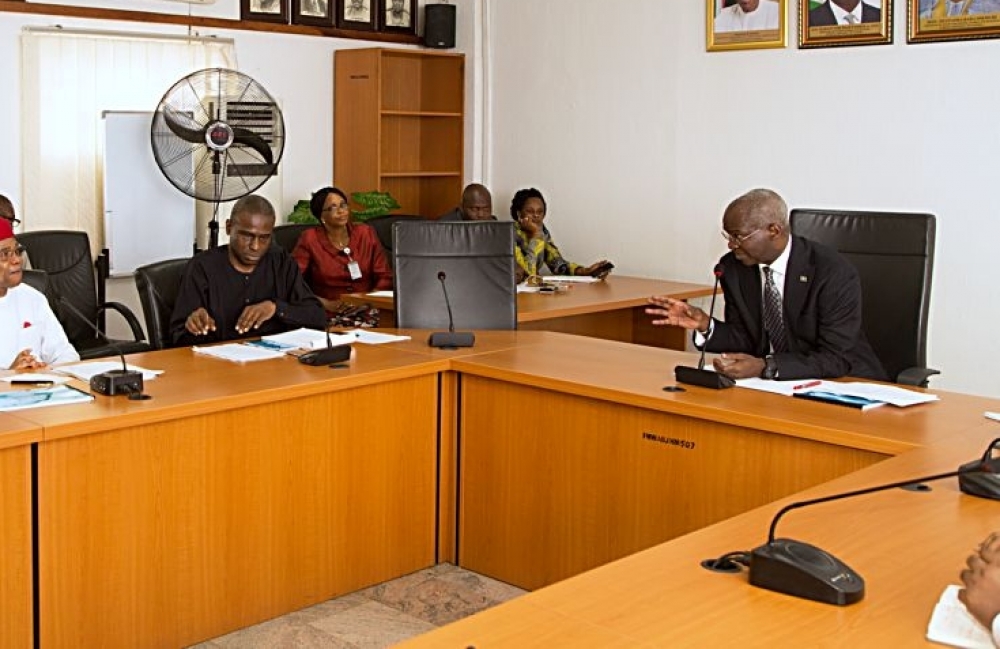
No Nation Develops Without Building Its Infrastructure - Fashola The Honourable Minister of Power, Works and Housing, Babatunde Fashola SAN, has disclosed that President Muhammadu Buhari’s administration is committed to providing the necessary roads, bridges, rails and electricity that will, in no distant time bring about the overall social economic and political development of Nigeria inspite of visible and sharp decline of oil revenue. Fashola disclosed this late yesterday, when he received in audience the Management, 18 facilitators and 57 participants of the Nigerian Institute of Transport Technology (NITT), Zaria, who paid him a courtesy call in his Mabushi office. He commended the effort of NITT for including Transport Planning and Logistic works in their curriculum which is useful in the chain of production and distribution of goods and services in Nigeria, adding that the present administration needs the services of the institute and that Mr President is providing a very useful laboratory material for members of the institute to thrive. The Minister described members of NITT as stakeholders and partners in the wheel of progress and development of the Nigeria economy, noting that ‘’ the elements of national development and prosperity have come together at the appropriate time’’. He therefore enjoined members of NITT to support President Muhammadu Buhari’s administration to achieve his mandate of providing the basic needed infrastructure for the overall benefit of Nigerians. Earlier, the Acting Director General and Chief Executive of NITT, Dr Abimbola Odumosu stated on behalf of his institute that the reason for their visit was essentially to seek for partnership with the Federal Ministry of Power, Works and Housing in the development of manpower as regards transport and logistics which is NITT’s area of specialisation, stating that collaboration between NITT and the Ministry will provide the nation with the needed impetus for sustainable growth and development. Dr Abimbola disclosed that NITT was established in 1986 as a Management Development Institution to among other things provide management training for personnel employed in all modes of transport and Serves as a Transport Intelligence Centre for monitoring transport and logistics system and to conduct research in all modes of transport in Nigeria ...
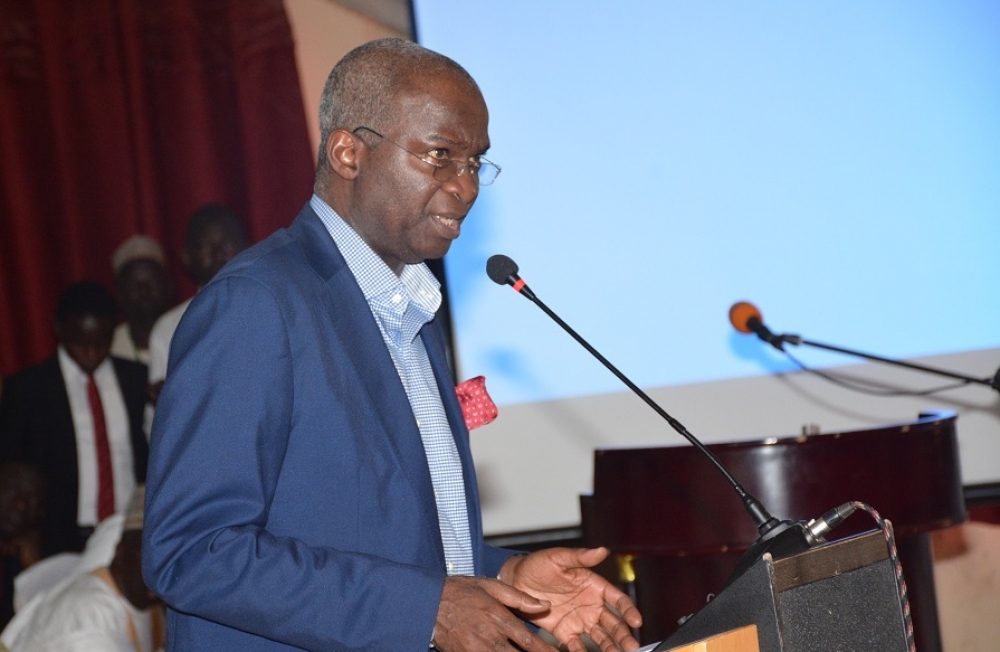
Infrastructure- Key To A Sustainable Economy And Development- Fashola The Honourable Minister of Power, Works and Housing, Babatunde Raji Fashola SAN, has reiterated President Buhari’s commitment to renew and expand the Nigerian economy through the provision of critical infrastructure, which is the gateway to a sustainable economy and development across the globe. The Minister said this when he received members of Federation of Construction Industry in Nigeria (FOCI) who paid him a courtesy call in his Office today. Fashola emphasized that all gratitude should go to President Buhari who merged the three ministries namely; Power, Works and Housing so as to create rapid development in infrastructural growth of the nation as well as maximum impact on the economy. He explained that the Ministry is almost completing 34 pilot National Housing programme in the States that have provided land for the take-off of the programme, adding that rehabilitation and reconstruction of Federal Secretariats are also going on in Bayelsa, Anambra, Zamfara and Nasarawa States. The Minister stated that power generation has increased from 4, 000 megawatts in 2015 to 8, 000 megawatts in 2018. He noted that Nigerians now spend less on fueling of generators and plants because of frequent and improved electricity supply nationwide. He said that President Buhari’s led Administration is rebuilding and expanding the Nigeria economy policy decision through building of infrastructure, adding that the Federal Government recognizes the efforts of the Association in helping to galvanized the quarry and mining industry due to the volume of construction going on in the built environment and the road sector. He said “’When I first met you, there were complains of non- payment for three to four years before the coming of this Administration. But I can confidently say there is not one year since the beginning of this Administration that contractors have not been paid, the money move round the economy.” Fashola also explained that Executive Order 5 seeks to achieve local participation for Nigerians and Nigerian companies, stressing that the Ministry is already compiling list of Nigerians working on sites, arguing that government is set to protect its citizens as is a global practice. He further explained that the latest Executive Order 7 signed by the President is a driver to Industrialization, adding that this will expand construction work and manufacturing jobs that will evidently create more jobs and improve the economy. The Minister noted that the essence of these Executive Orders is government’s commitment to create next level jobs, employment, infrastructure and manufacturing. Earlier, the Director General of the association and leader of the delegation, Engr. Mrs Olubunmi Adekoje appreciate the Ministry for the support given to the Association and timely intervention in the area of finance to boost the activities of the industry. In attendance was the Permanent Secretary of Power, Works and Housing, (Work and Housing) Muhammed Bukar and Directors from the Ministry ...
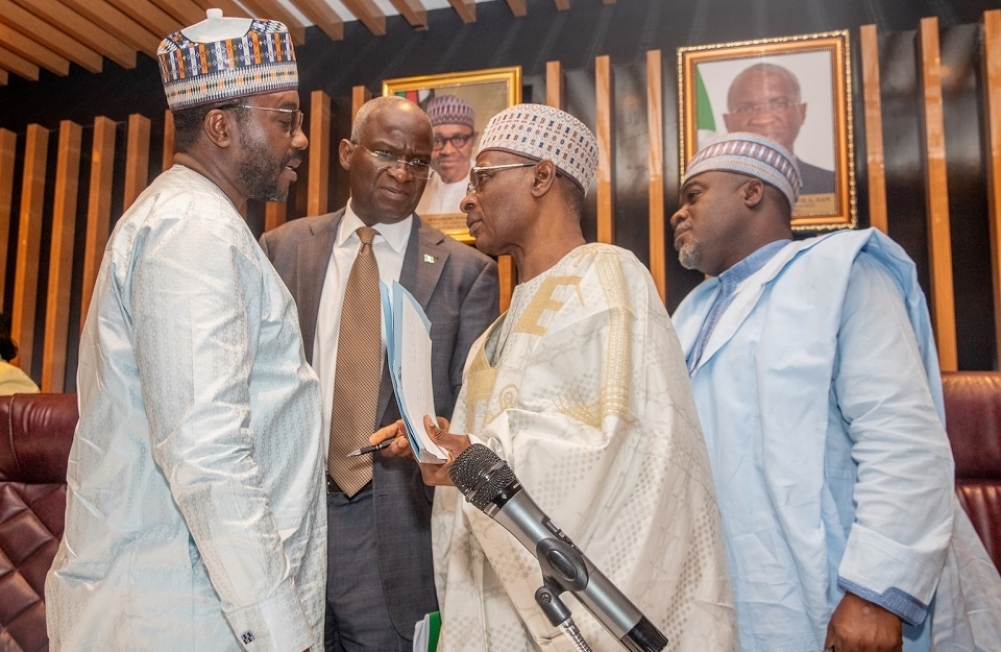
FG’s Maintenance Policy Is To Empower Nigerians At The Base Of The Economic Pyramid, Enable Small Businesses Grow- Fashola * As Minister addresses the Press on Infrastructure Maintenance Framework for Public Buildings recently approved by FEC * Says Buhari’s signing law to protect people living with disability from discrimination, exclusion also offers job opportunities to redesign, remodel, retrofit assets nationwide The Minister of Power, Works and Housing, Mr. Babatunde Fashola SAN, Thursday in Abuja, briefed the Press on the recently approved National Infrastructure Maintenance Framework saying it is a choice of the Buhari Administration to drive the small business sector, skill utilization and to move the economy from growth without jobs to growth driven by new jobs that reward services. Addressing newsmen at a conference, attended also by Heads of Ministries, Departments and Agencies as well as Parastatals and Members of the National Assembly, among other stakeholders, Fashola said, however, that the Framework, which applies to public buildings for now, would ultimately extend to other public assets like roads, bridges, rail, power installations and other infrastructure of a public nature. The Minister, who said the Framework was approved on January 9, 2018, explained that the Federal Executive Council’s approval meant that “after decades of agonizing about lack of maintenance, the Buhari government has chosen to act”, describing it as “policy decision of enormous profundity”, as, according to him, “the records do not indicate that any such policy decision has previously been taken at the federal level”. He said the decision to approve the Framework was provoked by a memorandum from the Ministry of Power, Works and Housing that challenged the conventional thinking that "Nigeria does not have a maintenance culture", adding, “The memorandum argued and FEC agreed, that maintenance of infrastructure, whether public or private, is not a cultural issue but an economic one”. According to him, the memorandum showed that in the built industry, only about 23 per cent of the workforce was employed by Design (6%), Construction (15%) and Governance (2%), while the remaining 77 per cent were employed by Maintenance and Operation adding, “the Council was persuaded to accept that while skill training and vocational centres exist almost nationwide for training artisans like plumbers, painters, bricklayers, welders, tilers, electricians etc., there is a lack of National policy that makes the practice of these vocations economically worthwhile on a sustainable basis”. The Minister said available data showed that many people trained in vocations such as Plumbing, Carpentry, Tiling, Masonry, Painting, Bricklaying, Welding, Electrical installations etc often resort to other vocations in which they do not have training such as riding motorcycles and tricycles in order to make a living. Giving details on what the Framework entails, Fashola said the first step would be to conduct Site Assessment of the affected buildings involving measurements, valuation and data collation, all of which, he noted, require the employment of people to carry out the process thereby creating jobs even from the very first step, adding that it would also provide for credible data such as lettable space, value of the property and so on “which could form the basis of the economic decisions or even actions in emergency periods”. The next step, the Minister said, would be Condition Assessment which would also, according to him, require people to be trained and employed to assess the conditions of affected buildings from foundation to roof and for mechanical and electrical sustainability for purpose adding that the maintenance programme would then be developed from the assessments as to what jobs would need to be done to restore the building to fitness while award of maintenance contract, also based on the assessments, would then be following the existing procurement law. Citing an example, Fashola, who said the Ministry carried out a pilot programme on nine buildings comprising a Federal Government College, a Federal Hospital, a Federal Court building, a federal prison, a federal secretariat and four office buildings belonging to the Ministry, pointed out that in one of the sample buildings leading up to the memorandum to FEC, out of 63 air-conditioning units, 11 required replacement or repairs while windows, doors, tiles, roofing materials, plastering works were also identified that required replacement or repair. And in another building, he said, out of about 30 toilets or so, about 12 were not functional, providing jobs for those in the Plumbing business, pointing out that buildings owned by parastatals, airports and others were yet to be reached where such jobs were likely waiting for skilled workers. “This provides a window of opportunity for small businesses who are into facility management and for young graduates of building technicians, architecture, engineering and even technical schools to register for these contracts”, he said adding that successful bidders would then be in a position to employ artisans to execute the maintenance contract they have won in the bid. Fashola said each Ministry, Department and Agency (MDA) would be responsible for its own procurement for its own building after training of their designated personnel by the staff of the Ministry of Power, Works and Housing who would guide them through the framework approved by the Federal Executive Council, adding that because data is critical to the programme, “each MDA will file data with the Ministry of Power, Works and Housing who will centrally manage data and use it to advise government and brief the public, while the MDA reserves the right to keep its own data”. Reiterating that the implementation of the Framework would start with public buildings, the Minister, who noted that the award of contracts would not only drive employment for artisans but the demand of manufacturing and suppliers of parts like wood, pipes, paint, tiles, electrical fittings, windows and tools, in addition to those of cleaning items like soap, detergent, polish, varnish etc, declared, “This is the economy that we see ahead as we set out to implement this approval as we progress”. On the cost of implementation, Fashola said the pilot survey showed that the nine buildings would cost about N40.3 billion to reconstruct, while it would cost N922 million per annum to maintain them, which is about 2.3 per cent of cost of replacement, adding that if maintenance was pursued the buildings could last their lifespan of between 50 and 60 years and instead of using N40 billion to replace existing buildings it could be used to expand and provide more buildings for the nation’s growing population. “Just these nine buildings will require about 400 people to keep them well maintained a year. For example, the school will require at least 30 people to be employed per school for maintenance; and the federal government owns 104 Unity schools which potentially will require 3,120 maintenance staff. So you can see the economy we see when this extends to all our hospitals, all our courts, all our prisons, all our police stations, all our universities and covers all public buildings”, the Minister said. Comparing the new economic initiative to the Lagos Green Economy, Fashola declared, “This is an economic choice by this government to drive the small business sector, to drive skill utilization and to move the economy from growth without jobs to growth driven by new jobs that reward services”. The Minister also disclosed that President Buhari also in January signed the law to protect people living with disability from discrimination and exclusion thereby “raising the bar for construction, services and a new way of life for Nigerians”, adding, “We have five years to comply, and this requires that all our buildings must have lifts and well-designed ramps for people confined to their wheelchairs, not hills they cannot use on their own. “We must modify all our toilets with support for our brothers and sisters who are living with disabilities, as we must build sidewalks for them to use our roads without colliding with vehicles. Our airports and parking lots in buildings must become compliant with international best practice by providing corridors and facilities for people living with disabilities at arrival and departure points, while a minimum number of slots clearly designated must be provided for vehicles owned by people living with disabilities”, he further explained adding that this was another opportunity for jobs to re-design, to re-model, to retrofit all assets nationwide to comply with the law as signed by Mr President. “This is Nigeria that beckons upon us from today and the immediate future. A Nigeria where public infrastructure works because they are maintained; a Nigeria where everybody has a secure sense of belonging because they can use their skills and labour to earn a decent income and retain their dignity, a Nigeria where government cares for the people living with disability by providing the basic minimum facilities that gives them a sense of belonging to demonstrate their ability”, the Minister said. Pointing out that Government has taken the leadership role to provide the policy and the how to make the present Nigeria possible, Fashola urged all and sundry to take ownership of the platform of opportunities and make it work. “It is now your responsibility and mine to take ownership of this platform of opportunities and make it work for all of us”, he said. Responding to questions during the interactive session with the media and other stakeholders, Fashola explained that the maintenance contracts that would emerge from the implementation of the framework would be funded through appropriation adding that the members of the National Assembly were invited to also take note of the Framework and work out modalities in the annual budgets. On how to engage artisans and technicians who are already in government and those outside governments, the Minister explained that the Head of the Civil Service of the Federation would provide clarification adding that there are certain levels of entry that government has dispensed with and some of the artisans fall within those entry levels while the services are now contracted out. Also responding to the question on whether or not there would be sanctions for non-compliance, Fashola said the implementation would be largely by voluntary compliance adding that just as an individual would not wait for sanction before repairing broken down domestic utilities, MDAs would not need sanctions before embarking on maintenance of their facilities. Earlier in their goodwill remarks, Head of the Civil Service of the Federation who was represented at the occasion and the Director General, National Orientation Agency hailed the Framework as highly commendable in a country where maintenance culture had been jettisoned for decades while the Chairmen, House Committees on Works and Housing in the National Assembly, Hon. Dr. Abubakar Kannike and Hon. Mahmud Mohammed respectively, commended the Ministry for coming up with the Maintenance initiative pledging to play their role in ensuring that it gets consideration in the nation’s annual appropriations. ...
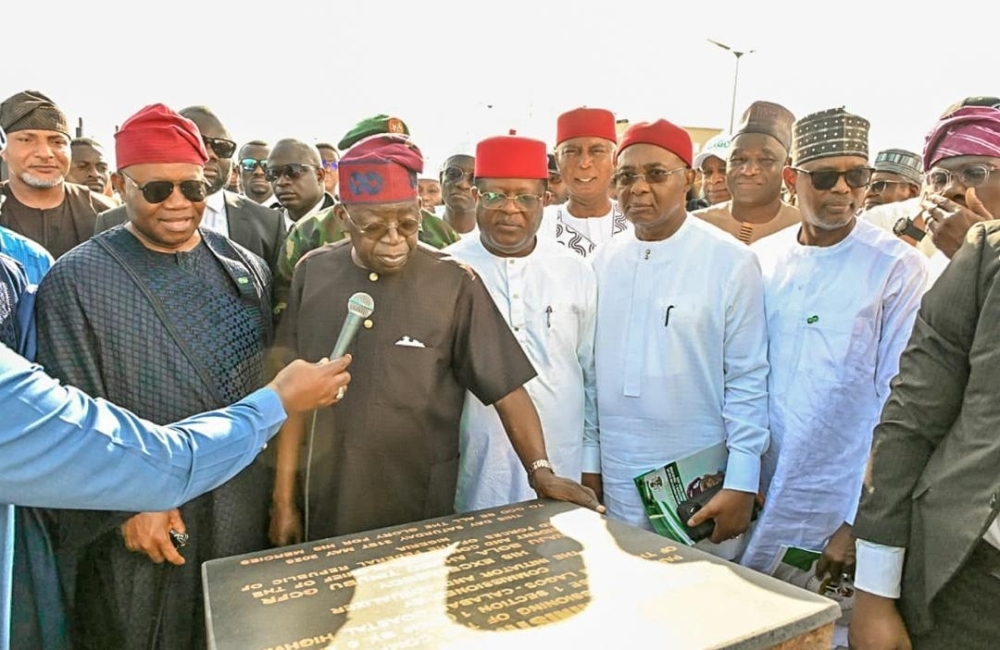
DRIVING NIGERIA’S FUTURE: CELEBRATING TWO YEARS OF TRANSFORMATIVE LEADERSHIP AND THE LAGOS-CALABAR COASTAL HIGHWAY MILESTONE
DRIVING NIGERIA’S FUTURE: CELEBRATING TWO YEARS OF TRANSFORMATIVE LEADERSHIP AND THE LAGOS-CALABAR COASTAL HIGHWAY MILESTONE
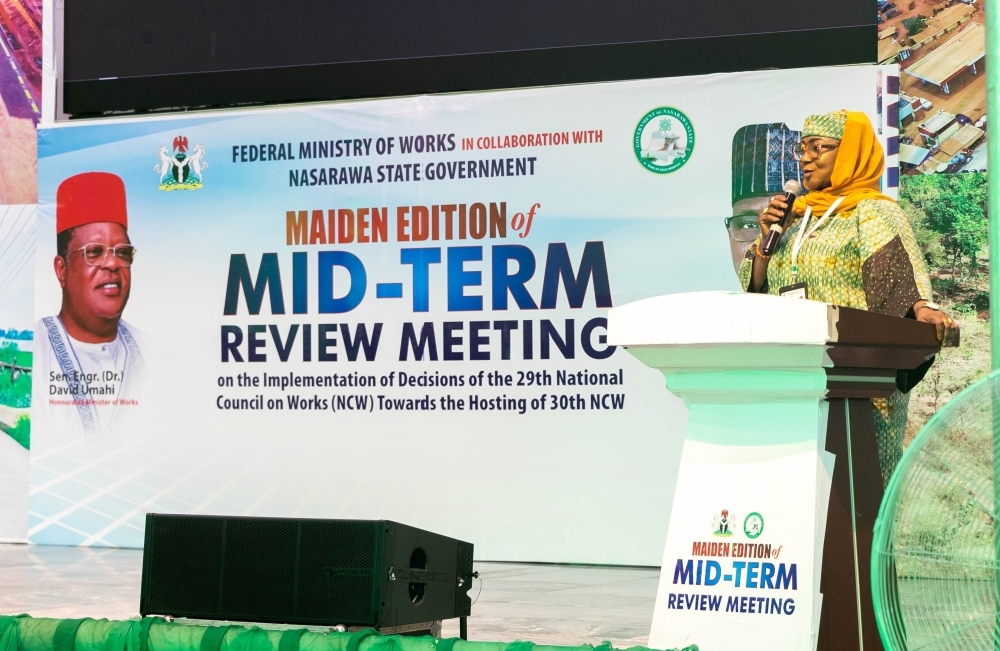
MID -TERM REVIEW MEETING ON THE IMPLIMENTATION OF THE DECISIONS REACHED AT THE 29TH NATIONAL COUNCIL ON WORKS (NCW) DAY 1
MID -TERM REVIEW MEETING ON THE IMPLIMENTATION OF THE DECISIONS REACHED AT THE 29TH NATIONAL COUNCIL ON WORKS (NCW) DAY 1